

TL;DR: Silo Season 3, Episode 9 finally reveals an apparent nuclear apocalypse, only to turn the answer into an even bigger conspiracy. With the Pact’s origins, suspicious founders and Daniel and Helen caught at ground zero, this is Silo mystery-box storytelling firing on all cylinders.
Silo has spent three seasons turning the simple act of knowing something into one of the most dangerous activities imaginable. Season 3 has pushed that obsession beyond Juliette Nichols and the familiar machinery of Silo 18, digging into the people who built this underground nightmare and the decisions that transformed humanity’s survival plan into an authoritarian civilisation. Episode 9 takes those threads and yanks them hard enough to completely rearrange what we thought we understood about the apocalypse.
This is very much an episode where discussing its strengths means discussing its revelations, so consider the blast doors officially closed: major spoilers for Silo Season 3, Episode 9 follow. Bernard’s fate, Camille’s growing doubts about the algorithm and the expanding mystery surrounding the founders all matter, but the episode’s real payload arrives through Daniel and Helen. Their storyline doesn’t merely provide historical context anymore. It takes us directly to the moment the old world becomes the world of Silo.
Silo finally shows us the apocalypse — then makes it another mystery
The flashback storyline jumps forward, with Daniel and a pregnant Helen visiting the completed silo complex after people have already spent a year living underground as part of the project. The system is approaching its grand unveiling, yet practically everything about the visit feels wrong. Daniel is directed towards Silo 1 while Helen tours Silo 18, and the people around them behave with the particular flavour of suspicious calm that Silo has spent years teaching us never to trust.
The warning signs escalate when Daniel tries contacting his sister Charlotte. Their familiar family exchange produces the wrong response, immediately suggesting that somebody else may be controlling her phone. Daniel contacts Helen, the pair climb high enough at their respective silos to establish a connection and then finally see one another across the complex. That’s when the horizon erupts. A blinding flash gives way to a mushroom cloud, emergency instructions order everyone into shelter, Daniel is forcibly dragged towards Silo 1, and Helen is left near Silo 18 as the episode cuts away without confirming either character’s survival.
It’s a fantastic piece of Silo storytelling because the answer instantly generates a nastier question. Yes, we appear to have finally witnessed the catastrophe that destroys the world. No, we still don’t know who caused it. The show essentially opens the vault containing its biggest secret only to reveal another locked vault sitting inside.
The nuclear explosion makes the founders look even more suspicious
The mushroom cloud initially appears to contradict the direction established previously, when Per Stensen identified nanotechnology as humanity’s looming existential threat amid conflict between Iran and the United States. Episode 9 instead presents what appears to be a nuclear detonation as the immediate catastrophe. That doesn’t necessarily erase the nanotechnology threat, but it does demolish any comfortable assumption that we already understand how all these pieces fit together.
More interesting is the behaviour surrounding the explosion. Several people connected to the project appear unusually tense before anything happens. Anna, Senator Thurman’s daughter and Charlotte’s partner, wants to reach the silos early and reacts awkwardly to Daniel suggesting breakfast the following day. Stensen is distracted. Henry quickly attempts to stop Daniel wandering away from Silo 1. Individually, those details could mean almost anything; together, they’re the kind of flashing red lights that would make even a Metal Gear Solid guard suspicious.
Then there is the extraordinarily specific information Helen receives during her tour: Silo 18 can withstand a 30-megaton nuclear explosion from as close as two miles away. Minutes later, a nuclear explosion occurs nearby. That does not prove the founders caused it, and Episode 9 deliberately avoids giving us enough evidence to make that leap confidently, but it certainly makes “terrible coincidence” difficult to swallow.
The tension therefore shifts from what happened? to who knew? If people behind the silo project expected an imminent attack, why were Daniel and Helen apparently kept outside that circle? If they knew enough to prepare, why wasn’t a wider warning issued? Silo is at its best when information itself becomes evidence of power, and Episode 9 weaponises that dynamic beautifully.
The Pact reveal is quietly as disturbing as the mushroom cloud
Amid the nuclear fireworks, Episode 9 also provides an important answer about one of Silo‘s foundational texts. The Pact, effectively the operating scripture governing generations of underground life, originated with Anna Thurman and psychologist Dr. Victor Crnkovich. Its purpose was essentially to establish rules capable of keeping an underground population functioning for centuries without tearing itself apart.
That alone reframes the document. What future generations experience as inherited law began as an engineered response to mass psychological trauma. Dr. Crnkovich explicitly describes the broader project in those terms, which makes the silos feel less like bunkers and more like enormous behavioural experiments. Survival wasn’t simply about air, food, power and keeping thousands of people below ground. It was about controlling what frightened, traumatised human beings would do after losing everything.
Then Silo drops a wonderfully uncomfortable extra detail: AI apparently generated the Pact, with Anna and Crnkovich editing the result. It’s almost darkly funny until you consider the implications. A civilisation spends centuries treating rules as effectively sacred, while those rules may trace back to machine-generated recommendations for controlling human behaviour. Considering everything we’ve learned about the algorithm, that detail feels far too significant to dismiss as a throwaway gag.
Daniel and Helen may connect the past directly to Silo 18
The episode leaves Daniel and Helen in carefully chosen locations. Daniel is being forced towards Silo 1, which we now understand occupies a central position within the wider system, while Helen is near the entrance to Silo 18 — Juliette’s silo. Neither survival is confirmed, but both are close enough to shelter that their stories clearly have somewhere to go if they make it inside.
Helen’s pregnancy makes her placement particularly intriguing. Hundreds of years separate this storyline from Juliette’s era, so any connection would likely be generational rather than direct. Episode 9 doesn’t establish that Helen is an ancestor of any present-day character, and treating that possibility as fact would be jumping several levels down the staircase, but the show is clearly encouraging us to notice where she ends up.
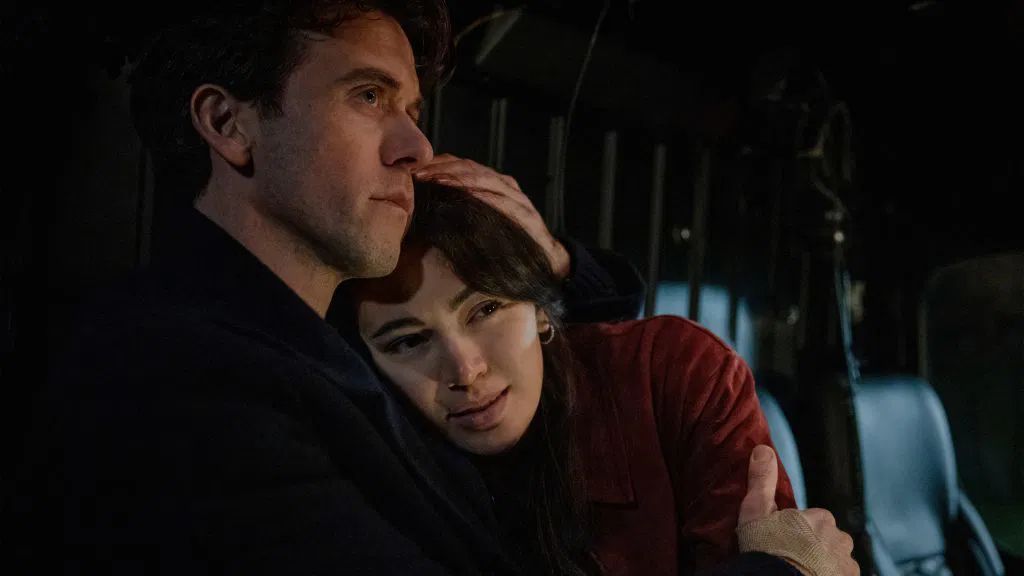
Daniel’s separation feels equally deliberate. His engineering ability could explain why the founders specifically want him inside Silo 1, particularly if they believe his skills will matter after the catastrophe. More importantly, forcibly separating him from Helen turns the apocalypse from gigantic world-building into something painfully personal. Humanity’s old world may be ending, but for Daniel the immediate horror is much simpler: the person he loves is standing at another silo while the sky explodes between them.
That’s exactly why the sequence lands. Silo understands that a mushroom cloud is spectacle; two people desperately trying to reach each other while it rises behind them is drama.
Verdict
Silo Season 3, Episode 9 is the kind of penultimate episode this series thrives on: huge answers delivered with enough new uncertainty to make the mythology even more addictive. Showing what appears to be the nuclear catastrophe could have reduced one of the show’s oldest mysteries to exposition. Instead, the suspicious behaviour of the founders, the strange circumstances surrounding Charlotte, Daniel and Helen’s separation, and Silo 18’s oddly convenient nuclear specifications turn the revelation into a conspiracy puzzle.
The Pact material is arguably even more fascinating because it connects the physical survival of humanity with the psychological architecture controlling generations afterward. Meanwhile, Daniel and Helen give the mythology an emotional centre, preventing all the talk of algorithms, founders and extinction events from becoming a Wikipedia page with Rebecca Ferguson somewhere in the margins.
There are still major pieces deliberately missing, particularly regarding responsibility for the explosion and what the founders actually knew beforehand. But that’s frustration by design rather than narrative stalling. Episode 9 doesn’t just show us how the world of Silo may have ended. It makes me considerably less certain that the apocalypse happened the way we’ve been encouraged to believe.