

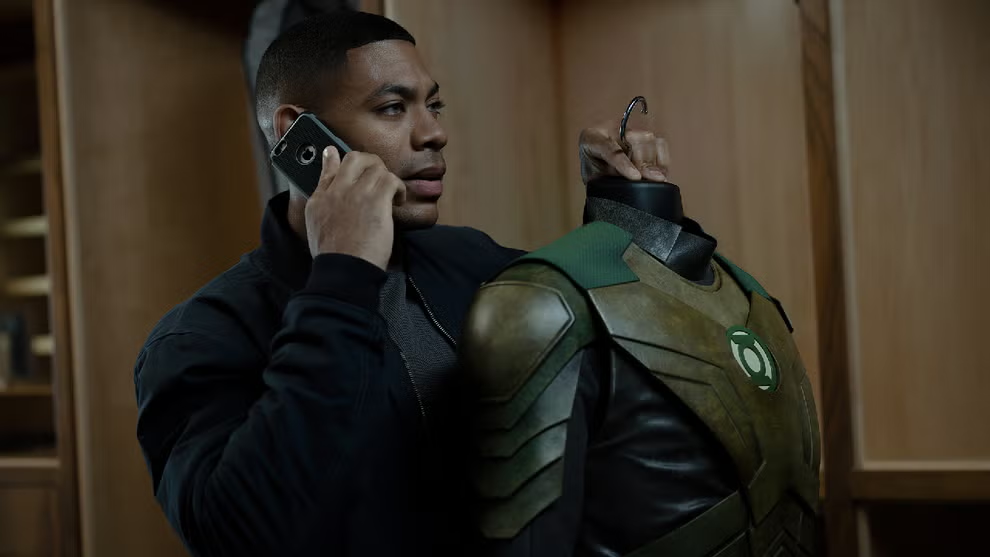
TL;DR: Lanterns Episode 3 gives Aaron Pierre his strongest showcase yet, transforming John Stewart’s Green Lantern destiny into a compelling story about fear, family, identity and the hidden cost of becoming a hero.
Three episodes in, Lanterns finally stops teasing what kind of Green Lantern series it wants to be and starts showing us. “OutKast” largely pushes the central investigation aside and turns its attention toward John Stewart, using his past to explore a wonderfully uncomfortable question for superhero television: what if becoming the hero you were supposedly destined to be is actually the thing that damaged you?
That immediately gives Lanterns Episode 3 more emotional weight than another hour of cosmic clues and mysterious suspects could have delivered. Aaron Pierre gets the material he has been waiting for, while the episode digs into John’s family, his military history and the strange circumstances surrounding his connection to the Green Lantern Corps. The result is ambitious, occasionally heavy, but easily the strongest showcase yet for why this version of John Stewart could become one of the DCU’s most fascinating characters.
John Stewart’s Green Lantern origin becomes something much darker
“OutKast” takes a pretty massive swing at John’s mythology by connecting his destiny to events that began long before he ever wore the ring. We learn that when Abin Sur crashed near Rushville, the ring did not immediately arrive at Hal Jordan. Instead, it first encountered John Stewart Sr., asking whether he was afraid.
He was.
That seemingly simple admission becomes the wound around which much of the episode is built. Being confronted by something impossible leaves John Sr. traumatised, while Bernadette Stewart is forced to become the stabilising force within the family. Then a Guardian enters their lives and sees potential not in John’s father, but in young John himself.
The idea that John could essentially be conditioned into becoming an ideal Lantern is disturbing in exactly the right way. Green Lantern mythology has traditionally treated overcoming fear as aspirational, but Lanterns starts poking holes in that philosophy. Fearlessness sounds fantastic when printed beside a superhero logo. Applied to an actual human being, however, removing fear can mean suppressing vulnerability, sensitivity and the basic emotional machinery that tells us when something hurts.
Suddenly, the Green Lantern Corps feels considerably less like Space Hogwarts and a little more like an intergalactic military recruitment programme with terrifyingly good branding.
Aaron Pierre finally gets to show us the man behind the discipline
The biggest beneficiary of this shift is Aaron Pierre. John has spent much of Lanterns operating behind discipline and restraint, which makes sense for the character but also means Pierre has frequently been asked to communicate through what John refuses to reveal.
“OutKast” finally cracks that armour.
Through different stages of John’s life, the episode reveals a character caught between identities that do not comfortably coexist. There is the soldier capable of following orders, the artist buried underneath that discipline and the son still carrying the complicated expectations of his family. His eventual path into becoming a Marine sniper makes sense within that construction, but the episode refuses to treat military discipline as his entire personality.
That distinction is important because John Stewart has accumulated several different identities across decades of DC storytelling. He has been an activist, architect, soldier and Green Lantern, depending on which era or adaptation introduced you to him. Lanterns doesn’t simply choose one interpretation and delete the others from continuity like somebody angrily editing a DC wiki at 3 a.m. Instead, it tries to find the psychological bridge connecting them.
Pierre makes that contradiction believable. When the story reaches John’s later encounter with the Guardian during a strange, temporally fractured interview process, his desire for the promised ring carries more than superhero excitement. He wants meaning. If his life has been shaped toward a destination, then reaching that destination becomes proof that all the shaping was somehow worth it.
That is a dangerous emotional equation, and Lanterns knows it.
John’s parents explain the contradictions inside him
J. Alphonse Nicholson and Jasmine Cephas Jones are crucial to making the Stewart family material work. John Sr. and Bernadette aren’t presented merely as explanatory devices who conveniently manufacture the hero audiences already recognise. They have their own tensions between who they are, who society expects them to be and who they believe their children should become.
The episode’s smartest character work comes from how those contradictions echo through John. His father possesses sensitivity beneath a more traditionally masculine exterior, while Bernadette displays strength and resolve while carrying responsibility for holding the family together. John inherits pieces of both, yet those pieces become increasingly difficult to reconcile once his future has essentially been decided for him.
There is tragedy in parents trying to prepare a child for greatness while accidentally sanding away parts of the person they are supposedly preparing. “OutKast” understands that good intentions do not magically prevent damage. John is being trained to become exceptional, but the cost of that process is increasingly difficult to ignore.
That makes his origin feel less like a superhero awakening and more like a psychological inheritance.
Lanterns turns fear into something more complicated than weakness
Green Lantern stories are obsessed with fear, understandably. Willpower versus fear is baked into the mythology at a molecular level, right alongside glowing jewellery and increasingly questionable decisions by tiny blue space bureaucrats.
“OutKast” cleverly challenges the simplicity of that equation. John Sr.’s fear is completely understandable when something impossible suddenly enters his bedroom and lifts him into the air. Yet that response becomes associated with inadequacy, setting off consequences that ripple through his family.
John then grows up under the opposite expectation. He is supposed to conquer fear, control himself and become worthy of a destiny selected for him by forces he barely understands. But what happens when fearlessness stops being courage and becomes emotional suppression?
That is where Lanterns begins doing something genuinely interesting with superhero mythology. Most origin stories treat accepting the mantle as liberation. Bruce Wayne becomes Batman. Peter Parker accepts his responsibility as Spider-Man. The costume externalises something the character has finally understood about themselves.
For John, becoming Green Lantern may represent the opposite.
If his entire life has been engineered toward receiving the ring, then finally putting it on might validate the very forces that prevented him from deciding who he wanted to become. The superhero identity audiences are waiting to celebrate could simultaneously represent John’s greatest achievement and his deepest loss.
That is far more interesting than another glowing fist construct.
Hal Jordan’s shadow makes John’s destiny even more personal
The episode also strengthens John’s complicated relationship with Hal Jordan by giving his resentment deeper roots. Hal didn’t simply receive a position John wants. From John’s perspective, Hal received something that had effectively been promised to him after years of preparation and sacrifice.
The frustration becomes even sharper when Hal interferes with John’s military mission by capturing his target. Their conflict therefore isn’t merely veteran-versus-successor banter or the familiar buddy-cop friction Lanterns could easily have settled for.
Hal represents an unbearable possibility: maybe John’s suffering wasn’t necessary.
If someone else could simply be chosen by the ring while John spent his life being shaped into the supposedly perfect candidate, then the entire foundation beneath his identity becomes unstable. That gives their relationship emotional stakes far beyond deciding who gets to wear the shiny green uniform.
Final Verdict
Lanterns Episode 3 is the point where the series’ grounded detective drama and cosmic mythology finally begin feeding the same story. “OutKast” uses John Stewart’s history not merely to explain him, but to challenge the heroic destiny awaiting him. Aaron Pierre delivers his strongest material so far, while J. Alphonse Nicholson and Jasmine Cephas Jones give the Stewart family enough complexity to prevent John’s past from feeling like an extended exposition dump.
The episode’s biggest gamble is also its greatest strength: becoming Green Lantern no longer feels like an uncomplicated victory for John. His destiny has been shaped by fear, expectation, family pressure and forces operating far beyond his control. Comic purists may understandably have complicated feelings about such a substantial reworking of John Stewart’s history, but as television drama, it gives the character something incredibly valuable: becoming a superhero might not solve his identity crisis. It might complete it.