
TL;DR: Lanterns episode 2 successfully separates Hal and John without losing their magnetic dynamic, deepens Rushville’s mystery, delivers some unexpectedly sharp comedy, and finally begins opening the door to the cosmic Green Lantern mythology fans have been waiting for.
Lanterns arrived with an unusual proposition for a Green Lantern series: take one of DC’s most outrageously cosmic concepts, park it in small-town America, and let two stubborn space cops investigate something deeply unpleasant. Episode 2 doubles down on that approach rather than racing toward emerald constructs and intergalactic fireworks, and the restraint continues to work surprisingly well. Kyle Chandler’s Hal Jordan and Aaron Pierre’s John Stewart spend much of the episode following separate threads, which could have drained the momentum established by the premiere. Instead, the separation gives both characters room to breathe while allowing the mystery surrounding Rushville to become considerably stranger. The result is an episode that feels confident enough to be funny, creepy and occasionally ridiculous without losing sight of the larger DC mythology waiting beyond the horizon.
Two Lanterns are better apart than expected
The biggest gamble in Lanterns episode 2 is separating Hal and John after their prickly chemistry did so much heavy lifting in the premiere. Chandler and Pierre have already established an entertaining generational friction, with Hal operating largely on instinct and accumulated experience while John prefers something resembling professionalism. Taking that dynamic away for much of an episode sounds like voluntarily unplugging your best controller halfway through a boss fight, yet it reveals why the pairing works in the first place. Hal is chaotic even when nobody is around to argue with him, while John’s controlled exterior becomes funnier when he is confronted with situations that refuse to behave logically. Their eventual reunion consequently carries more weight because the episode has spent time showing exactly what each man brings back to the partnership.
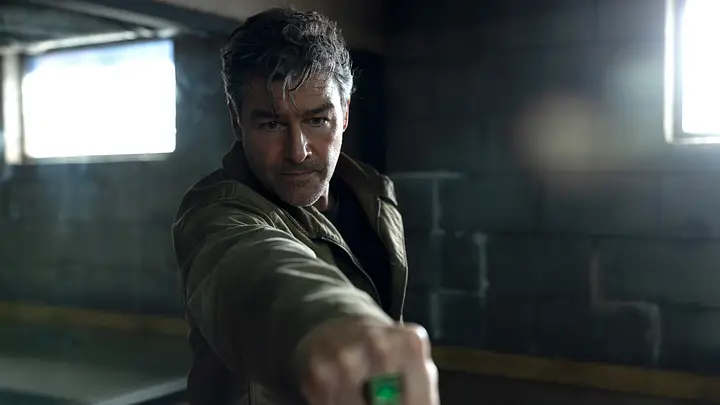
Chandler continues to play Hal as a veteran whose heroic résumé does absolutely nothing to make him pleasant company. There is weariness beneath the sarcasm, but the performance wisely avoids turning that exhaustion into generic tortured-superhero gloom. Hal can be irritating, abrasive and remarkably difficult while still possessing the instincts that made him Green Lantern material, and his investigation around Rushville repeatedly demonstrates why dismissing him is dangerous. The increasingly bizarre circumstances surrounding his detective work also give Chandler room to lean into the show’s dark comedy. Lanterns may dress itself like a prestige crime drama, but there is something wonderfully absurd about watching an intergalactic superhero stumble through a rural investigation where every new clue seems determined to make the situation more suspicious.
Sheriff Kerry gives Hal exactly the resistance he needs
Kelly Macdonald’s Sheriff Kerry becomes particularly important once John is elsewhere because Hal desperately needs someone capable of pushing back against him. Macdonald supplies that friction without feeling like a substitute partner inserted to maintain the same formula. Kerry has her own authority, frustrations and knowledge of Rushville, making her clashes with Hal feel less like superhero banter and more like two investigators who would both prefer the other person stopped touching their crime scene. Their exchanges give the episode some of its funniest moments, especially as Hal’s behavior becomes increasingly difficult to explain using normal human standards. More importantly, Kerry’s involvement complicates the investigation by suggesting she understands considerably more about the town’s unusual circumstances than her initial presentation implied.
That shift helps the central mystery finally acquire some texture. The murder investigation remains deliberately grounded, but episode 2 begins poking holes through that surface and allowing the cosmic weirdness underneath to leak out. Paul Ben-Victor’s Antaan and the references to Manhunters and devastated civilizations expand the stakes without suddenly transforming the series into a galaxy-spanning effects showcase. There is still an obvious budget-conscious quality to having extraterrestrial players conveniently resemble humans, and longtime Green Lantern fans may understandably crave more bizarre species, impossible architecture and creatures that look like somebody emptied a Jack Kirby sketchbook into a blender. Still, Lanterns compensates by making identity itself part of the tension, using dialogue and behavior to suggest when someone may not be exactly what they appear.
John Stewart gets his own kind of weird
John’s side of the episode operates on a different frequency, and Aaron Pierre continues making restraint look compelling. Pierre understands that John does not need to announce every emotion crossing his mind; much of the character’s appeal comes from watching him absorb increasingly strange information while trying to maintain his composure. His time away from Hal also reinforces that he is not merely the younger Lantern whose job is to challenge the veteran. John investigates, evaluates and makes decisions independently, even when those decisions force him to reconsider how much trust he is willing to place in Hal. That gradual movement matters because Lanterns is clearly building its central relationship rather than magically manufacturing friendship after a couple of shared adventures.
The comedy works especially well here because Pierre plays John with such seriousness. The stranger his surroundings become, the less the series needs him to acknowledge the joke. That contrast gives Lanterns a personality increasingly distinct from both traditional superhero television and the broader comedic tendencies audiences associate with parts of the modern DC universe. The humor emerges from uncomfortable personalities, bizarre circumstances and people trying to maintain professional dignity while dealing with profoundly unprofessional levels of nonsense. Crucially, the jokes rarely sabotage the mystery. The episode can make you laugh at Hal’s investigative methods before reminding you that something genuinely sinister appears to be operating underneath Rushville’s sleepy exterior.
The cosmic door finally cracks open
For all the episode’s strengths as a character-driven detective story, its closing stretch is where Lanterns starts teasing the show many Green Lantern fans have been waiting to see. Hal and John’s motel conversation provides an important emotional beat, with John choosing to share what he has discovered despite lingering uncertainty about his mentor. It is a small development rather than some grand declaration of brotherhood, which makes it far more believable. These two are nowhere near becoming best friends, but trust is beginning to form through accumulated choices rather than screenplay shortcuts. For a series built around two men who would probably argue over which direction to evacuate a burning building, that incremental progress feels exactly right.
Then the episode finally points toward Oa and Sinestro, with Ulrich Thomsen entering the picture as the imprisoned former Lantern. The appearance is brief, but it immediately changes the scale of what Lanterns might become. Until this point, the series has largely succeeded by making Green Lantern mythology fit inside the grammar of a murder mystery; Sinestro’s arrival suggests the writers know they cannot keep the cosmic side locked in the evidence room forever. That balancing act will become increasingly important. The grounded approach gives Lanterns its identity, but Green Lantern without genuine cosmic spectacle eventually risks becoming a police procedural wearing an expensive power ring. Episode 2 seems aware of that danger and begins widening its universe at precisely the right moment.
Verdict
Lanterns season 1 episode 2 confirms that the premiere’s success was not dependent entirely on keeping Hal Jordan and John Stewart in the same room. Kyle Chandler remains wonderfully abrasive as a veteran Hal whose instincts are considerably better than his people skills, while Aaron Pierre gives John a quiet authority that becomes more compelling as the mystery deepens. Kelly Macdonald proves an excellent addition to the investigative dynamic, and the increasingly strange revelations surrounding Rushville finally give the central case the intrigue it needs.
There are still moments when the deliberately grounded presentation makes the Green Lantern universe feel smaller than it should, particularly when its alien mythology arrives disguised in conveniently human packaging. Yet the references to Manhunters, larger cosmic conflicts and especially Sinestro suggest Lanterns is slowly preparing to remove the training wheels. For now, the mixture of detective drama, dry comedy and DC mythology remains remarkably effective. Episode 2 does not explode the universe open, but it makes you very eager to see what happens when that green light finally reaches full brightness.