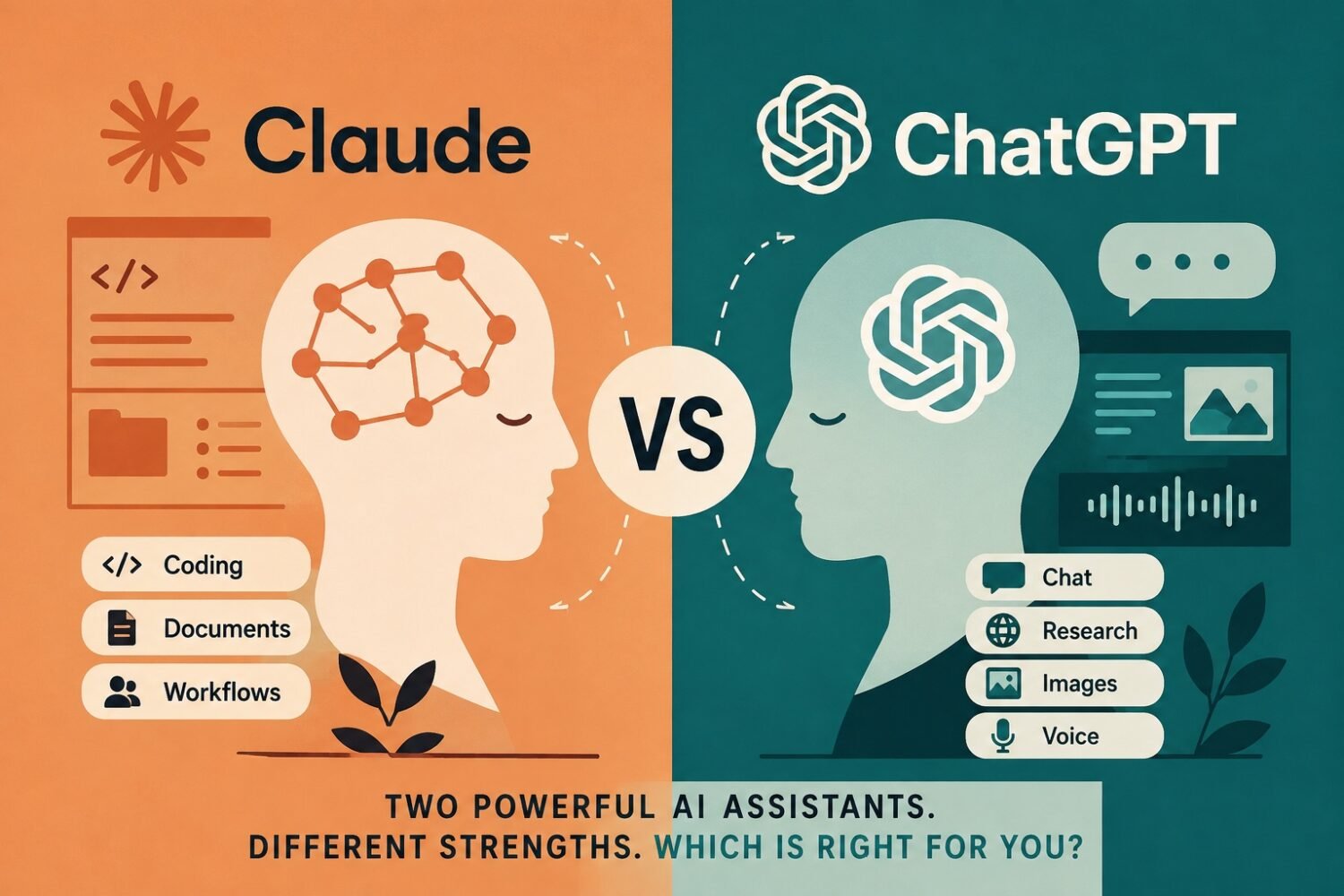
TL;DR: Claude is particularly compelling for coding, documents and agentic knowledge work, while ChatGPT is the stronger general-purpose choice for users who value voice, images, research and multimodal flexibility. Ignore single benchmark victories, test both against your real workflow, and pay for the ecosystem that consistently saves you the most time.
The Claude vs ChatGPT argument has become the AI equivalent of PlayStation versus Xbox, Android versus iPhone, or whether Han shot first. Everyone has a favourite, everyone has screenshots proving their favourite is smarter, and somewhere on the internet somebody is currently feeding both assistants the same deliberately impossible prompt and declaring the resulting winner the future of civilization.
The reality in 2026 is considerably more interesting. ChatGPT and Claude have evolved beyond simple chatbots into sprawling productivity platforms. Both can research subjects, analyze files, write and debug code, reason through complicated questions, create documents and perform increasingly agent-like work. Their flagship models are extraordinarily capable, while their surrounding apps have become almost as important as the models themselves.
That means choosing between Claude and ChatGPT based purely on which model wins a benchmark is increasingly like choosing a smartphone by comparing processor scores. Interesting? Absolutely. Geek catnip? Without question. But it tells you surprisingly little about which device you’ll actually enjoy using every day.
The better question is what you want your AI assistant to become. Claude increasingly feels like a focused workbench for knowledge work, coding and delegated computer tasks. ChatGPT feels more like an ambitious general-purpose computing layer, spanning conversation, research, voice, images, coding and multimodal interaction. Neither philosophy is universally better, but the distinction matters enormously once AI becomes something you use for hours rather than occasionally asking how long to boil an egg.
Claude vs ChatGPT isn’t really one model versus another
The first thing I’d throw into the nearest digital recycling bin is the idea that “Claude” and “ChatGPT” each represent one intelligence. They don’t. You’re comparing platforms containing different models, modes, usage limits and tools, and those combinations keep changing.
OpenAI’s current GPT-5.6 family illustrates the problem nicely. GPT-5.6 spans Sol, Terra and Luna capability tiers, with Sol positioned as the flagship and Terra as a lower-cost model. Access also varies according to your ChatGPT plan and selected effort level. OpenAI says GPT-5.6 Sol is available to Plus, Pro, Business and Enterprise users through medium and higher effort settings, while Free and Go users get GPT-5.6 Terra in ChatGPT Work and Codex. (OpenAI)
Anthropic follows a comparable hierarchy. Claude Fable 5 sits at the high end for demanding knowledge and coding workloads, while Sonnet 5 targets broader everyday and production use. Anthropic describes Sonnet 5 as a versatile model covering coding, agents and professional workflows, while Fable 5 is positioned for particularly difficult knowledge and coding problems. (Anthropic)
Consequently, a benchmark saying one company’s flagship beats another company’s everyday model doesn’t settle much. Even flagship-versus-flagship comparisons need context. Performance can change with reasoning effort, tools, prompt design and the kind of problem being tested. A model brilliant at software engineering might be merely excellent at factual recall, while another can reverse that relationship. Compressing all of this into one “intelligence score” is wonderfully convenient and slightly bonkers.
Accuracy matters, but benchmark worship can mislead you
Accuracy is obviously important. If I’m asking an AI assistant to investigate a technical problem, analyze a contract or explain why my hypothetical home server has decided DNS is optional today, confidence without correctness isn’t useful.
But measuring large language models is awkward because their answers aren’t deterministic lookup-table responses. Prompt wording matters. Tool access matters. Reasoning settings matter. The evaluation dataset matters. Whether the model can search the web matters. Even seemingly tiny changes to a test can alter the result.
Hallucination metrics deserve particular attention because fluent nonsense remains one of generative AI’s most dangerous party tricks. A hallucination isn’t merely a wrong answer. The real problem is that an LLM can present an invented citation, nonexistent feature or fictional historical detail with exactly the same linguistic confidence it uses for something true. The prose engine doesn’t contain a little warning light that starts flashing whenever reality leaves the building.
This is why I’d resist declaring either Claude or ChatGPT “more accurate” in some universal sense based on a single third-party benchmark. Benchmarks are useful evidence, not papal decrees. For serious work, the better workflow is still to ask for sources, inspect those sources and independently verify consequential claims. A two-point benchmark advantage won’t save you if the model confidently invents the one fact your presentation depends upon.
The same applies to model regressions. Newer models can score better overall while feeling worse for a particular person’s workflow. Optimization is multidimensional: reasoning, latency, verbosity, safety behaviour, personality, coding performance and hallucination resistance can move differently. “The benchmark improved, therefore every interaction improved” is exactly the sort of logic that would get a PC reviewer chased out of town carrying a suspiciously cherry-picked bar chart.
Claude’s biggest advantage is its workbench mentality
Where Claude becomes particularly compelling is when the conversation stops being the product and starts becoming the control panel.
Claude Cowork is a good example. Anthropic describes Cowork as a way to delegate multi-step work, with access to folders, browser context, documents and connected tools. It also supports instructions, projects, skills and plugins that can encode recurring processes. That makes Claude increasingly interesting for people who don’t merely want answers but want an AI system to operate within a defined workflow. (Anthropic)
Skills reinforce that philosophy. Rather than repeatedly explaining how a task should be performed, users can establish reusable instructions and processes. Anthropic has been expanding this approach across its ecosystem, including Claude Code, Cowork and specialist environments. Its Claude Science workbench, for example, combines tools, packages, auditable outputs and computing resources for scientific workflows. (Anthropic)
That direction makes Claude especially appealing to developers, researchers and professionals whose work involves large amounts of text, code, documentation or repeatable procedures. Think less “chatbot living in a browser tab” and more “extremely fast junior collaborator with access to the workshop.”
The caveat is important: agentic AI raises the stakes when it makes mistakes. A wrong paragraph is annoying. A wrong action performed across your files can be considerably more exciting in the Jurassic Park sense of the word. Permissions, review steps and sensible backups remain essential whenever an AI system can manipulate real data.
ChatGPT’s biggest advantage is breadth
ChatGPT’s strongest argument is almost the opposite. OpenAI has spent years turning ChatGPT into something much broader than text conversation, and by 2026 the sheer number of interaction modes can be genuinely useful.
Image generation is built directly into the platform, with OpenAI continuing to develop its dedicated image-generation stack through ChatGPT Images 2.0. (OpenAI) That matters if your workflow regularly jumps between writing, visual ideation, editing images and research. Claude can produce useful diagrams and programmatic visual material, but ChatGPT is the more natural destination when generative imagery itself is part of the job.
Voice is another major differentiator. OpenAI introduced GPT-Live in July 2026, using a full-duplex architecture that allows the system to listen and speak simultaneously rather than treating conversation as alternating recorded voice notes. It can maintain conversational flow while handing more complicated questions to other capabilities behind the scenes. (OpenAI)
Current ChatGPT Voice can also combine spoken interaction with web search, memory, text and images. Eligible subscribers who need camera or screen sharing can still use those capabilities through Advanced Voice, although the newer Live mode itself doesn’t currently support video or screen sharing. (OpenAI Help Center)
That distinction is worth getting right because “ChatGPT supports live video” and “the newest ChatGPT voice mode supports live video” aren’t presently the same statement. AI platforms change quickly enough that feature matrices can become archaeological documents before you’ve finished making the coffee.
For someone who wants one AI subscription to cover research, brainstorming, images, voice conversations, file analysis and occasional coding, ChatGPT’s breadth is difficult to ignore.
Coding is where the comparison gets properly interesting
Developers have particularly good reasons to consider both platforms because coding has become a battlefield rather than another checkbox on the feature list.
Claude Code and Claude’s broader agent ecosystem make Anthropic especially attractive when software development is the primary workload. Claude Pro includes Claude Code access, as do the Max subscriptions, and Anthropic continues tying coding, Cowork and agent workflows together under the same consumer subscriptions. (Claude Help Center)
OpenAI, meanwhile, has Codex alongside the broader ChatGPT ecosystem, and GPT-5.6 is available across ChatGPT, Codex and the OpenAI API. (OpenAI) The result isn’t a clean “Claude codes, ChatGPT chats” divide. Both companies are aggressively pursuing software development, and both can be excellent depending on repository size, language, tooling and how autonomously you want the agent to operate.
I’d therefore choose according to workflow rather than internet mythology. If your day revolves around repositories, terminals, long coding sessions and delegated engineering tasks, Claude deserves serious attention. If coding is one activity among research, document work, images, voice and general assistance, ChatGPT’s broader toolbox may prove more convenient.
And developers should remember that switching costs are unusually low. This isn’t 2009, when buying an ecosystem meant spending years accumulating proprietary cables. You can keep both free accounts, subscribe to one and periodically reevaluate.
ChatGPT feels more like an AI companion; Claude feels more like an AI colleague
The usage patterns around these platforms hint at another difference.
OpenAI’s consumer research found roughly 70 percent of ChatGPT consumer usage was non-work related, with around 30 percent associated with work. That doesn’t mean ChatGPT isn’t serious productivity software; it means people have incorporated it deeply into everyday life, including information seeking, decision support, learning, writing and personal tasks. (OpenAI) OpenAI’s more recent Signals dataset continues tracking ChatGPT across both work and personal projects. (OpenAI)
That breadth makes sense when you consider ChatGPT’s product design. Memory, conversational voice, image generation and general-purpose assistance naturally encourage people to ask it about everything from debugging Python to planning dinner.
Claude’s trajectory feels more deliberately oriented around producing and manipulating work. Anthropic’s June 2026 Economic Index reported that 93 percent of the Claude conversations it classified produced an identifiable artifact, with explanations, documents and reports, and guidance among the most common outputs. (Anthropic)
I wouldn’t turn those statistics into a personality test. You aren’t required to wear a tie before opening Claude, and ChatGPT won’t confiscate your spreadsheet because you asked it about Elden Ring yesterday. But they illustrate the products’ different centres of gravity.
Pricing is similar until you look at the details
For individual users, the pricing war is almost suspiciously symmetrical at the upper end.
Claude Pro costs $20 per month in the US, with a discounted annual option. Max 5x costs $100 per month and Max 20x costs $200 per month. The names are unusually honest by software-subscription standards: the Max tiers primarily give substantially more usage, alongside priority access to newer features and models. (Claude Help Center)
Anthropic also lets paid subscribers continue beyond included limits using usage credits. Those credits switch additional consumption onto pay-as-you-go pricing, and Anthropic offers prepaid usage bundles with discounts at larger denominations. (Claude Help Center)
OpenAI’s mainstream consumer pricing currently includes ChatGPT Go at $8 per month in the US, Plus at $20 and Pro at $200. Go pricing can vary by market. Plus includes features such as voice, image generation, file analysis and deeper research capabilities, although usage limits can still apply. (OpenAI)
The $8 Go tier gives ChatGPT an interesting middle ground for people who regularly exceed free limits but cannot justify another $20 monthly subscription joining Netflix, Spotify, cloud storage and the other tiny financial vampires attached to their credit card.
Price alone therefore doesn’t determine the winner. At $20, you’re comparing ecosystems and limits rather than simply buying “better AI.” Heavy users need to pay particularly close attention to usage policies because a fantastic model you regularly cannot access is technically just a very sophisticated menu item.
Free users have a different decision to make
Free tiers are important because they’re how enormous numbers of people experience these systems, and the differences here aren’t merely model names.
ChatGPT now uses advertising on eligible Free and Go experiences. OpenAI initially announced the advertising program in January 2026 as a way to subsidize broader access while keeping Plus, Pro, Business and Enterprise ad-free. (OpenAI)
That changes the comparison for users who simply want an occasional AI assistant without another monthly bill. Some people won’t care about advertising if it helps preserve useful free access. Others will immediately prefer an alternative without that business model. That’s a legitimate product preference rather than a question of which neural network has the prettier benchmark graph.
What matters more is whether the free tier lets you complete your actual tasks before encountering restrictions. Limits can depend on model demand, context length, attached files and computationally expensive features. Comparing advertised free plans without actually considering your workload is like comparing mobile contracts while ignoring data allowances.
If you use AI twice a week, both free products may be plenty. If you’re uploading enormous documents every afternoon, free-tier comparisons become much less relevant because you’re already behaving like a paid power user.
Privacy, trust and AI politics now belong in the buying decision
Choosing an AI assistant isn’t exactly like choosing a mechanical keyboard. You’re potentially giving it documents, conversations, work material and access to other software, so company policies and governance decisions deserve scrutiny.
The events surrounding Anthropic and the US government in early 2026 made that unusually visible. Anthropic resisted military use of Claude for mass domestic surveillance and fully autonomous weapons, after which the US government moved to classify the company as a supply-chain risk. The dispute became a major confrontation over how much control AI developers should retain over downstream military applications. (AP News)
OpenAI subsequently reached its own agreement with the Department of War. According to OpenAI, its agreement prohibits domestic surveillance of US persons, prevents its systems from independently directing autonomous weapons where human control is required, and maintains technical safeguards through a cloud-only deployment with OpenAI’s safety systems intact. OpenAI also publicly opposed Anthropic’s supply-chain-risk designation. (OpenAI)
Reasonable people can interpret those events differently, and “which AI company is more ethical?” isn’t something a feature comparison can reduce to a green tick or red cross. Corporate ethics aren’t processor specifications.
The practical lesson is simpler: if trust, military relationships, data handling or corporate governance matter to you, investigate them independently. Don’t outsource your moral judgment to whichever company’s PR department writes the punchier manifesto.
Don’t choose your AI assistant because of one viral screenshot
One of the strangest habits surrounding generative AI is judging an entire platform from a single conversation posted on social media.
A user asks Claude and ChatGPT an obscure riddle. One nails it. Screenshot. Victory declared. Somewhere, presumably, confetti cannons fire.
This is terrible buying methodology.
LLMs vary between prompts, models and reasoning settings. They can also behave differently when tools such as web search are available. If you’re choosing between Claude and ChatGPT, build a small personal torture chamber instead. Give both systems examples of the work you actually perform. Use the same source document. Ask the same programming question. Try the same research assignment. See how often you need to correct each one and how much useful work survives after verification.
Pay attention to friction as much as answer quality. Which interface makes managing longer projects easier? Which one handles your documents more naturally? Which output requires less editing? Which service’s limits interrupt you? Do you actually use voice or image generation, or are those features merely shiny buttons you’ll admire twice before forgetting?
The best AI assistant isn’t the one that wins somebody else’s benchmark. It’s the one that removes the most friction from your workflow without introducing unacceptable errors.
Who should choose Claude in 2026?
Claude makes the strongest case for people who primarily view AI as a serious work environment.
If your typical session involves software development, lengthy documents, research material, structured deliverables or multi-step knowledge work, Anthropic’s ecosystem has a coherent appeal. Claude Code, Cowork, skills and the broader agent strategy all point toward a platform designed around handing meaningful chunks of work to AI rather than simply exchanging messages with it.
I would also lean toward Claude if you appreciate a product whose surrounding features remain tightly centred on text, coding and professional workflows. ChatGPT’s gigantic feature surface is powerful, but not everyone needs an AI Swiss Army knife with seventeen blades, three screwdrivers and an image generator hiding where the corkscrew should be.
Claude isn’t automatically the “smart one,” nor should you assume it will always outperform ChatGPT at coding because somebody’s benchmark said so this month. Its advantage is the combination of strong models and a workflow philosophy that makes sense for sustained knowledge work.
That distinction becomes more valuable the more frequently you use AI.
Who should choose ChatGPT in 2026?
ChatGPT remains the easier recommendation for someone who wants one AI service to do an unusually broad range of things.
Its current ecosystem spans advanced language models, web-connected research, file handling, coding, image generation and sophisticated voice interaction. GPT-Live’s simultaneous listening and speaking makes conversational AI considerably more natural, while image generation gives ChatGPT a creative capability that fundamentally changes what the platform can produce. (OpenAI)
It’s particularly attractive for households, students, general enthusiasts and professionals whose AI usage changes constantly. Monday might involve analyzing a spreadsheet. Tuesday is debugging code. Wednesday you’re generating visual concepts. Thursday you’re talking through a complicated topic while walking. Friday you’re asking why a smart-home device has betrayed you and joined the forces of darkness.
ChatGPT also offers more consumer pricing granularity thanks to Go sitting between Free and Plus. For users who want increased capacity without paying $20 per month, that option can matter. (OpenAI)
The downside of breadth is complexity. ChatGPT increasingly resembles an operating environment rather than a simple chatbot, and keeping track of models, modes and capabilities can occasionally feel like studying the skill tree in a particularly ambitious RPG.
The smartest option might be using both
The uncomfortable conclusion for anyone hoping for a Highlander-style “there can be only one” showdown is that Claude and ChatGPT complement each other rather well.
You don’t necessarily need two paid subscriptions. For many enthusiasts, the sensible arrangement is paying for whichever platform handles the majority of their work while retaining a free account on the other. That gives you a second opinion when an answer looks suspicious and an alternative tool when one platform’s particular strengths become useful.
This is especially valuable for important research. Asking another LLM to review the first one’s reasoning doesn’t magically establish truth—two confident robots can absolutely be wrong together—but differences between their responses can expose assumptions worth investigating manually.
More importantly, don’t develop platform loyalty faster than these products deserve it. AI changes absurdly quickly. The assistant that best fits your workflow in August 2026 may not be the winner six months later. Models change. Limits change. Features migrate between subscription tiers. Yesterday’s killer advantage becomes tomorrow’s standard checkbox.
Treat your subscription like software, not a football club. Reevaluate it occasionally.
Verdict
There isn’t a universal winner in Claude vs ChatGPT in 2026, and that’s ultimately good news. Competition has pushed both products far beyond the glorified text boxes they resembled only a few years ago.
Claude is my stronger recommendation for users whose priorities revolve around coding, documents, repeatable professional workflows and delegating substantial knowledge work. Anthropic’s combination of Claude Code, Cowork, skills and increasingly agentic tools gives the platform a focused identity. It feels built around the idea that AI should become part of your working environment rather than merely answer questions inside it.
ChatGPT is the better all-rounder. Its combination of GPT-5.6 models, voice, images, research, coding and multimodal interaction makes it easier to recommend when your requirements refuse to stay neatly inside one category. If you want an AI assistant that might analyze a document at breakfast, help debug software after lunch and have a spoken conversation while you’re commuting home, ChatGPT’s broader toolbox is compelling.
Don’t make the decision from a benchmark leaderboard, viral hallucination screenshot or corporate marketing page. Try both with your own difficult tasks. Measure how often each saves you time, how often you have to correct it and whether you’re actually using the features you’re paying for.
In the end, the best AI assistant isn’t the one that appears smartest in a laboratory. It’s the one you can trust, verify and put to useful work.