

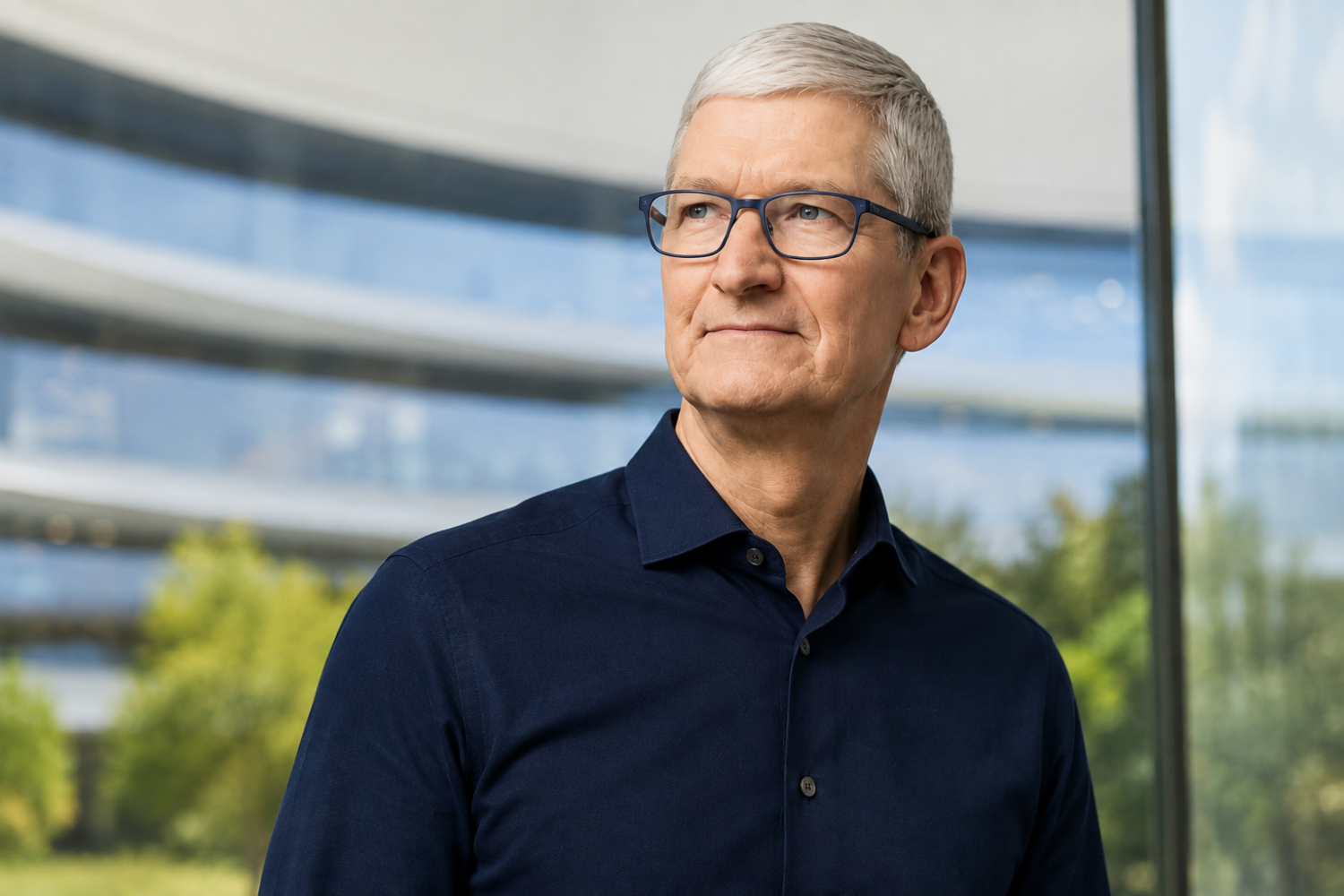
When Tim Cook took control of Apple in August 2011, he inherited what might have been the most intimidating job in technology.
Steve Jobs wasn’t simply Apple’s CEO. He was Apple. The iMac, iPod, iPhone and iPad had turned Jobs into the face of modern consumer technology, and there was an understandable question hanging over the company when Cook took over: what exactly happens to Apple without Steve Jobs?
Fifteen years later, we have the answer.
Apple didn’t collapse. It didn’t become irrelevant. It became considerably bigger.
As Cook steps down as CEO after 15 years, he leaves behind a company almost unrecognisable in scale from the one he inherited. Cook may never have possessed Jobs’ mythology, but he didn’t need to.
His legacy is different: he took the machine Steve Jobs created and figured out how to make it enormous.
From $108 billion a year to $109 billion in three months
Perhaps no number explains the Cook era better than this one.
Apple generated $108.2 billion in revenue during its entire 2011 fiscal year, around the time Cook became CEO.
In Apple’s third quarter of 2026 alone, the company generated $109.4 billion.
In other words, the Apple Tim Cook leaves behind can generate roughly as much revenue in three months as the Apple he inherited generated in an entire year.
For fiscal 2025, Apple’s annual revenue reached approximately $416 billion, nearly four times the 2011 figure. Net income grew from roughly $26 billion in 2011 to $112 billion in 2025.
Then there’s Apple’s valuation.
Apple was worth somewhere around $350 billion when Cook took over. During his tenure it became the first publicly traded US company to cross $1 trillion, then $2 trillion and later $3 trillion.
Apple shares, adjusted for stock splits, traded at around $13 shortly after Cook became CEO in 2011. By the end of his tenure, they were trading above $300 — an extraordinary return for anyone who stayed along for the ride.
Cook didn’t simply preserve Apple.
He industrialised it.
Cook turned Apple’s ecosystem into its greatest product
Cook’s biggest achievement may not be a single device at all.
It is the ecosystem.
The Apple of 2011 was already extraordinarily successful, but it was still largely a company built around selling hardware. The Apple Cook leaves behind sells hardware as the entrance ticket to a huge network of subscriptions, accessories, payments, entertainment and cloud services.
Apple now has more than 2.5 billion active devices around the world.
Services provide an even more dramatic comparison.
Apple generated roughly $9.4 billion from services in 2011. By fiscal 2025, that business was generating approximately $109 billion annually.
That’s an entire business roughly the size of 2011 Apple hiding inside modern Apple.
Apple Music, Apple TV+, Apple Arcade, Apple Fitness+, Apple Pay and iCloud+ all arrived during Cook’s leadership.
Selling someone an iPhone was no longer the end of the transaction. Under Cook, it became the beginning of a relationship that could last for years.
Cook did more than sell iPhones
One of the most persistent criticisms of Cook has always been that Apple stopped creating major new products after Jobs.
There hasn’t been another product under Cook with the cultural impact of the iPhone, but comparing everything Apple creates to arguably the most important consumer technology product of the century is an absurdly high bar.
Cook’s Apple still created several enormous businesses.
The Apple Watch transformed Apple into a major force in wearables and health technology.
AirPods went from being mocked when they were announced to becoming one of the most recognisable consumer electronics products in the world.
Then came products such as the HomePod and Vision Pro, along with Apple’s push into entertainment and financial services.
But arguably Cook’s most important product decision was one most customers never actually see.
Apple Silicon.
The transition away from Intel processors and toward Apple’s own M-series chips fundamentally changed the Mac. Apple gained tighter control over performance, efficiency, battery life and its future product roadmap.
It was classic Tim Cook-era Apple: vertical integration, supply-chain control and relentless optimisation.
The iPhone became an empire
Cook didn’t invent the iPhone.
What he did was turn it into one of the largest businesses on Earth.
Apple sold approximately 72 million iPhones in fiscal 2011, generating around $47 billion in iPhone revenue.
By fiscal 2025, annual iPhone revenue had climbed to roughly $210 billion.
That means today’s iPhone business alone generates nearly twice as much annual revenue as all of Apple did when Cook became CEO.
Across Cook’s tenure, Apple shipped billions of iPhones around the world and expanded the device into the centre of an ecosystem containing the Watch, AirPods, Mac, iPad and an increasingly valuable services business.
The iPhone didn’t disappear after Steve Jobs.
Under Tim Cook, it became an empire.
The operations guy became Apple’s superpower
Cook was never supposed to be Steve Jobs 2.0.
Before becoming CEO, he was Apple’s chief operating officer, specialising in manufacturing, inventory and supply chains.
As CEO, that operational discipline became one of Apple’s greatest advantages.
Cook’s Apple mastered global production at almost incomprehensible scale while maintaining premium pricing and some of the strongest margins in consumer technology.
It expanded retail, grew internationally and turned product launches involving tens of millions of devices into almost routine events.
Apple today employs roughly 166,000 people, while its retail network has expanded to more than 500 stores around the world.
Cook didn’t create Apple’s obsession with controlling hardware and software together.
He simply extended that philosophy across practically the entire company.
More than $1 trillion returned to shareholders
Cook also transformed Apple’s relationship with Wall Street.
In 2012, Apple reinstated its quarterly dividend and began what would become one of the largest share-repurchase programmes in corporate history.
Apple has spent hundreds of billions of dollars buying back its own shares during Cook’s leadership, dramatically reducing the number of Apple shares outstanding.
Add dividends to the equation and Apple has returned more than $1 trillion to shareholders during the Cook era.
It’s not as exciting as hearing Steve Jobs say “one more thing.”
But shareholders probably aren’t complaining.
Steve Jobs built modern Apple. Tim Cook scaled it beyond imagination.
Trying to decide whether Steve Jobs or Tim Cook was “better” for Apple misses the point.
They performed completely different jobs.
Jobs returned to a struggling Apple and gave it a reason to exist. He created the philosophy and products that produced the iMac, iPod, iPhone and iPad.
Cook inherited that foundation and proved it could survive its creator.
That may ultimately be his greatest accomplishment.
There was no guarantee Apple would remain Apple without Steve Jobs. History is littered with companies that lost visionary founders and slowly became shadows of themselves.
Instead, under Cook:
- Annual revenue went from $108 billion to more than $400 billion.
- Apple’s valuation went from roughly $350 billion to several trillion dollars.
- Its installed base expanded beyond 2.5 billion active devices.
- Services grew from less than $10 billion to more than $100 billion a year.
- Apple returned more than $1 trillion to shareholders.
Tim Cook never became the second Steve Jobs.
That turned out to be precisely the point.
He didn’t try to recreate Jobs’ Apple.
He took what Jobs built and transformed it into one of the largest, richest and most influential companies the world has ever seen.
And perhaps that’s the simplest way to describe the Tim Cook era:
Steve Jobs made Apple iconic. Tim Cook made it gigantic.