
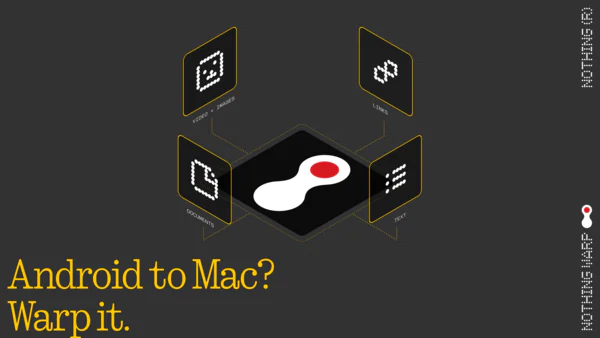
Nothing quietly pulled its newly launched Warp app from circulation just hours after unveiling it on April 15, 2026, leaving behind a curious case of rapid disappearance with no public explanation so far.
The app aimed to fill a gap in cross-device file sharing for Nothing phone users by mimicking the simplicity of AirDrop or Quick Share, but with a notable twist: it routed transfers through the user’s Google Drive account. Instead of direct peer-to-peer connection, Warp would silently upload the selected file to Drive, deliver it to the target device, and then delete the temporary copy. The approach was functional if somewhat roundabout, requiring an active Google account and internet connection rather than the instant, local transfer many users expect from modern sharing tools.
Nothing promoted Warp as a convenient stopgap, especially for moving files between a phone and computer without cables or manual folder navigation. A companion Chrome extension handled the desktop side of the process. Yet by mid-afternoon on the same day, the entire project had vanished. The original announcement blog post was deleted, the Play Store listing disappeared for anyone who had not already installed the app, and the Chrome extension was taken down. Reddit users were among the first to notice the sudden absence, prompting speculation about what went wrong behind the scenes.
The swift reversal raises obvious questions about internal testing, potential privacy or security concerns around routing files through Google Drive, or perhaps an overlooked technical issue that surfaced only after public launch. Nothing has yet responded to requests for comment, leaving the abrupt withdrawal open to interpretation. In an industry where apps often linger in beta or early access for weeks, yanking a product within hours signals either a serious flaw or a last-minute strategic pivot.
This episode fits a broader pattern for Nothing, the company founded by Carl Pei that has built a reputation for bold experiments alongside its phone hardware. From transparent phone designs to unique software flourishes, the brand frequently tests unconventional ideas. Warp appeared to be another such experiment, attempting to solve a common pain point with an indirect cloud-based method rather than building a fully proprietary sharing protocol. Its quick disappearance, however, underscores the risks of rushing consumer-facing features to market without sufficient safeguards or contingency planning.
For users who managed to install Warp before it vanished, the app may still function for now, though support and future updates seem unlikely. In the meantime, most Android users continue to rely on established options like Quick Share, Nearby Share, or standard cloud storage workflows for moving files between devices.
The incident leaves a lingering sense that Nothing’s ambition sometimes outpaces its execution timeline. While the core idea of seamless cross-platform sharing remains valuable, especially as ecosystems grow more fragmented, Warp’s short life suggests the company may need more rigorous vetting before future software experiments reach the public.