
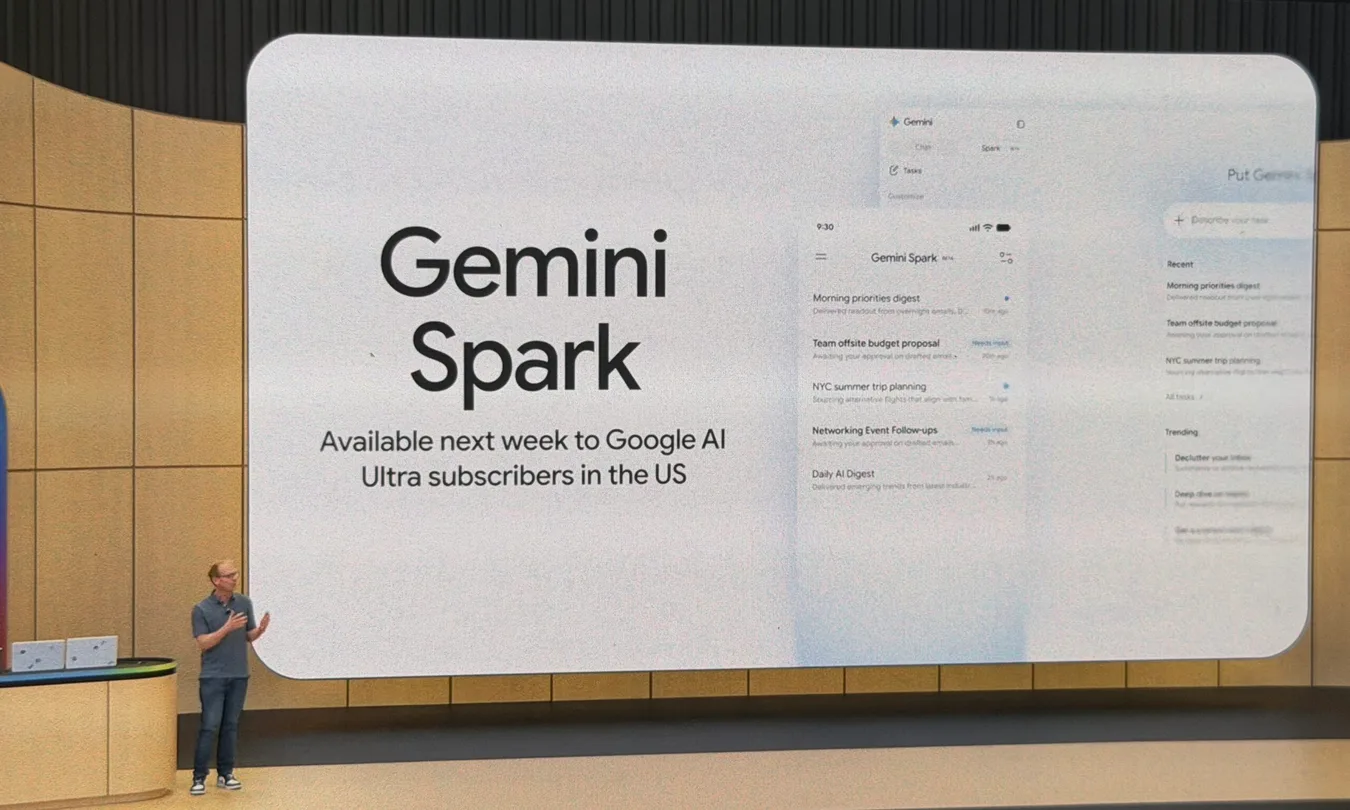
Google is expanding its Gemini lineup with Gemini Spark, now available to Google AI Ultra subscribers in the United States. The tool moves beyond simple question-and-answer interactions, positioning itself as an autonomous agent capable of managing tasks across a user’s digital environment. Instead of switching between separate applications for scheduling, research, or coordination, users can delegate work to the system, which operates in the background even when devices are offline.
Google describes the agent as remaining under user oversight, requiring approval for major actions. This design attempts to address a key tension in current AI development: the gap between conversational tools and systems that actively execute on behalf of people. Early demonstrations suggest it can handle multi-step processes, such as comparing options and updating calendars, without constant input. Yet the rollout arrives amid broader industry efforts to evolve AI from helpful responder to proactive operator.
This represents a logical progression from earlier voice assistants like Siri and Alexa, which mostly retrieved information or controlled basic smart home functions. Those tools felt limited because they operated within narrow domains and required explicit commands. Modern AI agents like Gemini Spark aim for deeper integration, drawing on access to email, calendars, and third-party services. The vision echoes experiments from companies including OpenAI and Anthropic, where agents are being tested for research, booking, and workflow automation.
However, capability alone does not guarantee adoption. The central obstacle remains trust. Many users already hesitate to let AI draft emails or summarize documents without review. Granting permission for independent action raises higher stakes. Even with approval checkpoints, mistakes in automated decisions could lead to scheduling conflicts, privacy breaches, or unintended data sharing. Past incidents with AI hallucinations and data leaks provide reasonable grounds for caution. Google has emphasized safeguards, but history shows that technical controls often lag behind ambitious features.
The timing also matters. As AI agents proliferate, questions about data ownership and transparency become more pressing. When an agent works quietly across ecosystems, users may lose visibility into exactly what information is accessed or stored. Regulatory scrutiny around AI ethics and consumer protection continues to grow, particularly in regions with stricter data rules than the United States.
Despite these concerns, the push toward agentic AI reflects genuine user frustration with fragmented digital experiences. Juggling multiple apps for routine tasks wastes time. A reliable coordinator could improve productivity for those willing to experiment. Still, success will depend less on flashy demonstrations and more on consistent, error-free performance over months of real-world use. Early adopters will likely serve as unwitting testers while the system matures.
Gemini Spark offers an interesting test case for how comfortable people are ceding control to artificial intelligence. The technology is advancing quickly, but public readiness may not keep pace. Whether this becomes a practical daily tool or another ambitious experiment depends on Google’s ability to earn sustained confidence rather than simply showcasing technical potential.