
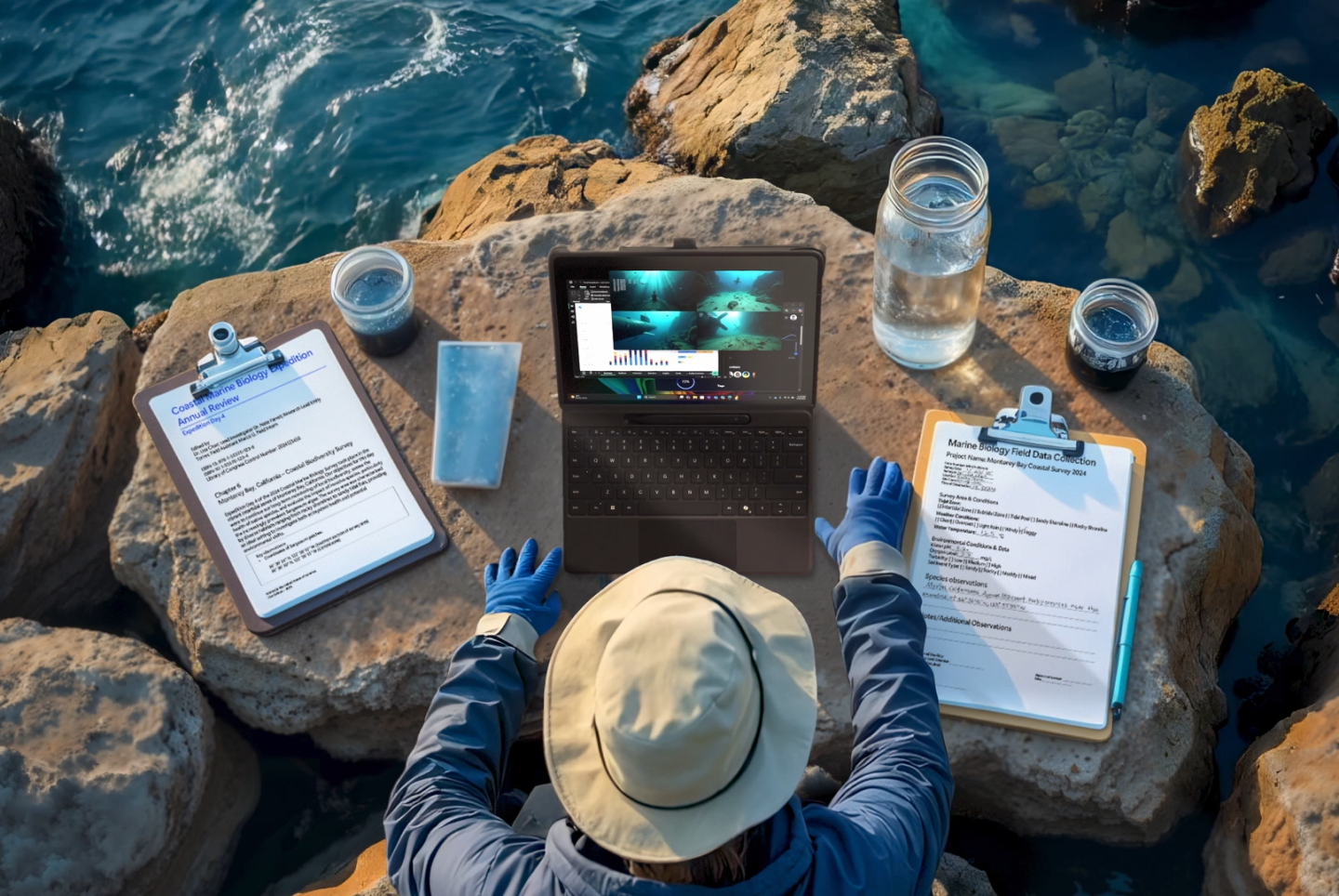
Nearly three months after publishing a promotional video for its Surface Pro and Surface Laptop devices, Microsoft has revealed that the ad was partially created using generative AI—news that, until now, went largely unnoticed by viewers. The minute-long ad, originally uploaded to YouTube on January 30, blended AI-generated visuals with live footage so seamlessly that not a single top comment called out its synthetic origins.
In a recent post on its Design blog, Microsoft detailed the creative process behind the video, offering a rare look into how generative tools are now being incorporated into commercial production. The company stopped short of identifying every AI-generated shot, but it confirmed that segments with minimal movement—such as quick cuts or static imagery—were well-suited to AI rendering. More intricate sequences, like hands typing on a keyboard, were captured through traditional filming methods.
The workflow involved using AI tools not just for visuals, but also in pre-production. Text generation platforms helped draft scripts, pitch decks, and storyboards, which were later refined by human creatives. From there, sample images and prompts were used to guide the generation of visuals, some of which were further edited to remove telltale AI “hallucinations” or errors. Those finalized images were eventually fed into AI video platforms, including tools like Hailuo and Kling, to generate the final footage.
Microsoft’s creative team acknowledged that the process was anything but automatic. Creative director Cisco McCarthy described it as “chiseling away” at the outputs—running thousands of prompts and iterating constantly. While the process required a significant amount of fine-tuning, the overall production time and costs were reportedly slashed by around 90% compared to traditional methods.
The ad’s lack of obvious AI artifacts was helped by its brisk pacing and short duration. Upon closer inspection, some viewers might now spot clues—like oversized objects, handwriting that looks more like font art, or a slightly uncanny visual quality—but those details weren’t enough to raise suspicion at the time of release.
Microsoft’s move reflects a growing trend: AI is becoming an integrated part of the creative toolkit rather than a replacement for human effort. As Jon Friedman, Microsoft’s head of design, recently put it, the designer’s role is shifting from creation to curation—“how do you edit?” being the new central question.
While the Surface AI ad may not have gone viral, its quiet success hints at a larger transformation underway in how content is made. It also raises new questions about transparency, trust, and the evolving relationship between human creators and machine assistance. For now, the ad serves as a case study in how generative AI can blend into commercial media almost invisibly—at least when used with a careful, editorial hand.