

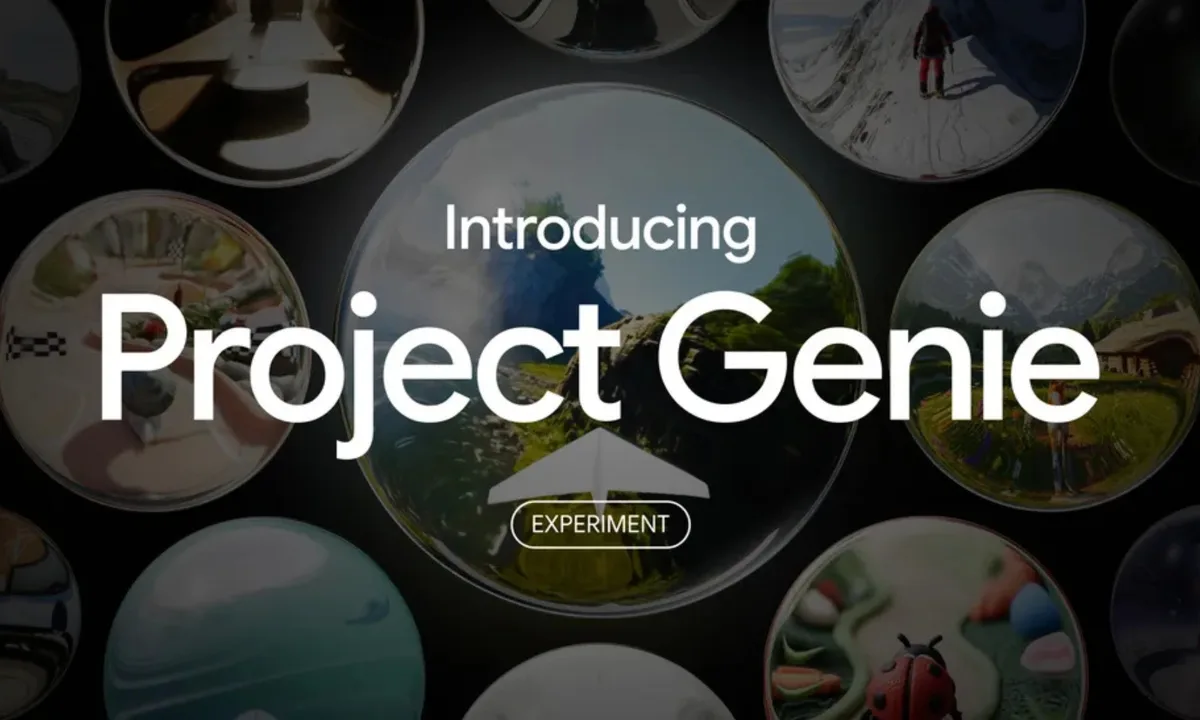
Google has introduced an experimental system called Project Genie that points toward a different direction for generative AI, one focused less on producing isolated pieces of content and more on building entire interactive environments. Developed by Google DeepMind, Project Genie is positioned as a “world model,” capable of generating a navigable digital space from minimal input such as a short text prompt, a rough sketch, or a single image. Rather than delivering a finished video or static scene, the system produces a sandbox-style environment that evolves in real time as the user moves through it.
Most consumer-facing AI tools so far have trained users to expect outputs like text, images, audio, or pre-rendered video. Project Genie shifts that expectation by focusing on interaction. Once a world is generated, users can explore it through a controllable character, with the AI continuously predicting movement, adjusting the environment, and simulating cause-and-effect relationships. This approach removes the need for traditional game engines, manual coding, or 3D modeling workflows, which have historically made world-building slow, expensive, and technically complex.
According to Google, Project Genie combines several internal models, including Genie 3, Gemini, and Nano Banana Pro, to handle reasoning, rendering, and real-time responsiveness. The result is an environment that reacts dynamically to user actions, accounting for basic physics and spatial consistency as the experience unfolds. Google describes potential use cases that range from robotics simulation and animation prototyping to fictional world-building and virtual exploration of real or imagined locations.
The system is structured around three core capabilities. World sketching turns a prompt or image into an initial environment that can expand organically. World exploration allows users to move through and interact with that environment, while the AI infers how objects and surroundings should respond. World remixing enables users to adapt or build on existing worlds, treating them as starting points rather than fixed creations.
From an industry perspective, the appeal is clear. Interactive world creation has traditionally required large teams, long development cycles, and significant budgets, particularly in open-world games and simulation software. A tool like Project Genie could reduce early-stage prototyping time and lower the barrier for experimentation, though it is not positioned as a replacement for full-scale production tools.
Access, for now, is limited. Project Genie is only available to Google AI Ultra subscribers in the United States who are at least 18 years old. At $249.99 per month, this is Google’s most expensive AI subscription tier, reinforcing the idea that the project is still in an early, exploratory phase rather than a mass-market product. The company has also acknowledged that the experience is unfinished, with limitations in character control and overall polish.
Even with those constraints, Project Genie offers a practical glimpse into a future where generative AI is not just producing assets, but assembling interactive experiences on demand. Whether it evolves into a developer tool, a creative platform, or something closer to a consumer product remains an open question.