
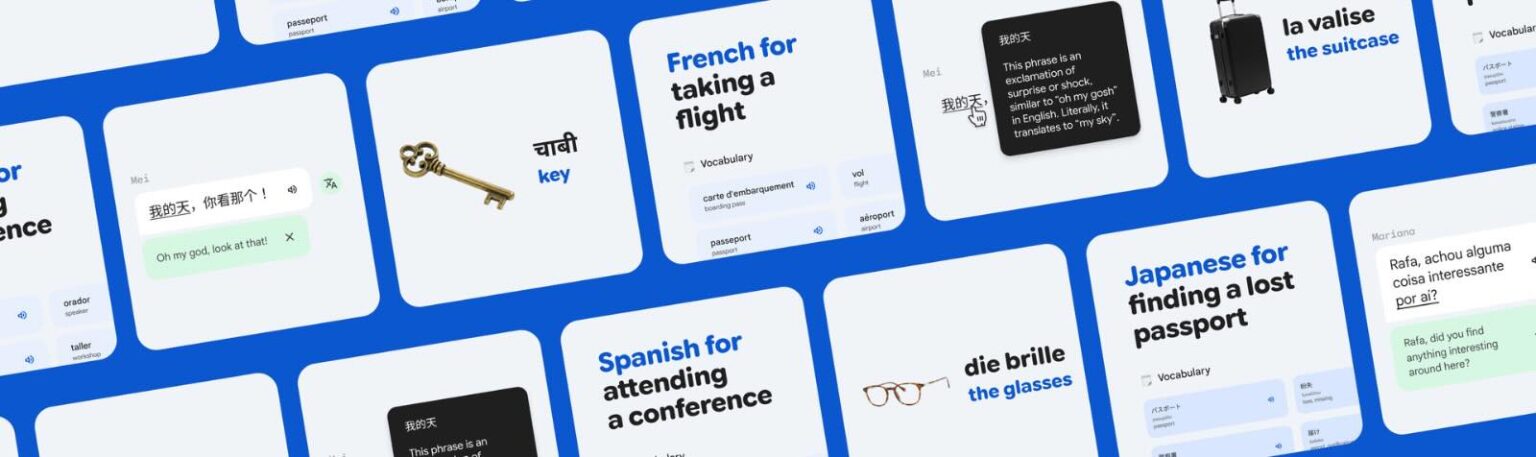
Google has quietly stepped into the language learning space with Little Language Lessons, an experimental tool developed under Google Labs that delivers AI-generated lessons in small, flexible doses. While it’s not a direct replacement for more established platforms like Duolingo, it does reflect Google’s growing interest in personal, adaptive learning experiences powered by generative AI.
Unlike traditional language apps, Little Language Lessons isn’t a standalone mobile app—it lives in the browser and is part of Google’s early-access experimental playground. To access it, users sign in with their Google account and agree to standard disclaimers about the experimental nature of the AI involved, including its potential for inaccuracies—a common caveat with generative tools.
Currently, Google offers support for 22 languages, with options for regional variants such as French (France vs. Canada) and different forms of Chinese, English, Spanish, and Portuguese. Once inside, users can explore three “experiments,” each offering a different way to interact with language content.
The first, Tiny Lesson, allows users to type in a specific purpose or theme—like “ordering food,” “taking a taxi,” or “going on a first date”—and receive vocabulary, useful phrases, and grammar tips relevant to that context. These lessons are highly customizable and can include spoken pronunciation guides, making them useful for travelers or anyone needing language support in specific real-world scenarios.
The second experiment, Slang Hang, explores informal language and regional expressions. After selecting a supported language, users are presented with short, AI-generated conversations that demonstrate how slang is naturally used. While this feature is still limited in its language coverage, it hints at a more immersive and culturally aware learning experience than traditional textbooks or apps usually provide.
Finally, Word Cam brings a visual element to the platform. Users can snap a photo with their device, and the AI will identify and label objects in the image in the selected target language. Clicking on each word brings up pronunciation, definitions, and usage examples. It’s a lightweight but clever way to tie vocabulary to real-world visuals, something few language apps currently offer with any sophistication.
Google positions Little Language Lessons as an exploratory tool rather than a full-scale competitor to Duolingo, but the overlap in functionality is clear. While Duolingo offers a gamified, structured path through language levels, Google’s approach is looser—more spontaneous and use-case-driven, designed to meet learners where they are instead of pushing them along a linear path.
Still, accuracy remains a sticking point. Because all content is AI-generated, users are warned that translations and explanations may not always be reliable. Unlike Duolingo’s human-reviewed curriculum, Google’s tool lacks built-in fact-checking, which could pose problems for beginners unfamiliar with a language. The casual, open-ended nature of the tool also means learners need to be more self-directed.
That said, for those comfortable navigating occasional AI quirks—and who want a more customizable learning experience—Little Language Lessons offers an intriguing alternative. Its photo-based vocabulary, real-life scenario lessons, and conversational slang generator present a fresh take on how language learning can be approached in the age of AI.
For now, it’s unclear whether Google intends to scale this into a full-fledged product or keep it as a low-stakes experiment. But in a time when the language learning market is expanding—and AI is increasingly shaping how content is created—Little Language Lessons feels like a glimpse of what the future of language tools might look like: flexible, personalized, and constantly evolving.