
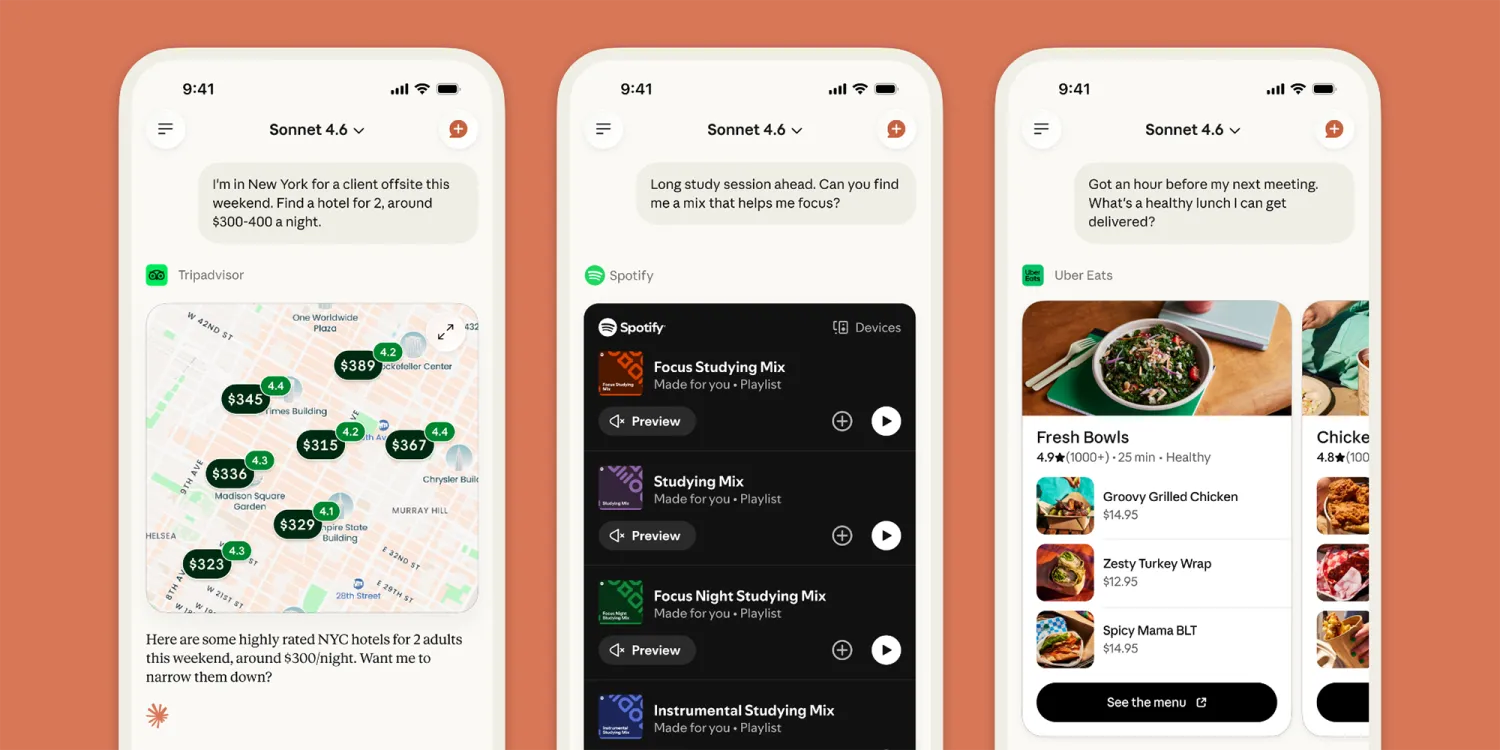
Anthropic has expanded Claude’s capabilities by adding direct integrations with a range of third-party services, allowing the AI to handle practical tasks from ordering dinner to offering music suggestions and assisting with basic tax estimates.
Announced this week, the new “connectors” mirror features already available in competitors like Google’s Gemini, reflecting a broader industry shift toward AI agents that interact with everyday apps rather than operating in isolation. The initial batch covers food delivery, travel, entertainment, and financial tools, giving users a way to delegate routine actions through natural language prompts.
Services now connected include Uber Eats and Instacart for grocery and meal delivery, Resy for restaurant reservations, and Uber for rides. Travel-focused options such as Booking.com, TripAdvisor, and Viator expand Claude’s utility for planning trips, while StubHub handles event tickets and Taskrabbit and Thumbtack connect users with local services. On the audio side, Spotify integration lets Claude recommend songs or podcasts and supports Spotify Connect to transfer playback across devices. Financial connectors include Intuit Credit Karma and TurboTax, the latter providing real-time tax estimates and refund projections based on Intuit’s core framework. Notably, Claude stops short of completing full tax returns, which remains a prudent limitation given the complexity and legal stakes involved.
These integrations arrive as AI assistants move beyond simple chat into more actionable territory. Early voice and text tools often felt like novelties, but deeper service connections raise the possibility of genuinely useful automation. At the same time, they introduce familiar concerns around data sharing, account permissions, and reliability. Handing partial financial or booking details to an AI requires trust that the underlying connections remain secure and that the model accurately interprets user intent without introducing errors.
The rollout positions Claude more competitively in a crowded field where every major AI provider is racing to embed itself into daily routines. Anthropic has emphasized measured development in the past, yet the pace of these announcements shows pressure to match features from OpenAI, Google, and others. For users, the immediate value will depend on how smoothly the connectors perform in practice—whether they save time or simply add another layer of setup and potential points of failure.
Expectations should remain tempered. While ordering food or pulling up tax estimates through conversation sounds convenient, real-world friction such as confirmation steps, payment handling, and edge cases will determine whether these tools become habits or occasional experiments. The company has indicated more connectors are planned, suggesting this is an ongoing expansion rather than a one-time addition.
In the wider context of 2026’s AI landscape, such integrations highlight a maturing but still uneven push toward helpful agents. They offer tangible steps forward in usability, yet also underscore the gap between marketing promises and dependable execution. For now, Claude’s connectors provide another option for those already in the Anthropic ecosystem, particularly users who value its generally cautious approach to AI behavior.