
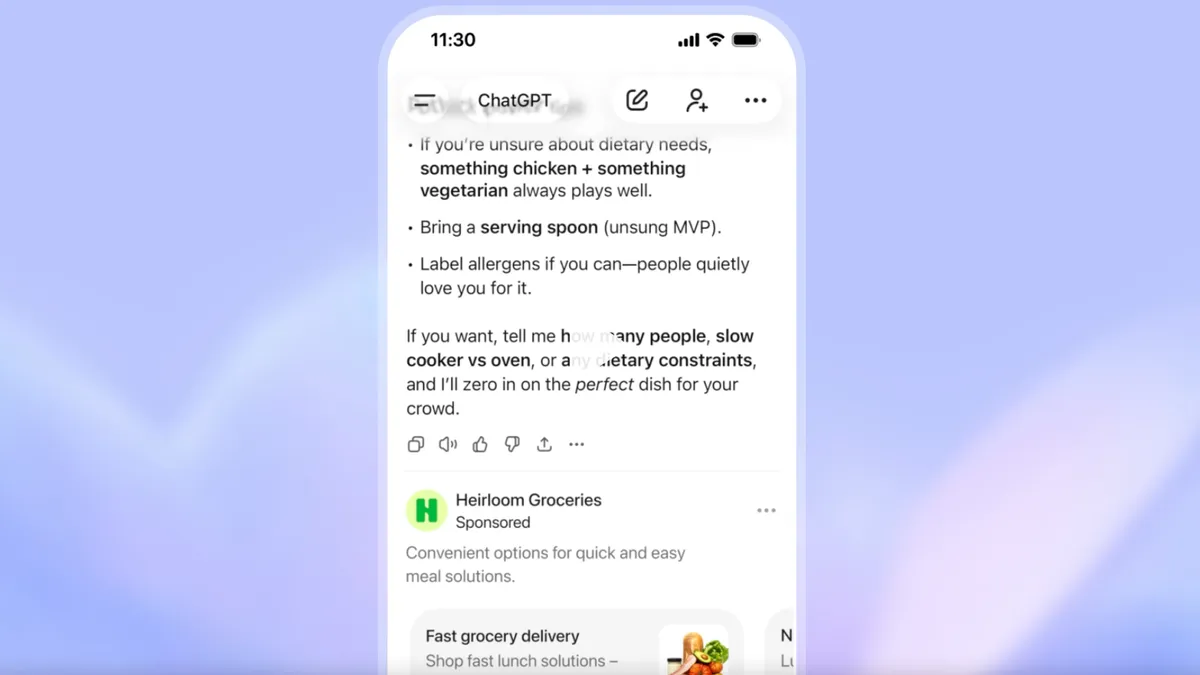
OpenAI has begun testing advertisements inside ChatGPT for users in the United States, marking the first time paid placements have appeared within the conversational interface. The rollout applies to users on the Free tier and the newly introduced lower-cost ChatGPT Go plan. Paid subscriptions, including Plus, Pro, Business, and Enterprise, will continue to operate without ads.
The change reflects a shift in how OpenAI is approaching monetization as usage scales and infrastructure costs rise. According to the company, advertising is being introduced as a way to subsidize free and low-cost access while maintaining continued investment in development and system capacity. OpenAI has stressed that this is an early-stage experiment rather than a finalized product decision.
Ads appear directly within chats but are visually separated from AI-generated responses and clearly labeled as sponsored. OpenAI says the placements are matched to the topic a user is already discussing, rather than being inserted arbitrarily. At the same time, the company says it has implemented safeguards to prevent ads from appearing in sensitive contexts such as health-related or political conversations.
Privacy has been positioned as a central concern in the rollout. OpenAI states that conversations and personal chat data are not shared with advertisers, and that ads do not influence how ChatGPT responds to user prompts. Users will also have some control over their ad experience, including options to limit personalization or opt out entirely in exchange for reduced access to free usage.
The company has framed this phase as a test-and-learn period, with feedback from early users expected to shape how advertising is refined or expanded. OpenAI has not committed to a broader international rollout or to making ads a permanent feature for free users, signaling that the approach could evolve based on reception and performance.
The introduction of ads comes amid wider pressure across the AI industry to establish sustainable revenue models. As conversational AI tools become more resource-intensive and competitive, companies are exploring different trade-offs between subscriptions, usage limits, and advertising. While some rivals have publicly ruled out ads as part of their long-term strategy, OpenAI’s move suggests that advertising may become one of several mechanisms used to balance accessibility with financial viability.
For users, the change represents a noticeable shift in how ChatGPT functions as a product. Whether ads are seen as a reasonable compromise for free access, or as an intrusion into what has largely been an uncluttered experience, is likely to determine how broadly the model is accepted as testing continues.