

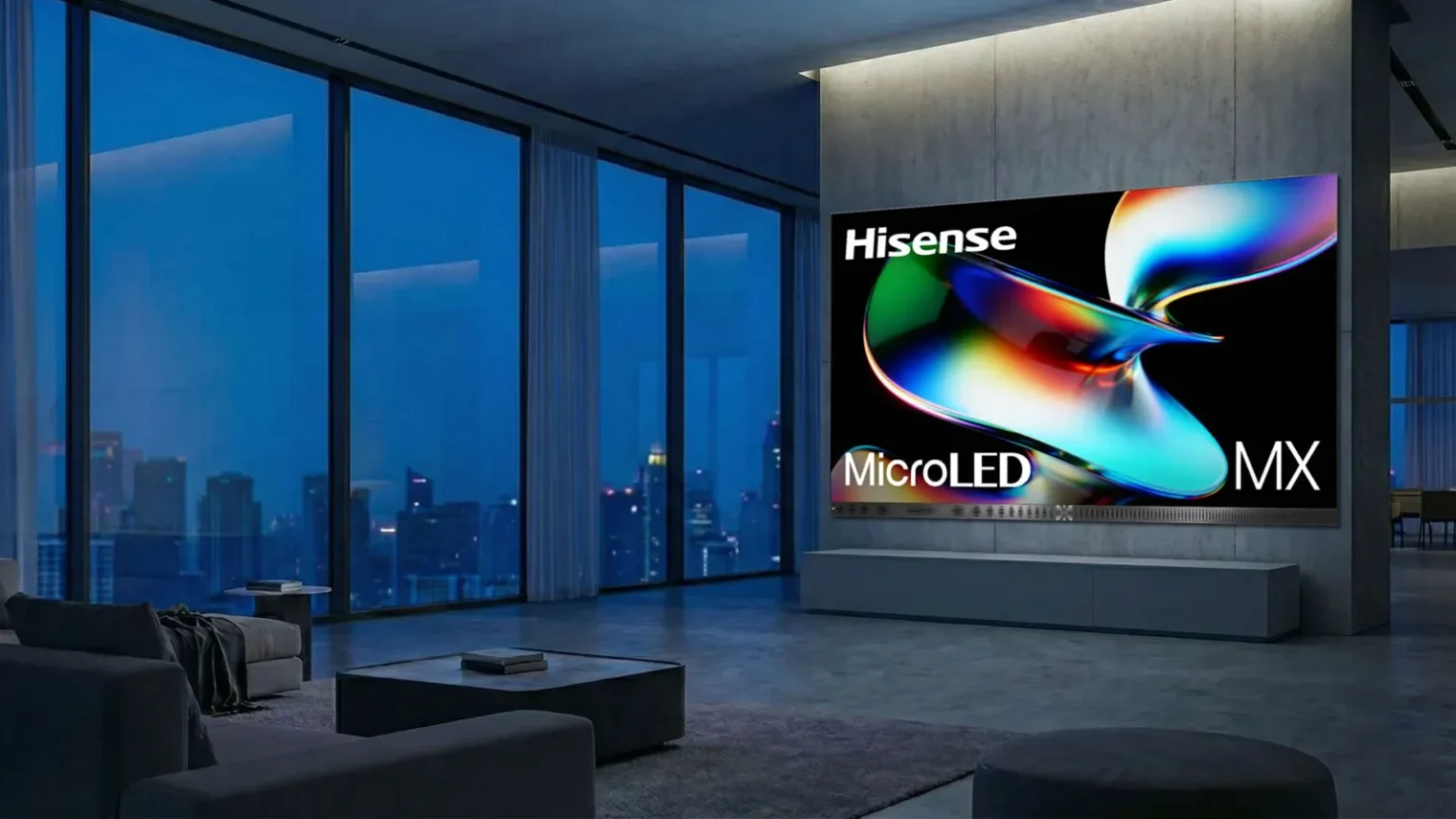
At CES 2026, Hisense introduced a Micro-LED television architecture that marks a technical departure from current industry norms. Alongside demonstrations of its latest Mini-LED Evo displays, the company revealed what it describes as the first Micro-LED TV system to use four primary colours rather than the conventional three. The approach, branded RGBY Micro-LED, adds a dedicated yellow element to the familiar red, green, and blue configuration.
Micro-LED technology itself is not new. It has been discussed and demonstrated for years as a potential successor to OLED and high-end LCD systems, largely due to its use of self-emissive microscopic LEDs that can deliver high brightness, long lifespan, and precise light control. Samsung was the first to publicly showcase Micro-LED in a consumer-facing form with its modular “The Wall” display at CES 2018, positioning the technology as scalable to extreme sizes. Since then, Micro-LED has remained largely confined to ultra-premium, large-format displays.
What differentiates Hisense’s CES 2026 announcement is not the scale of the panel, although its 163-inch Micro-LED model is clearly aimed at the luxury segment, but the addition of a fourth colour channel. By introducing yellow as a native emitter rather than relying on colour mixing alone, Hisense argues that the display can represent warmer tones, such as golds, ambers, and skin tones, with greater accuracy and less reliance on interpolation. The company frames this as an expansion of colour volume in areas where human vision is particularly sensitive to subtle variation.
In theory, adding a yellow primary could reduce the workload placed on red and green subpixels when rendering certain hues, potentially improving efficiency and colour stability at high brightness levels. Whether this translates into a visible advantage over existing high-end Micro-LED or OLED displays will depend on calibration, content mastering, and how consistently the additional colour channel is used across real-world material.
The idea of adding extra colour elements to displays is not without precedent. More than a decade ago, Sharp experimented with RGBY subpixel layouts in its Aquos LCD televisions, first shown at IFA 2010. Those sets used edge-lit LED backlights and were limited by the display technologies of their time. While conceptually related, Hisense’s implementation operates on a very different technical level, using self-emissive Micro-LEDs rather than filtered backlighting.
As with most Micro-LED announcements, practical considerations remain. Displays of this size and complexity are expected to be extremely expensive, and availability is likely to be limited. For now, RGBY Micro-LED appears less about immediate consumer adoption and more about signaling Hisense’s ambitions in the premium display market, particularly as rivals prepare their own next-generation panels.
With CES 2026 still ongoing and additional announcements expected from companies such as Samsung and LG, Hisense’s four-colour Micro-LED stands out as one of the more technically interesting developments from the show. Whether it represents a meaningful step forward or a specialized branch of display evolution will become clearer as the technology matures beyond demonstrations.