


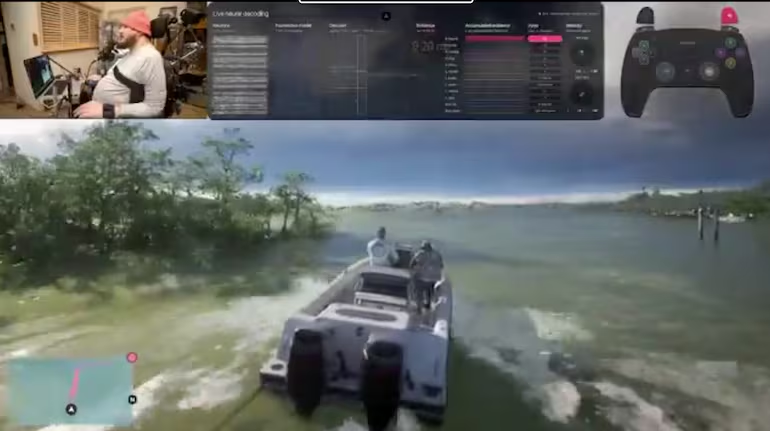

Neuralink has released a new demonstration of its brain implant, and this time the test is Grand Theft Auto VI. In a clip of about two minutes, a participant in the company’s clinical trial drives through the game’s streets and flies a plane without using a controller. He controls everything by imagining movements, which the implant decodes and turns into button presses.
The timing was deliberate. Neuralink posted the video on X on 20 November, one day after GTA VI launched on PlayStation 5 and Xbox Series X|S. Elon Musk then shared it to his own large following. Rockstar’s most anticipated release in years was the obvious choice for a showcase.
The mapping itself is the most interesting part. Imagining a tap of the ring finger registers as the square button. Imagining sliding the right hand forward pulls the plane’s nose up. An imagined foot movement is assigned to another input, though the footage doesn’t make clear what it does. An overlay shows the decoded signals live next to a DualSense controller graphic that lights up as each command lands. In practice, the system translates intended body movements into the controller layout the game expects.
The participant’s background explains why this matters to him. Before the implant, he used a computer with a mouth stick and an iPad, which left his jaw aching. He says he could control a computer right away after receiving the device, and describes it as getting his “portal to the world back.”
This builds on earlier demonstrations. Noland Arbaugh, Neuralink’s first human recipient, received his implant in January 2024. Two months later he showed cursor control and played chess, and he later spent time with Civilization VI. Those are slow, turn-based games. GTA VI requires constant, simultaneous inputs in real time, which is a much harder test of the decoding.
There are important caveats. The device is investigational, is not approved by the FDA or any other regulator, and is available only to trial volunteers. Neuralink itself cautioned that individual experiences may not reflect how the implant works for others. The company also hasn’t said which console was used or how the system connects to it, although the DualSense graphic points toward a PS5. It has published no figures on latency, command accuracy or calibration time. Without those numbers, outside observers can’t judge reliability. The clip is a curated demonstration by the company, not an independent evaluation.
Brain-computer interfaces from Neuralink, Synchron and academic groups like BrainGate are moving toward everyday use, and gaming is becoming a convenient public benchmark. The bigger question is whether control this precise holds up for hours rather than minutes, and for patients who aren’t in a carefully managed trial.