
TL;DR: Fincher makes Tarantino’s first sequel look terrific, and Pitt is as magnetic as ever, but the plot only starts at the 90-minute mark and most of the cast is wasted. It’s a pleasant Netflix hangout movie, not the next Once Upon a Time.
This is the kind of team-up film nerds usually only get in late-night “what if” threads. Quentin Tarantino writes, David Fincher directs, and Brad Pitt comes back as the most quietly dangerous stuntman in Hollywood lore. It’s Tarantino’s first true sequel, and the first time since From Dusk Till Dawn in 1996 that he has given one of his scripts to another director. For Fincher, it’s his first sequel since Alien 3 and the last film under his Netflix deal. That’s a lot of trivia piled onto one movie, and honestly, the story of how it got made is more gripping than a good chunk of what ends up on screen.
The setup jumps to 1977, eight years after Cliff and Rick Dalton wrecked the Manson Family’s plans in Tarantino’s alternate history. Rick is off working on an Australian TV series, so Cliff gets by on a patchwork of jobs: managing and running the projector at L.A.’s New Beverly Cinema, tending bar at a dive, and doing the odd shady fixer job for Hollywood types. In between, he watches old movies at home with his father, played by Peter Weller. It’s a lovely, lived-in starting point for a character study. The problem is that the movie seems happy to stay at the starting point for most of its running time.
A hangout movie that leaves its plot parked for 90 minutes
The story you’d expect a film like this to have only shows up around the 90-minute mark, and by then there’s roughly 45 minutes left. That’s when Scott Caan’s ’70s TV star Charlie Peters hires Cliff to help him back out of a deal with some Filipino mobsters, and the movie finally has somewhere to go. Before that, it’s pure hangout cinema: Cliff drifting between gigs, a burst of brutal violence here, a bit of flirting there, and slowly, the people who’ll matter in the last act come into his orbit. It plays like spending hours on the substories in a Yakuza game while the main quest sits untouched on the map. Sometimes that’s the best part of the game. Other times you just want Kiryu to get on with it.
How much patience you have here depends entirely on how much you like Cliff as company. For me, the opening stretch has real pleasures: the period texture, the projection booth, and Tarantino’s obvious love for a version of Los Angeles that lives on reels and late-night TV (fittingly, he owns the real New Beverly). But a hangout movie needs either a big supporting cast or a slow-burning sense of danger to keep things moving, and this one has much less of both than its predecessor. By the time the plot wakes up, the payoff feels rushed rather than earned.
Brad Pitt’s Cliff Booth is still magnetic, but a myth makes a thin lead
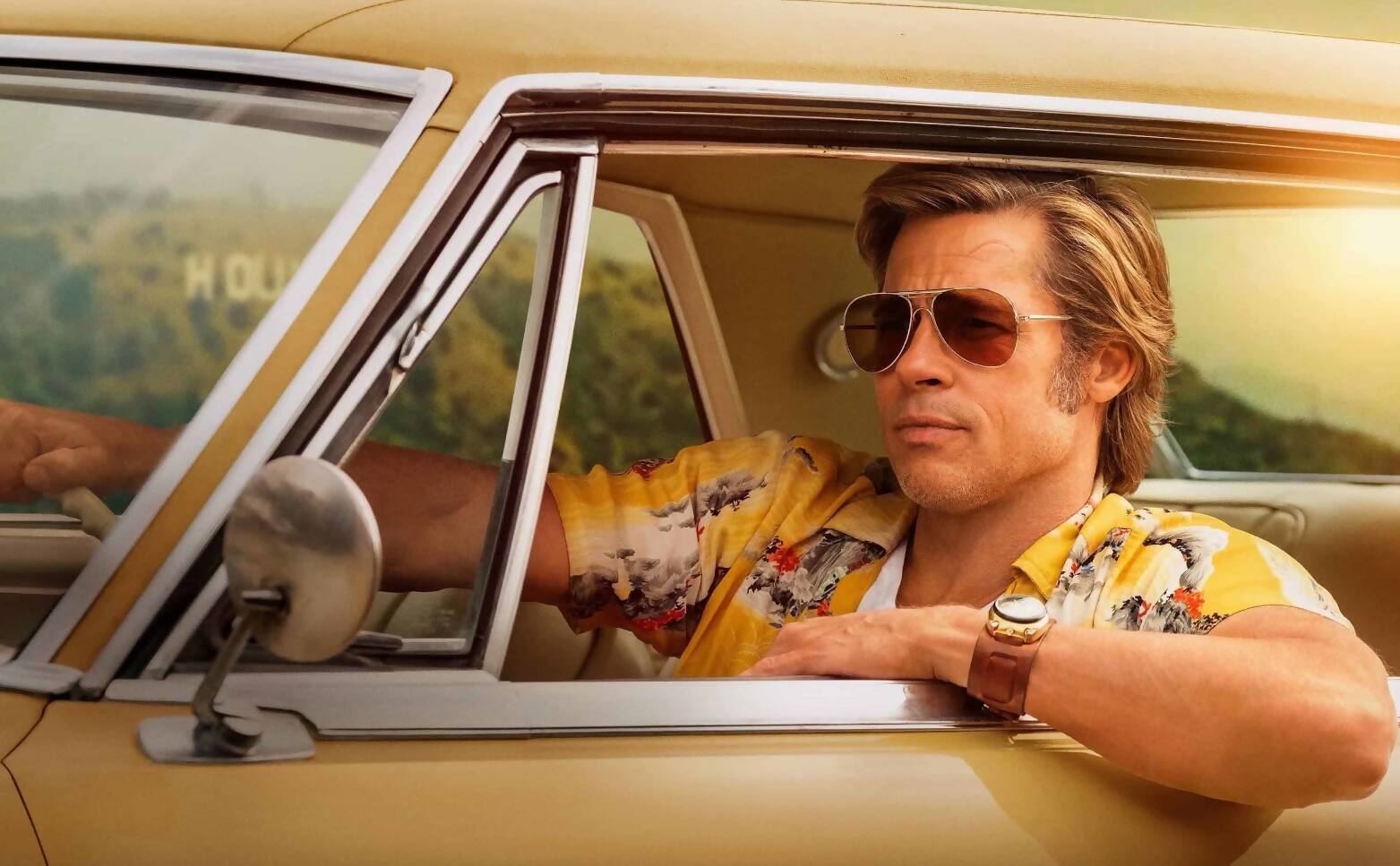
Pitt won an Oscar for this role, and he steps back into it effortlessly. The easy, sun-faded calm is still there, with that faint hint of violence underneath that tells you the friendliest guy in the room is also the most dangerous one. The film adds a lot of backstory through Cliff’s stories and anecdotes, and some of them are very funny. None of them change him, though. He ends the movie the same man he was at the start, which suits a character who loves episodic TV but makes for a static lead in a feature film.
I think the trouble is that Cliff has always worked best as a legend glimpsed from the side. Next to Rick Dalton’s fragile, sweaty insecurity, his calm read as cool. Put at the center, he’s mostly vibes with no tension to push against. The scenes with his father look like the most promising way in, a chance to see where his toughness came from, but Weller fades out after a few early scenes and never connects to the main story. It feels like a deleted subplot that someone forgot to cut.
Elizabeth Debicki shines while the rest of the cast waits for material
The supporting cast is full of strong actors who are given almost nothing to do. Carla Gugino plays Charlie’s wife, who has a history with Cliff, and that history never goes beyond a hint. Yahya Abdul-Mateen II plays a Blaxploitation star with enough charisma to carry his own spinoff, yet he mostly hovers at the edges. Caan does fine as the guy who sets off the plot, but Charlie is a function more than a person. Timothy Olyphant comes back as Jim Stacy for a cameo short enough that most viewers will miss it.
Elizabeth Debicki, as the sharp Hollywood agent Crosby, is the one who breaks through. She and Pitt have a teasing, guarded chemistry that gives the film its liveliest scenes, and it’s the only relationship that hints Cliff might be able to change. Unfortunately, the movie leaves that thread hanging once it has to hurry into its violent finale. If the script had built itself around those two, this could have been a far more interesting sequel.
More Tarantino than Fincher, and a natural fit for Netflix
Anyone expecting the chilly precision of Zodiac or Gone Girl should adjust. This is a Tarantino film from start to finish, opening with a recreated Blaxploitation movie called Soul Brothers Die Hard!! and full of the loose, digressive dialogue he made his name on. Fincher’s touch comes through mostly in how good everything looks: the occasional shot with a razor-thin depth of field, and a climactic action sequence with real punch. He shoots it all beautifully, but he never seems to put his own stamp on the material. It’s the work of a master craftsman acting as a very expensive translator.
Netflix may be the best place for this film. It’s a movie made mostly of people talking in bars, projection booths and living rooms, and that kind of storytelling fits your couch better than a crowded cinema. Watching at home also takes some of the sting out of the slow first 90 minutes, which feel less like a test of patience and more like an evening hanging out with Cliff. You can pause, grab a drink, and settle into its rhythm the way you would with one of the old TV shows he loves. As Fincher’s last film for Netflix, it’s a fittingly low-key goodbye: polished, easy to watch, and unlikely to keep you up at night.
Verdict
The Further Mis-Adventures of Cliff Booth isn’t a bad movie. It has sharp dialogue, gorgeous images, a confident Brad Pitt, a standout Elizabeth Debicki and a finale that delivers. What it lacks is a story strong enough to justify bringing these people back together, along with the supporting cast and underlying menace that made Once Upon a Time… in Hollywoodso absorbing. Tarantino completists and Cliff Booth devotees will find plenty to enjoy on Netflix. Anyone expecting the next great film from either of these directors should keep expectations modest.