

Oppo has spent the last few years putting its best smartwatch hardware into round designs, so the Watch 5 marks a change of direction. Announced in China on November 15, it brings back a rectangular display, something the company’s lineup hasn’t featured in a while. It also leans more toward fitness tracking than smartwatch features.
The screen is a 1.85-inch AMOLED panel at 390 x 450 pixels with a 60Hz refresh rate. Oppo rates it at 600 nits typical brightness and up to 1,500 nits peak, which should hold up well in direct sunlight. Gorilla Glass 5 covers the display, and the frame is aluminum. At 9.2mm thick and 25 grams without the strap, it’s light enough to wear overnight. That matters, because sleep tracking is one of its core features
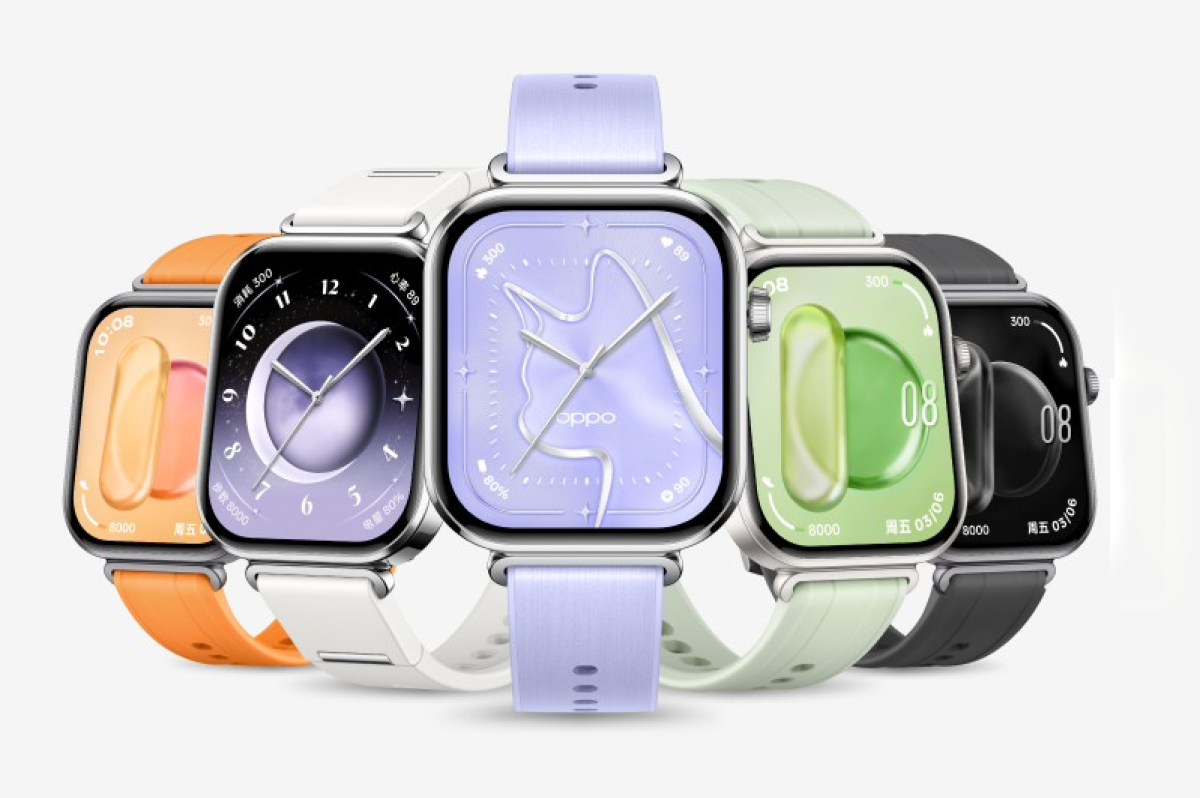
Under the glass is a BES2710IBP chipset running ColorOS Watch 17, Oppo’s own wearable platform, rather than Google’s Wear OS. That choice explains much of what the Watch 5 offers. Chips from Bestechnic usually favor power efficiency over raw performance. Proprietary watch platforms tend to give up broad third-party app support in return for longer battery life. Oppo rates the 351mAh cell at up to seven days between charges, a big improvement over the one-to-two-day range typical of full Wear OS watches.
The health suite includes heart rate, blood oxygen, sleep, stress and skin temperature monitoring, plus more than 100 activity modes. Built-in GPS means runners and cyclists can leave their phones at home. Durability ratings are strong: IP68 and IP69 against dust and water jets, plus 5ATM water resistance for swimming. Bluetooth 5.2 handles the phone connection. NFC supports Alipay and WeChat Pay, and Oppo’s Xiaobu voice assistant is built in. Both of those features point to a product designed for the Chinese market first.
That leads to the biggest open question. Oppo has not shared pricing or any plans for international availability. If the Watch 5 does launch globally, the payment and assistant features would likely change or disappear, as often happens with China-first wearables.
The Watch 5 enters a busy segment. Huawei’s Watch Fit series and Xiaomi’s Redmi Watch line already offer rectangular, battery-focused fitness watches at aggressive prices, and both have broad international distribution. Oppo’s specs are competitive on paper, especially the bright display and dual ingress ratings. Pricing will likely decide whether it can stand out, and whether this return to a square design continues beyond China.