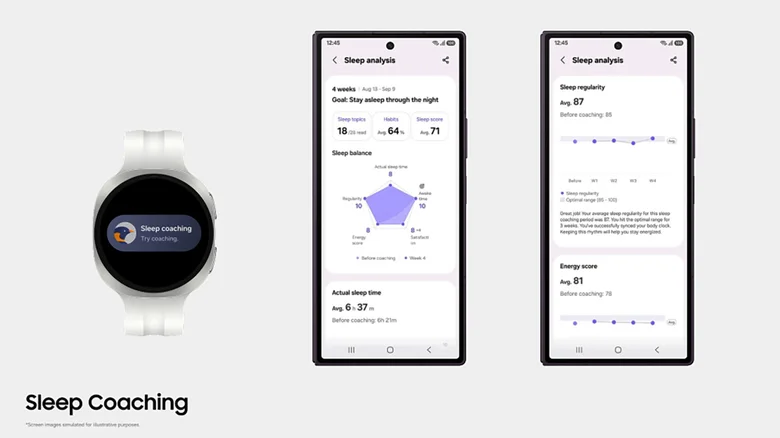
Samsung is lowering the barrier to entry for its Sleep Coaching feature in Samsung Health. Until now, the program needed a full week of consecutive sleep data within a month before it would start. That is a bigger hurdle than it sounds for anyone who charges a watch overnight or skips wearing it on weekends. The new requirement is three nights of tracked sleep from the previous two weeks.
The update supports Galaxy Watch 4 models and newer, along with the Galaxy Fit 3 and Galaxy Ring. Setup starts with a questionnaire about how consistent your sleep schedule is, how often you wake during the night, how much caffeine and alcohol you consume, and how satisfied you are with your rest. Samsung combines those answers with your tracked data to assign one of its Sleep Animal profiles and build a coaching plan that runs four to eight weeks.
The animal archetype approach will be familiar to Fitbit users, and it is mostly framing. The more meaningful change is that the program adjusts weekly recommendations as your patterns change, rather than following a fixed script. Daily checklists cover standard sleep hygiene advice, such as reducing screen time and caffeine late in the evening or getting outside for some light stretching after waking. Samsung says the guidance is grounded in behavioural sleep science, though the advice itself is not new.
Reporting is also being redesigned. A five-point Sleep Balance chart maps sleep duration, regularity, time spent awake overnight, self-reported satisfaction and Samsung’s Energy Score, with the aim of showing where your sleep is falling short. Morning messages summarise the previous night and suggest changes. How useful those suggestions are will depend largely on how accurately a wrist or finger sensor reads your night, which is still an approximation compared with a clinical sleep study.
Runners also get a few changes. Running Coach now has 12 levels instead of 10, giving intermediate and experienced runners more room to progress before reaching the top of the program. Sharing options for personal bests, milestones and routes have been expanded. The most practical addition is Strava integration, which lets users bring saved Strava routes for running, trail running and cycling into Samsung Health.
That partnership matters more than it may seem. Serious athletes tend to keep their data in Strava regardless of which watch they wear, so opening that connection makes Samsung’s platform less of a walled garden. The features begin rolling out this month. Whether three nights of data is enough for meaningful personalisation, rather than just a faster start, will become clearer once people work through the full program.