
TL;DR: Dark Matter Season 2 episode 7 splits its cast across worlds, with Charlie’s grief-fuelled search for his twin and Amanda’s desperate escape delivering real emotional stakes. It’s fragmented and occasionally confusing, but it sets up the final stretch effectively.
Seven episodes into its second season, Apple TV’s Dark Matter has stopped pretending its multiverse is tidy. Most of the main cast are now separated, and many are tangled up with alternate versions of themselves. Episode 7 doesn’t try to untangle any of it. It splits its attention between two very different journeys through the box and trusts the audience to keep up. That’s a bold move for a show that began as a fairly contained identity thriller, and I respect it, even when it leaves me wishing I’d kept a whiteboard next to the sofa like I was tracking timelines in Netflix’s Dark.
The upside of this sprawl is that the season finally feels like it’s exploring the full weight of its premise rather than circling one man’s nightmare. The downside is obvious. When every character can exist in several flavours at once, the emotional through-line has to work twice as hard to stay visible. Episode 7 handles this by keeping its focus narrow within each thread, and that choice is why the hour mostly works. It isn’t the cleanest episode of the season, but it’s one of the more purposeful ones, because both of its major storylines are driven by something deeply personal rather than plot mechanics.
Charlie’s solo trip into the box is the season’s most human storyline yet
The strongest material belongs to Charlie (Oakes Fegley), who goes into the box alone to search for Max, a twin brother who died at the age of four in Charlie’s own world. This is the Dark Matter premise boiled down to its rawest form. The whole series is about roads not taken, but here the road not taken is a sibling Charlie never got to grow up with, and that turns a sci-fi gimmick into grief with a doorway attached. His first solo voyage carries real dread, because the box has never felt like a place where a teenager should be wandering unsupervised. When he shuts his eyes and asks for help, the moment lands as both desperate and oddly hopeful, which is exactly the tone this storyline needs.
Where he ends up is the episode’s most intriguing stop: the home of Laurel, played by Margo Martindale. She has a welcome sign up, offers Charlie advice on finding Max, and radiates the kind of calm that suggests travellers through the corridor are not new to her. Casting Martindale is a smart bit of shorthand, because she can make kindness feel completely sincere while leaving you unsure what’s going on behind it. Her house plays like a safe room in a survival horror game, the one quiet space where a strange NPC hands you a clue before you head back into the dark. Then a door opens, Charlie sees someone the camera refuses to show us, Laurel tells him it’s okay, and he leaves with his mission intact. Withholding that reveal is a cheap trick on paper, yet it works here because his reaction makes it clear the visitor matters to him.
Amanda and Ryan’s plague-world escape trades nuance for adrenaline
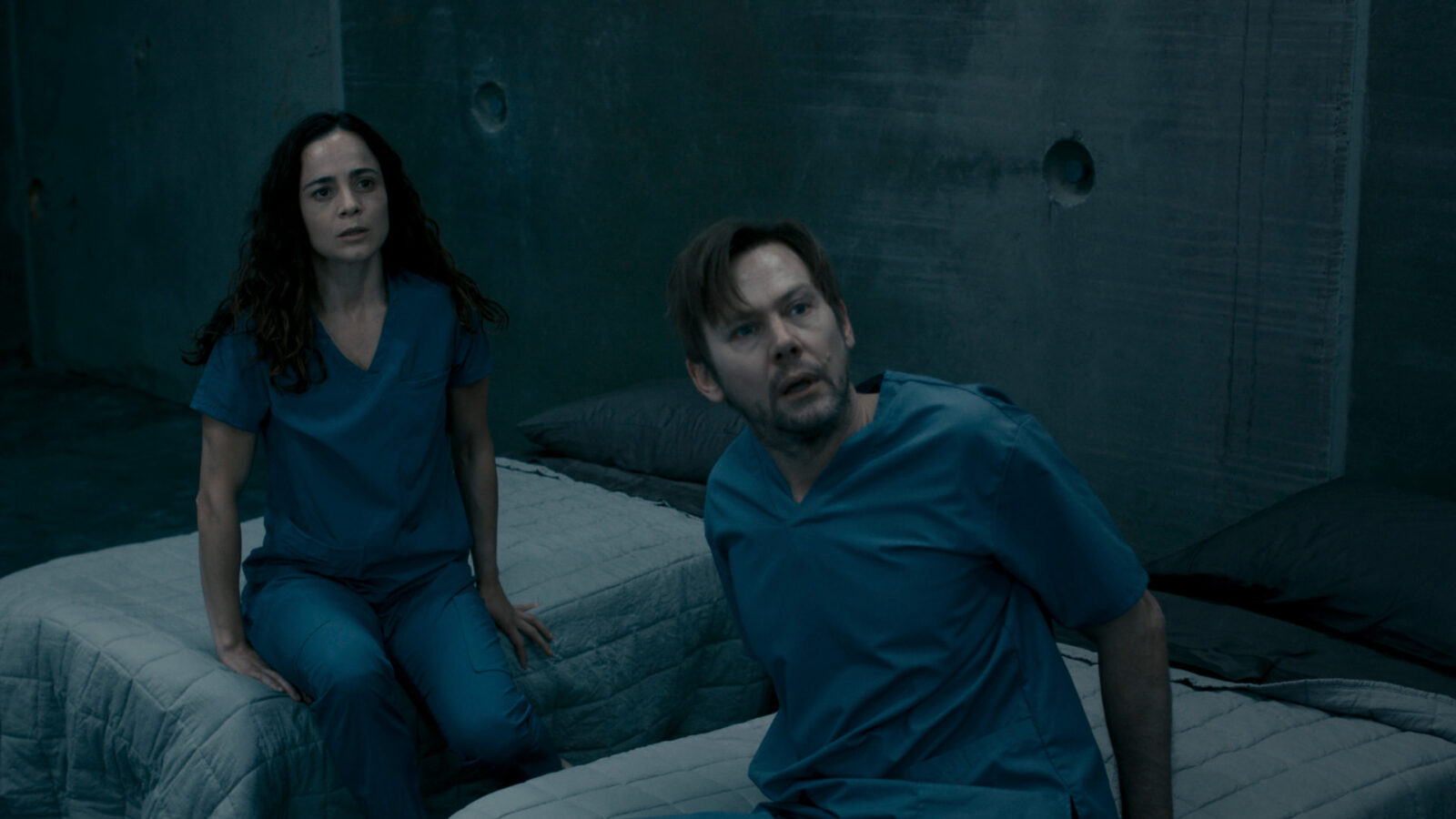
The second thread is louder and more conventional. Amanda (Alice Braga) and Ryan (Jimmi Simpson), captured in a plague-ravaged world in the previous episode, attempt a breakout with help from Leighton (Dayo Okeniyi). This is Dark Matter in action-movie mode, and the shift in energy is welcome after Charlie’s quieter, more introspective journey. The pacing tightens, the goal is simple, and for once the show gets to be a straightforward escape thriller rather than a philosophical puzzle box.
That simplicity is also its limitation. The plague world has only been around for two episodes, so it registers more as a dangerous level to clear than a fully realised place with its own texture. The thread closes on a last-second twist that leaves Amanda’s fate genuinely uncertain as Ryan pushes them onward into another world. It’s an effective cliffhanger, largely because Amanda has been one of the series’ steadiest anchors since the first season, and Braga has always given her a grounded intelligence that keeps the multiverse from floating off into abstraction. Putting her in danger raises the stakes far more than another alternate Jason ever could.
The pacing, the structure and the cost of splitting everyone up
Coming off a strong standalone fifth episode and the earlier fracture caused by Daniela’s departure, this stretch of Dark Matter Season 2 has committed to fragmentation. Cutting between Charlie’s eerie, introspective search and Amanda’s frantic escape creates a nice contrast in rhythm, one quiet and uncanny, the other urgent and physical. When the cross-cutting clicks, it recalls the best alternate-world episodes of Fringe, where every parallel reality earned its screen time by revealing something about the people inside it. When it doesn’t, the hour feels like two separate episodes sharing a running time.
Who gets the most out of this? Viewers who enjoy puzzle-box television and don’t mind questions piling up faster than answers will have plenty to chew on. Anyone who fell for the tight, single-protagonist thriller of season one may find the scattered structure frustrating, especially with the main leads less central to this particular hour. The show is clearly building toward a convergence in its final episodes, and the success of episode 7 will ultimately depend on whether those threads come together with emotional payoff rather than just a satisfying plot click.
Verdict
Dark Matter Season 2 episode 7 is a messy but meaningful chapter that understands what makes its multiverse worth exploring: personal loss, longing and the terror of not knowing what’s behind the next door. Charlie’s search for Max gives the season its most affecting storyline, and Margo Martindale’s Laurel adds a welcome layer of mystery. Amanda and Ryan’s escape injects momentum and a genuinely tense cliffhanger, even if the plague world itself feels underdeveloped. The fragmented structure will test patience, and the withheld reveals lean heavily on next-week bait. Still, for fans already invested in the Apple TV series, this is a strong setup episode that makes the remaining run feel essential.