
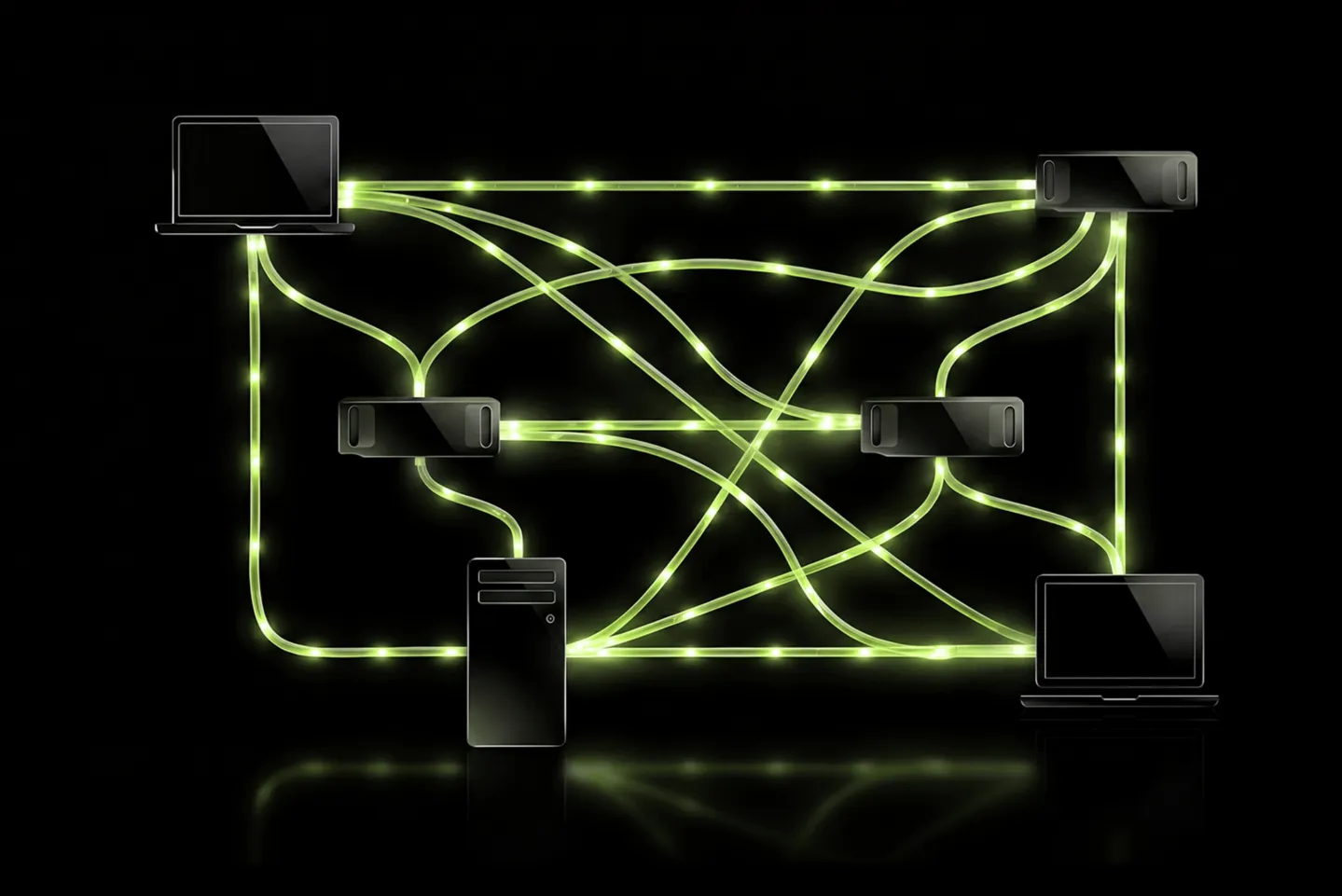
Nvidia wants to turn the collection of powerful computers sitting around your home into something resembling a miniature AI compute cluster. Its new Personal AI Router, or PAIR, is free open-source software designed to connect compatible machines on the same network and distribute local AI workloads between them.
Despite the name, there is no new Nvidia router to buy. PAIR is software that discovers supported computers, links their available processing resources and coordinates AI inference tasks across those systems. It is intended to work with local AI platforms including Ollama and LM Studio, potentially making existing hardware more useful without sending every workload to the cloud.
Support covers Nvidia GeForce RTX 20-series GPUs and newer hardware, alongside RTX Pro GPUs and Nvidia DGX Spark systems. Interestingly, Nvidia is not keeping the network entirely within its own hardware ecosystem: Macs powered by Apple M4 chips or newer are supported as well.
The basic idea is to make use of computing power that would otherwise be sitting idle. PAIR can assign work to available machines and adapt as computers enter or leave the pool. If someone starts gaming on an RTX-equipped desktop, for example, the system is designed to adjust rather than continuing to consume resources needed by the active user.
That approach becomes particularly relevant for AI agents. Instead of sending one enormous job to a single GPU, agentic systems can break a complicated request into multiple smaller tasks. PAIR allows those jobs to be processed in parallel across different computers, potentially reducing the bottleneck created when everything depends on one machine.
Nvidia’s example imagines a household with several unusually powerful systems — including RTX laptops, a DGX Spark desktop, a gaming PC and an Apple Silicon MacBook. That is obviously not a typical collection of family computers, and PAIR’s usefulness will depend heavily on how much compatible hardware someone already owns.
Still, the underlying concept is interesting because consumer AI is increasingly moving in two directions at once. Cloud services provide access to enormous models without requiring expensive hardware, while local AI promises greater privacy, offline availability and more direct control over data. PAIR attempts to make the second option more practical by treating several existing devices as one pool of computing resources.
There are practical questions that will matter beyond Nvidia’s demonstration. Performance will depend on the hardware available, network conditions and how effectively workloads can be divided between systems. A cluster assembled from mismatched household computers is not suddenly equivalent to a dedicated AI data centre simply because the machines can communicate.
But PAIR could make owning multiple powerful computers considerably more useful for enthusiasts experimenting with local models. Instead of choosing which machine gets an AI workload, Nvidia wants every idle GPU in the house to become available. For households already filled with expensive silicon, that unused computing power may finally have another job.