
TL;DR: The Paper Season 2 gets funnier, messier and more romantic while finally establishing an identity beyond The Office. Not every big comedic swing lands, but its excellent ensemble and Ned-Mare relationship make this a stronger, more confident workplace comedy.
Escaping the shadow of The Office was always going to be The Paper’s real performance review. The mockumentary format, awkward workplace dynamics and Greg Daniels connection make comparisons practically unavoidable, but Season 2 increasingly behaves like a sitcom confident enough to stop constantly checking whether Scranton approves. Its solution is surprisingly simple: make everything messier. Relationships become complicated, jokes become bigger, the Toledo Truth Teller becomes more chaotic, and workplace boundaries apparently get shredded faster than yesterday’s classified ads.
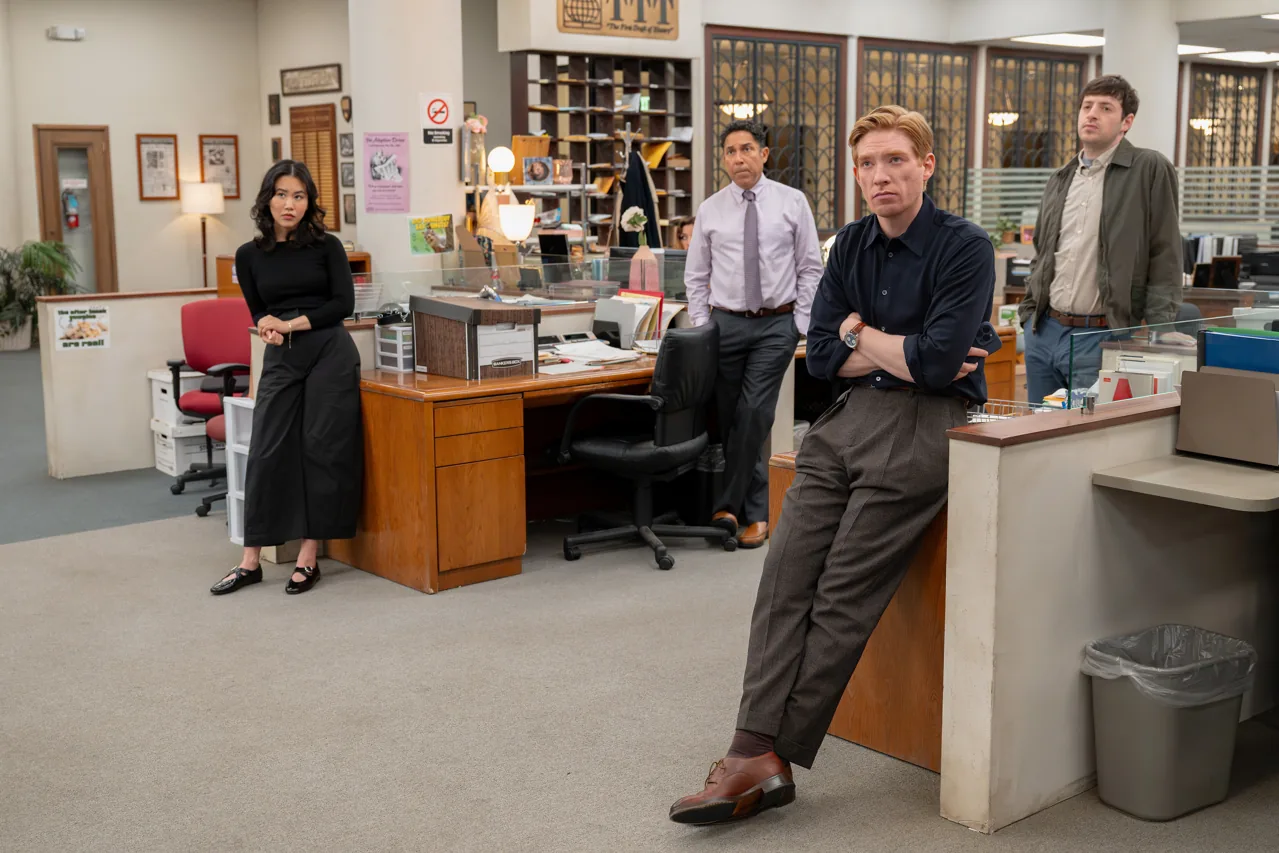
The second season, streaming September 9 on Peacock, puts Ned (Domhnall Gleeson) and Mare (Chelsea Frei) at the centre after the Truth Teller’s journalism-awards success. Their relationship has moved beyond romantic tension into an actual romance, giving the series something sitcoms weirdly struggle with: figuring out what happens after two characters finally get together. Around them, almost everyone else seems determined to make HR earn overtime, resulting in a season obsessed with relationships without completely abandoning the struggling newspaper that made this spin-off interesting in the first place.
Ned and Mare give The Paper Season 2 its emotional backbone
The smartest thing Season 2 does with Ned and Mare is refuse to spend another year grinding through the traditional will-they-won’t-they side quest. They’re together, they’re trying to make it work, and now the comedy comes from discovering that sharing values and attraction doesn’t magically unlock Relationship: New Game+ with all difficulty settings disabled.
Their shared commitment to journalism gives the romance more substance than simply pairing two attractive sitcom characters because viewers expect it. Work continually bleeds into their personal lives, whether they’re dealing with professional disagreements, jealousy or the inconvenient reality that running an understaffed newspaper isn’t exactly compatible with maintaining healthy boundaries. That overlap allows the series to make their romance part of its workplace comedy rather than something occurring in a separate narrative bubble.
Gleeson remains an excellent fit for Ned’s combination of capability and barely contained panic, while Frei gives Mare enough confidence to prevent the relationship becoming entirely Ned’s story. Together, they’re sweet without becoming unbearably sugary, and their disagreements make sense because these are two people with similar passions but different personalities. Season 2 eventually reaches for a more conventional relationship obstacle built around miscommunication, which feels disappointingly safe after spending so much time intelligently exploring what being together actually means.
Everyone at the Truth Teller apparently caught the romance debuff
Ned and Mare would provide more than enough romantic chaos for one workplace. The Paper, naturally, looks at that perfectly reasonable amount and chooses maximum difficulty.
Esmeralda (Sabrina Impacciatore) and Ken (Tim Key) develop their own bizarre quasi-romantic dynamic, while Oscar Martinez attempts to charm a nursing-home employee. Detrick (Melvin Gregg), Adelola (Gbemisola Ikumelo), Nicole (Ramona Young) and Troy (Eric Rahill) also become tangled in various crushes and romantic complications, while even CEO Marv (Allan Harvey) gets involved before the season is finished. It’s an impressive amount of workplace thirst for a newspaper presumably facing more pressing financial concerns.
Individually, these threads provide opportunities to expose different characters’ insecurities and eccentricities. Collectively, however, they occasionally make Season 2 feel overcrowded. The Paper works best when its characters’ personal disasters collide with the actual business of journalism; when everybody becomes consumed by romance simultaneously, the Truth Teller risks becoming merely the building where these relationships happen.
That’s particularly frustrating because the newspaper remains the show’s most valuable differentiator. Plenty of sitcoms can generate romantic chaos. Far fewer are centred on people trying to keep local journalism functioning with limited resources while producing something their community actually needs. Season 2 hasn’t forgotten that identity, but I wish it trusted that material as enthusiastically as it trusts office romance.
The comedy gets bigger, stranger and considerably riskier
Season 2 also expands the show’s comedic scale. The mockumentary DNA remains visible, but The Paper is increasingly willing to stretch beyond restrained workplace awkwardness and embrace outright farce. Sometimes it feels like the writers discovered the chaos slider in the settings menu and immediately dragged it to 100.
That produces a deliberately uneven hit rate. Esmeralda disguising herself as a teenage boy while investigating her son’s school pushes the absurdity far enough that the premise starts fighting the joke. Elsewhere, though, the bigger swings deliver exactly the kind of beautifully stupid commitment great workplace comedy needs: Ned escalating a fake rat-bite situation far beyond common sense and employees using condiments to reconstruct a crime scene are wonderfully ridiculous concepts because everyone involved treats the nonsense seriously.
That commitment is essential. Broad sitcom comedy collapses when characters appear aware they’re participating in a gag; The Paper is much funnier when its employees believe whatever lunacy they’re doing is a completely defensible response to the problem. The results aren’t consistently elegant, but I’ll take a comedy willing to fail spectacularly while chasing a memorable joke over one permanently stuck farming safe chuckles.
Lisa Gilroy is exactly the HR nightmare this office deserves
Season 2 expands the Truth Teller ecosystem with new characters, and Lisa Gilroy’s HR representative Lisa sounds like the standout addition. Competent enough to technically perform her job while being wildly inappropriate enough to create entirely new problems is basically the perfect character specification for this universe.
Gilroy joins a cast that already understands how to weaponise personality clashes. Sabrina Impacciatore continues to make Esmeralda’s desperate appetite for attention a reliable source of chaos, while Tim Key’s Ken provides another useful disruption to the office chemistry. Andy Richter appears as a temporary romantic possibility for Esmeralda, while Jon Lovitz joins as another new colleague.
The additions also signal that The Paper is building a sufficiently populated comedy sandbox to survive without relying entirely on inherited Office associations. That’s important for the show’s longevity. Workplace sitcoms become special when even supporting characters can enter a scene and instantly alter its energy, and Season 2 seems increasingly comfortable assembling that kind of ensemble.
The Office nostalgia is becoming The Paper’s safety blanket
Unfortunately, The Paper still can’t completely resist looking over its shoulder at Dunder Mifflin. There are story beats and character gimmicks throughout Season 2 that inevitably recall The Office: employees being reassigned, elaborate workplace celebrations, disguises, stalking-adjacent romantic insanity and even fat-suit comedy. With so many Officeveterans involved behind the scenes, some shared comedic instincts are inevitable.
The problem isn’t that these echoes exist. The Office remains one of television’s defining workplace comedies, and pretending this series has no connection to it would be ridiculous. The problem is that The Paper no longer needs the reassurance.
Two seasons in, Toledo has its own dysfunctional ecosystem, its own characters and a premise capable of generating stories Scranton never could. Local journalism provides fertile territory involving community politics, shrinking resources, ethical conflicts, dying print traditions and the bizarre personalities attracted to a profession permanently fighting for survival. Whenever The Paper embraces that identity, it feels like a successor rather than an expansion pack.
Verdict
The Paper Season 2 succeeds because it’s becoming more comfortable taking risks. Moving Ned and Mare directly into a relationship gives the central romance somewhere meaningful to go, while the broader ensemble and increasingly ambitious comedy produce enough inspired chaos to make the Truth Teller worth revisiting.
Not every experiment survives peer review. The sheer number of romantic subplots occasionally overwhelms the journalism angle, some larger comedic swings miss badly, and familiar Office tricks increasingly feel unnecessary now that The Paper has developed an identity of its own. But the cast is strong, the central relationship works, and the willingness to become bigger and stranger suggests a sitcom still discovering how funny it can be. It’s time to stop worrying about being the next Office and concentrate on becoming the best version of The Paper.