
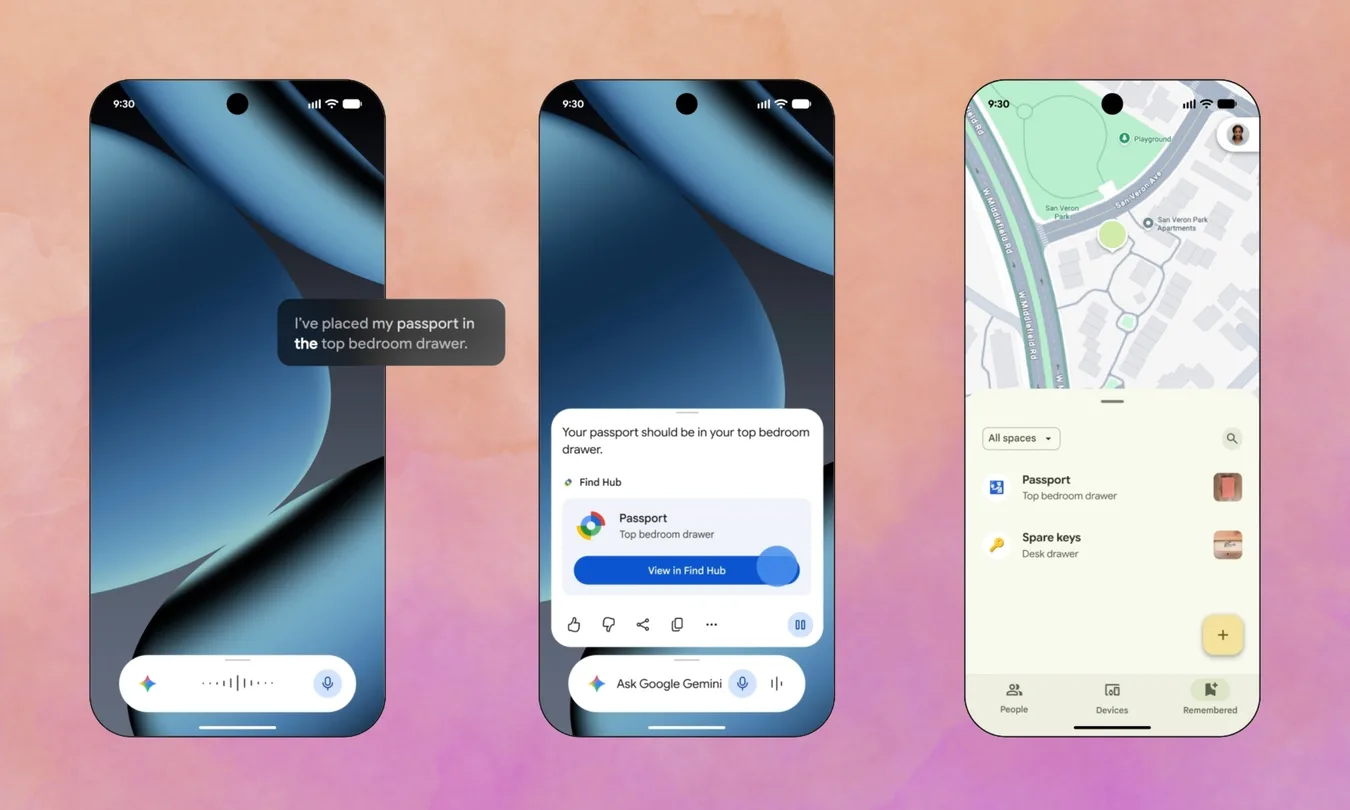
Google is pushing Gemini further into the territory of a personal memory assistant, with a new feature designed to help users remember where they have left everyday objects. Instead of digging through drawers or trying to reconstruct where something was last seen, users can tell Gemini where an item is stored and ask about it later.
It sounds almost comically simple, but that simplicity is precisely what makes the idea interesting. Generative AI assistants have spent the past few years demonstrating increasingly complicated capabilities, yet some of their most practical applications may involve solving mundane problems: remembering which cabinet contains a rarely used tool, where spare keys were placed, or where an important document was stored.
The feature forms part of Gemini’s September update and effectively gives Google’s assistant another layer of persistent personal context. Users can provide information about where belongings are kept, allowing Gemini to retrieve those details when asked at a later point. That shifts the assistant slightly away from the familiar question-and-answer chatbot model and towards something closer to an external memory system.
For Google, that direction makes sense. AI companies are increasingly trying to make assistants useful across longer periods rather than treating every conversation as an isolated interaction. Memory features can make an assistant feel considerably more useful because users do not need to repeatedly explain the same preferences, circumstances or personal information.
Remembering physical belongings also offers a particularly understandable demonstration of that concept. There is no elaborate AI workflow to learn: tell Gemini where something is, then ask Gemini when you cannot remember.
The trade-off, inevitably, is how much personal information users are comfortable handing over. A genuinely useful memory assistant becomes more effective as it learns more about someone’s routines, possessions and preferences. That creates an increasingly valuable personal database, while also making privacy controls, deletion options and transparency around stored information more important.
There is also a practical limitation that no amount of AI can completely solve. Gemini can remember the location users tell it, but it cannot necessarily know when somebody subsequently moves the object without updating that information. A beautifully remembered wrong location is still a wrong location.
Even so, the feature points towards where consumer AI assistants are heading. The competitive battle is increasingly about continuity and context rather than simply which chatbot can generate the smartest-looking answer to an isolated prompt. An assistant that reliably remembers useful details could become more valuable than one that merely performs well in demonstrations.
Gemini remembering where you put your belongings might therefore seem like a small September update, but it illustrates a much bigger ambition for AI assistants: becoming something users rely on continuously rather than something they open only when they have a question. Whether people are comfortable giving an AI enough personal context to make that vision genuinely useful remains the more consequential question.