

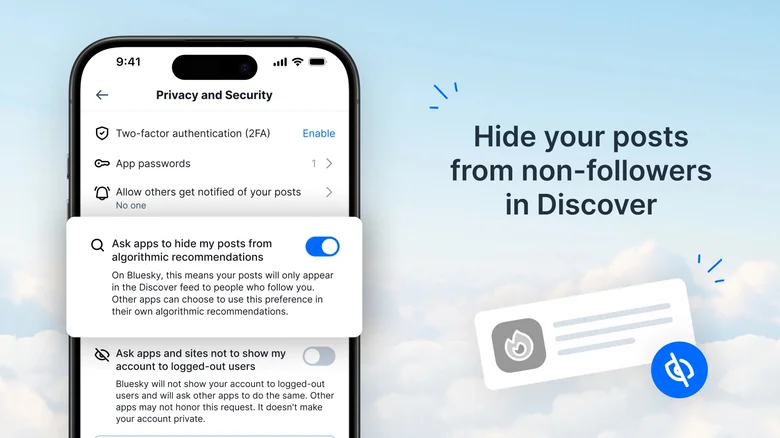
Bluesky is giving users a little more control over how far their posts travel, with a new setting designed to keep content out of the platform’s main algorithmic discovery feed.
The new privacy option allows users to ask Bluesky not to recommend their posts to people who do not already follow them through Discover, the app’s algorithmic feed. It is an account-wide setting rather than something that can be switched on for individual posts, meaning users who enable it are effectively choosing to reduce their exposure across the board.
That distinction matters because Bluesky has built much of its identity around open networks rather than tightly locked-down profiles. Unlike platforms that let users make their entire account private, Bluesky still does not offer a conventional private-account mode. Posts can remain visible elsewhere even after the Discover restriction is enabled.
The setting is therefore less of a privacy wall and more of a visibility control. Bluesky says users can ask apps to hide their posts from algorithmic recommendations, but that does not guarantee those posts will disappear from every feed built on the AT Protocol. Third-party services and alternative algorithmic feeds may still surface content depending on how they are designed.
For users, the practical benefit is straightforward: fewer chances of an ordinary post suddenly being pushed in front of a much larger audience.
That has become a meaningful problem across social platforms, where recommendation systems can turn relatively small conversations into viral events within hours. A joke, complaint or poorly phrased opinion intended for a familiar audience can quickly attract thousands of strangers once an algorithm decides it is engaging enough to promote. The result is often the internet’s familiar “main character” cycle, where attention arrives long before the person posting it has any idea what is happening.
Bluesky’s new setting does not eliminate that possibility, but it gives users a way to reduce one of the biggest routes through which accidental virality happens on the platform.
It also reflects a broader tension in social media design. Platforms benefit when content travels widely because discovery drives engagement, but users increasingly want more say over who actually sees what they post. The problem is that visibility controls become harder to enforce on open and federated systems, where different apps can interpret recommendation preferences in different ways.
Bluesky has suggested that this is only one of several updates aimed at giving users more control over their experience. What comes next will be more important than this single toggle, particularly if the company wants to preserve its open-network philosophy while still giving people meaningful tools to manage unwanted attention.
For now, Bluesky users finally have a way to tell the algorithm that not every post needs an audience beyond the people who already chose to follow them.