

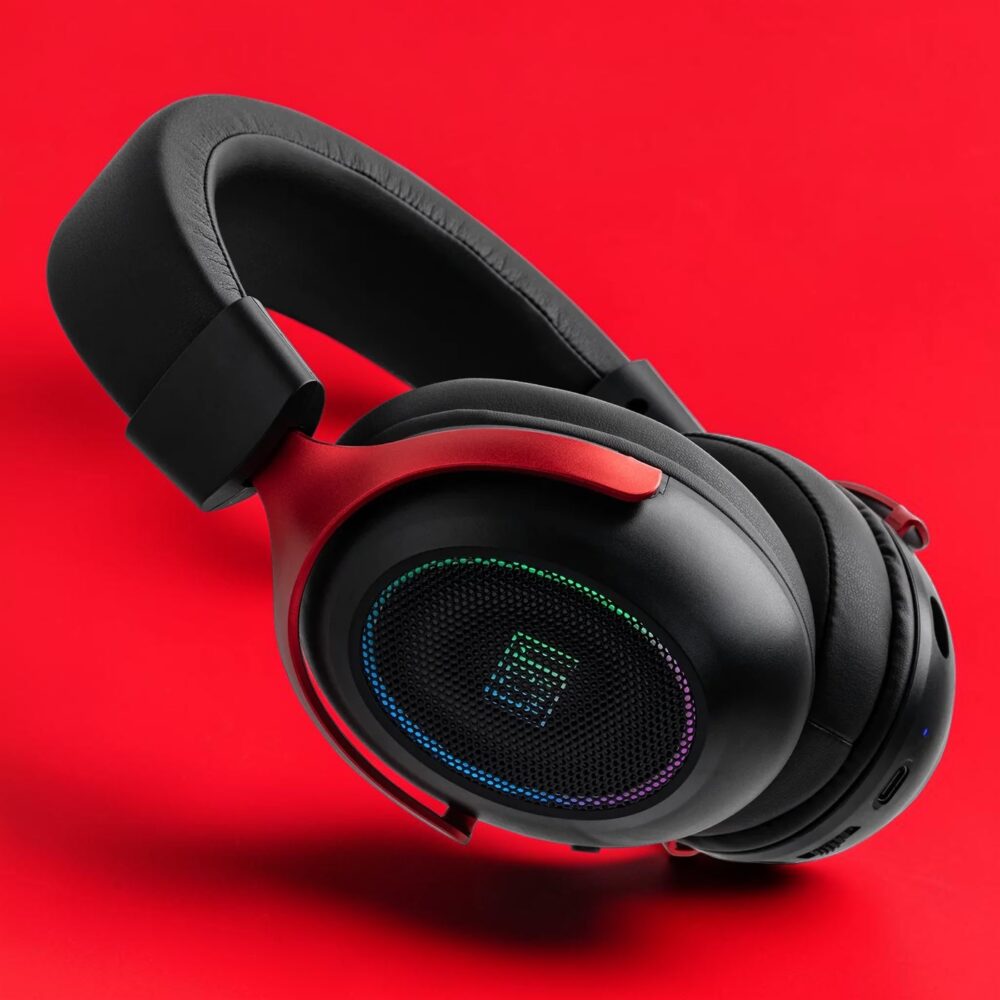
TL;DR: The EPOMAKER GX1 is an impressively equipped budget wireless gaming headset with open-back acoustics, 50mm drivers, low-latency 2.4GHz wireless, Bluetooth, wired connectivity and excellent potential battery life. Its lack of isolation makes it best for quieter gaming spaces, but at $44.99, the feature-to-price ratio is difficult to ignore.
The gaming-headset market has reached the point where buying something affordable no longer means accepting audio that sounds like it escaped from an airport vending machine. Budget headsets now routinely arrive waving around wireless connectivity, oversized drivers, RGB lighting, virtual surround sound and microphones promising to make your Discord voice resemble something recorded in a suspiciously expensive studio. Into that increasingly chaotic arena walks the EPOMAKER GX1, an open-back wireless gaming headset that costs just $44.99 at the time of writing and somehow manages to cram an unusually ambitious feature set into that price.

What makes the GX1 particularly interesting isn’t simply the checklist. EPOMAKER has built its reputation primarily around keyboards, so seeing the company wander into gaming audio feels a little like discovering your favourite keyboard nerd has secretly been building headphones in the basement. The GX1 combines 50mm dynamic drivers, 2.4GHz wireless, Bluetooth, wired connectivity, virtual 7.1 surround, dual microphone options and an open-back acoustic design. That’s a lot of headset for less than the price of some enthusiast keycap sets.
The important question, naturally, is whether those ingredients form a coherent product or merely an impressively crowded specification sheet.
Design and build quality
The EPOMAKER GX1 doesn’t attempt to disguise its gaming DNA, but thankfully it also avoids looking like something stolen from the cockpit of a rejected Transformers character. The design is relatively restrained, with large circular earcups, a conventional adjustable headband and RGB illumination providing the obligatory gamer seasoning. There are black-grey, white and pink versions, giving buyers more personality than the traditional choice between “black” and “slightly different black.”

At approximately 320g, the GX1 sits in sensible territory for an over-ear wireless gaming headset. It isn’t featherweight, but neither should it create the sensation that someone has strapped a small desktop PC to your skull. More importantly, the open-back construction should help with heat management because the earcups aren’t trying to imprison air around your ears. For anyone whose gaming sessions have previously ended with their headset developing its own tropical microclimate, that’s an underrated advantage.
EPOMAKER uses a seven-position adjustable headband and soft ear cushions, while the exterior combines painted and electroplated surfaces. At this price, expectations around materials need to remain realistic. This isn’t competing with premium audiophile hardware milled from exotic metals by elves living inside a CNC machine. What matters more is whether the design prioritises sensible weight distribution, usable adjustment and comfort, because those characteristics become considerably more important after hour three of a gaming session than whether an earcup hinge produces an appropriately luxurious metallic clunk.

The RGB lighting deserves a mention mostly because it has a surprisingly large consequence elsewhere. Yes, it adds some visual flair. Yes, you cannot actually see it while wearing the headset. And yes, like RGB RAM inside a PC case sitting underneath a desk, this has never stopped the gaming industry from putting lights on absolutely everything.
The open-back decision changes everything
The most interesting part of the GX1 is its open-back architecture. That’s relatively unusual among inexpensive wireless gaming headsets, and it fundamentally changes what kind of product this is.
Most gaming headphones are closed-back. They attempt to isolate your ears from the outside world while keeping whatever explosions, dialogue and questionable Spotify playlists you’re listening to contained inside. Open-back headphones deliberately allow sound and air to move through the earcups instead. The trade-off is dramatically reduced isolation, but the potential reward is a presentation that feels less trapped inside your head.
For gaming, that’s potentially excellent. A convincing soundstage can make virtual environments feel larger and more spatially believable. Rather than every sound appearing somewhere along an imaginary line connecting your ears, environmental effects have more room to breathe. Competitive shooters can particularly benefit when directional information is presented clearly, while sprawling single-player games can gain an extra layer of atmosphere.

But physics remains stubbornly immune to marketing departments. Open-back headphones leak sound, and outside noise gets in. The GX1 therefore makes much more sense in a quiet gaming room than beside somebody watching television, talking on the phone or performing their apparently daily ritual of rearranging every plate in the kitchen.
This isn’t a flaw so much as a fundamental characteristic. Buying open-back headphones and complaining about sound leakage is roughly equivalent to buying a convertible and being surprised by wind.
Audio hardware
EPOMAKER equips the GX1 with 50mm dynamic drivers covering the conventional 20Hz to 20kHz frequency range. Driver diameter alone tells us relatively little about actual sound quality, despite the industry’s occasional habit of treating larger drivers like engine displacement. Tuning, enclosure acoustics, distortion control and driver behaviour matter enormously.
What those large drivers and open earcups should provide is sufficient physical headroom for a spacious gaming presentation. That’s a more interesting goal than simply pursuing gigantic bass. Gaming audio needs impact, certainly, but competitive sound also depends heavily on separation and intelligibility. A grenade detonating shouldn’t turn the next two seconds of footsteps, reloads and voice communication into acoustic mashed potatoes.

The open architecture could prove particularly well suited to environmental-heavy games where atmosphere matters as much as raw punch. Rain, distant machinery, ambient wildlife, echoes and positional effects benefit enormously from a presentation that feels expansive rather than claustrophobic.
EPOMAKER also advertises virtual 7.1 surround processing. As always with virtual surround, I’d treat it as an option rather than an automatic upgrade button. Headsets still have two physical drivers, and virtual multichannel processing relies on psychoacoustic tricks to simulate directional speakers. Done well, it can enhance positional awareness. Done poorly, it can smear imaging and make everything sound like it has been relocated to an unusually echoey spaceship hangar.
For competitive games, good stereo imaging can often be preferable. For cinematic adventures, virtual surround may deliver the bigger spectacle. Having the choice is what matters.
Wireless performance and connectivity
Connectivity is another area where the EPOMAKER GX1 punches considerably above what its price suggests. You get 2.4GHz wireless, Bluetooth and wired operation, which effectively covers the three scenarios most people actually need.
The 2.4GHz connection is the important one for gaming. EPOMAKER specifies latency of 25ms through this mode, compared with a much broader 34ms to 200ms range over Bluetooth. That difference explains exactly why dedicated wireless dongles remain relevant in the Bluetooth era. Gaming is brutally unforgiving of delayed audio. A gunshot arriving noticeably after the muzzle flash creates the audiovisual equivalent of badly dubbed television.
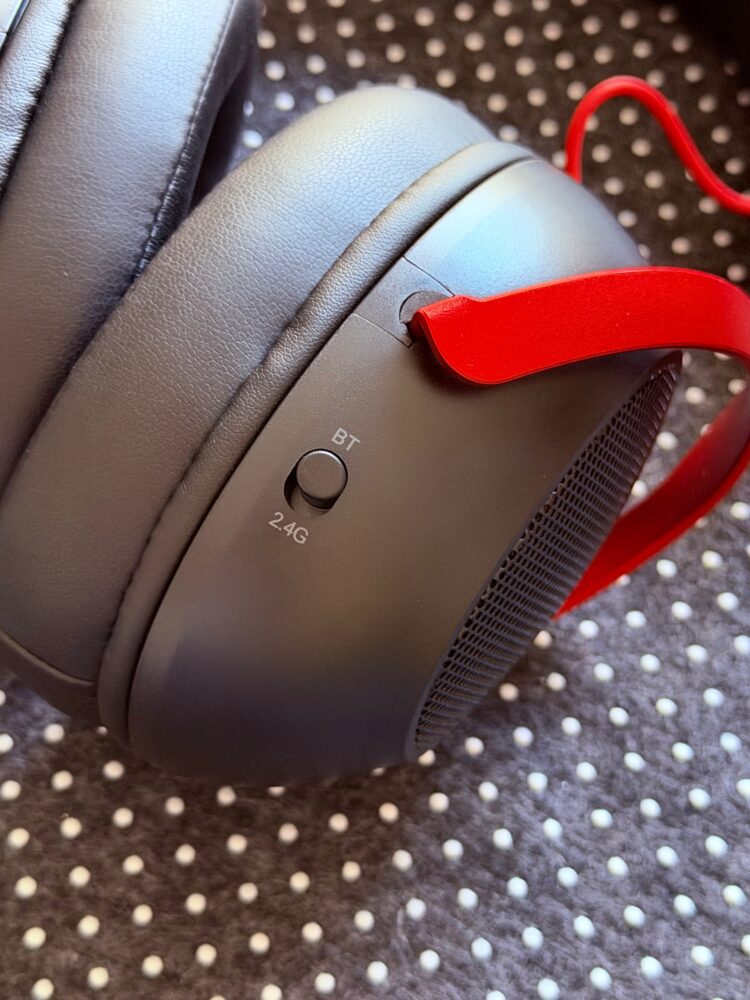
Bluetooth makes more sense when convenience matters. Pairing the GX1 with a phone or tablet for music, videos and calls means it doesn’t have to spend its entire existence chained spiritually to a gaming setup. Wired connectivity then provides the fallback option when wireless isn’t available or desirable.
Compatibility is broad but not universal in every mode. EPOMAKER lists 2.4GHz wireless support for PC, Mac, Switch and recent PlayStation systems, while Xbox Series consoles require the wired connection. Bluetooth isn’t supported for audio on PS4 or PS5. None of that is particularly unusual, but console gamers should know which connection they’ll actually be using before buying.

That flexibility is one of the GX1’s strongest arguments. A budget headset that can bounce between gaming machine, laptop, mobile device and wired source is considerably easier to justify than one that becomes an expensive earmuff whenever you leave your desk.
Microphone and communication
The GX1 takes an interesting dual-microphone approach. There’s an integrated microphone for convenience alongside a detachable external boom microphone equipped with environmental noise cancellation.
That arrangement makes sense. The built-in option means the headset remains useful when you don’t want a microphone boom hanging beside your face, while the detachable mic is the obvious choice for multiplayer communication. It also means you can physically remove the most visibly “gaming headset” part when you’re simply listening to music or watching something.

ENC shouldn’t be confused with active noise cancellation for listening. Here, the processing is intended to reduce unwanted environmental noise entering your microphone rather than eliminate outside sounds reaching your ears. That’s particularly useful around mechanical keyboards, PC fans and other background noise—the exact ecosystem in which a product from EPOMAKER is rather likely to find itself.
I wouldn’t expect a budget headset microphone to replace a dedicated USB mic for streaming, podcasting or serious content creation. That’s not really the assignment. A gaming microphone needs to make speech intelligible, keep distracting background noise under control and avoid making you sound as though you’re communicating with your squad through a drive-through intercom.

The detachable design also improves long-term practicality. Microphones and their connectors are common failure points on gaming headsets, so being able to remove the boom when it isn’t needed reduces unnecessary wear.
Battery life has an RGB-shaped plot twist
Here’s where things become amusing.
The GX1 contains a 2,000mAh battery and EPOMAKER quotes up to 70 hours of playback with RGB disabled. Turn the lighting on, however, and that figure drops to around 30 hours. Charging is listed at roughly three hours and twenty minutes.
Seventy hours is excellent territory for an inexpensive wireless gaming headset. That’s enough endurance that charging becomes occasional maintenance rather than another daily ritual alongside your phone, smartwatch, earbuds, mouse and every other rechargeable creature inhabiting a modern desk.

Thirty hours with RGB enabled is still perfectly usable. The comedy comes from sacrificing roughly forty hours of potential playback so that other people can enjoy colourful illumination attached to the sides of your head.
That’s a spectacularly gamer trade-off.
I’d leave the lighting disabled most of the time and enjoy the substantially longer runtime. RGB makes more sense when the headset is part of a visible streaming setup or when aesthetics genuinely matter to you. Otherwise, the extra endurance wins comfortably.
Battery longevity also matters beyond headline runtime. Rechargeable cells inevitably lose capacity over years of use, so beginning with a generous ceiling gives the GX1 more breathing room as it ages. A headset that eventually retains only part of a 70-hour maximum can remain perfectly practical long after a product that started life barely surviving a weekend.
Verdict
The EPOMAKER GX1 is interesting because it refuses to behave like a stereotypical cheap gaming headset. Instead of simply adding aggressive styling, enormous bass claims and enough RGB to guide aircraft toward a runway, EPOMAKER has built around an open-back acoustic design and surrounded it with features gamers can actually use.
That gives the GX1 a distinct personality. The 50mm drivers, virtual 7.1 processing and open earcups target spacious positional gaming audio, while 2.4GHz wireless provides the low-latency connection that matters during actual gameplay. Bluetooth and wired modes broaden compatibility considerably, the detachable ENC boom microphone adds practical flexibility, and up to 70 hours of battery life with RGB disabled is an excellent headline figure.

The catch is equally clear. Open-back headphones are terrible at pretending the outside world doesn’t exist. If your gaming environment is noisy, shared or filled with humans who don’t particularly want to hear your latest firefight, a closed-back alternative will probably make more sense. Virtual surround is also something I’d consider optional seasoning rather than the main course.
For gamers with a relatively quiet setup, however, the GX1 is an unusually intriguing budget headset. At $44.99, it offers enough connectivity and versatility to make considerably more expensive gaming headsets look nervously at their feature lists. It isn’t trying to be audiophile jewellery. It’s trying to deliver a spacious, flexible wireless gaming experience without requiring you to sacrifice this month’s game budget.
That sounds like a pretty sensible quest.