

TL;DR: A gorgeous film-noir experiment with strong M’Benga moments and intriguing La’an developments, but Una’s potentially powerful moral conflict never gets the depth it deserves.
Star Trek: Strange New Worlds Season 4
Star Trek: Strange New Worlds has always enjoyed treating the Enterprise like television’s most expensive genre playground. One week it can deliver earnest cosmic adventure, the next it is experimenting with comedy, horror, musicals, animation, or whatever other strange substance the writers have poured into the replicator. Season 4, Episode 4, “A Case of Chiaroscuro,” pushes that philosophy into film noir, bathing much of its adventure in monochrome shadows, trench coats, suspicious strangers, and enough dramatic lighting to make a cinematographer grin. Unfortunately, the episode’s visual confidence considerably outweighs its dramatic weight. There is a fascinating Una Chin-Riley story buried beneath all that smoke and shadow, but the episode spends too much time admiring the costume party to properly excavate it.
Welcome to noir Trek
The setup is classic Strange New Worlds: Commander Una Chin-Riley (Rebecca Romijn), newly promoted and carrying the extra weight that comes with that rank, heads out with Dr. M’Benga (Babs Olusanmokun) and Ensign Uhura (Celia Rose Gooding) to recover a probe that has wandered dangerously close to Klingon territory. Their mission takes them to Mat’aar XII, where the local environment causes the world to appear black and white to our Starfleet officers. Convenient? Absolutely. Scientifically hand-wavey? Naturally. But Star Trek has survived considerably more suspicious technobabble in the name of a good episode, so we can happily let this one through customs.
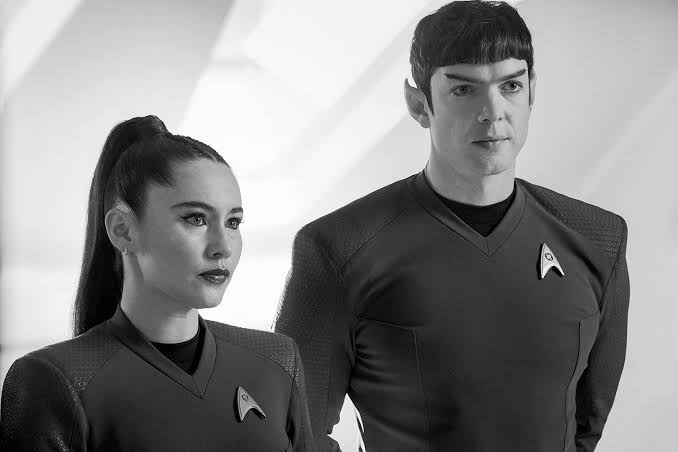
Visually, the conceit works surprisingly well. “A Case of Chiaroscuro” commits to its old-Hollywood atmosphere with high-contrast photography, period-inspired clothing and a world populated by shadowy authority figures, resistance fighters and morally uncertain strangers. There are traces of wartime romance alongside the noir influences, giving Mat’aar XII the feeling of an occupied city pulled from a movie made decades before anyone imagined warp drive. The production team clearly understands the iconography, and there is genuine pleasure in seeing Star Trek rendered through such an aggressively different visual language. The trouble is that recognizing the ingredients of a genre and finding something meaningful to do with them are two different missions.
Una deserves a deeper dilemma
The strongest dramatic possibility belongs to Una. Mat’aar XII exists under Klingon occupation, placing her in an uncomfortable position when she encounters locals fighting against their rulers. Starfleet procedure demands restraint, while Una’s history as an Illyrian gives the situation an obvious emotional charge. She understands better than most what it means for people to perceive a powerful institution as an occupying force, and that personal history should make her decisions feel agonizing. On paper, this is exactly the sort of conflict Star Trek handles beautifully: duty colliding with empathy while every available answer carries an ethical cost.
Yet the episode never quite digs deeply enough into that conflict. Rebecca Romijn gives Una the composure of an officer aware that every decision now carries greater consequences, but the script rarely gives her enough room to wrestle with the contradiction underneath that professionalism. Her promotion should make the situation even richer because command is partly about discovering that compassion and responsibility do not always point in the same direction. Instead, the resistance storyline moves through familiar beats without making Una’s connection to it feel as intimate as it should. The noir aesthetic promises moral ambiguity everywhere you look, yet the central character drama is oddly reluctant to get its hands dirty.
M’Benga remains one of the Enterprise’s best characters
Babs Olusanmokun once again demonstrates how much mileage Strange New Worlds can get from M’Benga simply by allowing him into a complicated room. He does not dominate the plot, but his presence gives the away mission a steadiness it badly needs. M’Benga can be physician, soldier, mentor and quietly intimidating survivor without any of those identities feeling incompatible. The contradictions are precisely what make him interesting, particularly because his instinct to heal exists alongside abilities developed for circumstances where healing was not an option.
His interactions with both Una and Uhura bring welcome texture to the episode. With Uhura, he becomes an experienced guide helping a younger officer navigate an environment where reading people matters as much as reading instruments. With Una, he functions almost like a moral stabilizer, understanding her sympathy while recognizing that sympathy cannot simply erase her obligations. Olusanmokun never needs to oversell M’Benga’s experience; there is always a suggestion that the doctor has already survived three worse versions of whatever disaster everyone else has just discovered. In an episode occasionally distracted by its own stylistic tricks, his understated performance feels refreshingly human.
La’an starts crossing uncomfortable lines
Back aboard the Enterprise, La’an Noonien-Singh (Christina Chong) continues down one of Season 4’s more intriguing paths. She becomes increasingly convinced that something suspicious is happening aboard the ship and begins pursuing the possibility of a traitor, even as those around her struggle to share her certainty. Spock (Ethan Peck) cannot simply validate every suspicion because their relationship has become more intimate, which gives their scenes a useful tension between personal loyalty and rational skepticism. La’an has always been intense, but this season appears interested in exploring what happens when that intensity stops being merely useful.
The subplot does not hit with enormous force on its own, but its implications are considerably more interesting than its immediate payoff. La’an ultimately conceals part of the truth from Captain Pike (Anson Mount), crossing a line that matters precisely because she can justify doing it. Pike’s response suggests that trust aboard the Enterprise is not necessarily the same thing as ignorance, leaving an intriguing question hanging over their relationship. Star Trekcharacters are often most compelling when their virtues become dangerous in excess, and La’an’s determination is beginning to drift into that territory. Hopefully Season 4 keeps pulling that thread rather than resetting her by next week.
Style cannot do all the flying
The broader problem with “A Case of Chiaroscuro” is not that Strange New Worlds experiments too much. Experimentation is practically encoded into the franchise’s DNA, and this particular series has earned the freedom to get weird. The problem comes when the format becomes more memorable than the story happening inside it. Previous stylistic departures have worked when the gimmick exposed something new about these characters or unlocked emotions a conventional episode could not. Here, black-and-white photography and noir archetypes mostly decorate a fairly straightforward political dilemma instead of transforming our understanding of it.
That leaves the episode in the awkward position of being enjoyable to look at while strangely difficult to become invested in. There are handsome compositions, committed performances and enough classic-cinema flavor to keep film geeks entertained, but the emotional engine repeatedly sputters. Even the appearance of Kor, connecting this story more firmly to familiar Klingon history, feels more like franchise seasoning than a development capable of giving the hour extra dramatic muscle. Strange New Worlds remains one of modern Trek’s most flexible shows, but flexibility only matters when the characters benefit from all that bending.
Verdict
“A Case of Chiaroscuro” is an attractive but frustrating chapter of Star Trek: Strange New Worlds Season 4. Its film-noir experiment gives the episode an immediately distinctive identity, and the production team clearly enjoys transforming Mat’aar XII into a monochrome playground of occupation, resistance and suspicious silhouettes. Babs Olusanmokun remains excellent as M’Benga, while La’an’s increasingly questionable choices aboard the Enterprise offer promising material for the rest of the season. Unfortunately, Una’s potentially powerful connection to the central conflict never receives the emotional depth it deserves, leaving the episode prettier than it is profound.
Fans who enjoy Strange New Worlds at its most playful will still find plenty to appreciate, particularly if old Hollywood and Trek happen to occupy neighboring shelves in their geek brain. Those craving the moral complexity promised by Una’s situation may come away considerably less satisfied. There is nothing inherently wrong with boldly going into another genre, but the Enterprise should return carrying more than a cool aesthetic. This time, the shadows look fantastic; what is hiding inside them is simply not interesting enough.