

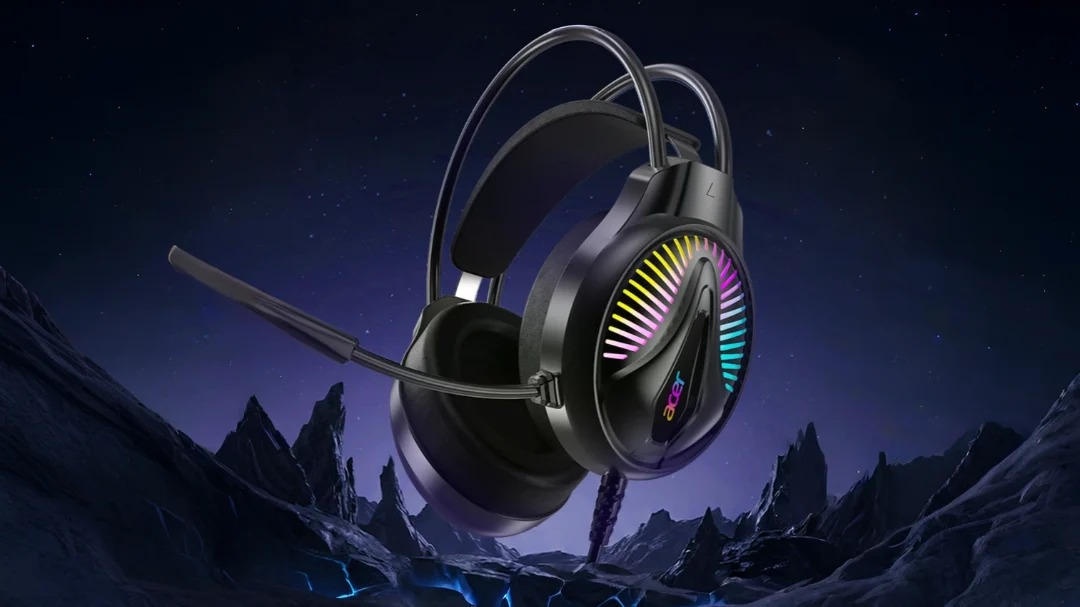
Acer has introduced a low-cost wired gaming headset in the Chinese market, the OHW201, priced at around 69 yuan or roughly $10. This positions it as an entry-level option aimed at budget-conscious players seeking basic functionality without a significant upfront investment. The headset relies on 40mm neodymium dynamic drivers, which deliver a sound profile emphasizing clear mids and sufficient bass for everyday in-game cues such as footsteps or ambient effects. It also incorporates 7.1 virtual surround sound processing through software, intended to improve directional awareness in multiplayer scenarios, though results in virtual implementations often vary depending on the source material and individual ear anatomy.
The closed-back design offers a degree of passive noise isolation, helping to reduce typical room distractions during extended sessions. For comfort, Acer incorporated a floating dual-headband structure paired with over-ear cushions that combine memory foam, a breathable layer, and soft fabric. This approach attempts to mitigate heat buildup, a common complaint in prolonged gaming use, though real-world performance will depend on fit and environmental conditions. The 360-degree omnidirectional microphone features basic noise filtering for voice chat, adequate for standard Discord or in-game communication, but unlikely to rival dedicated standalone mics in noisy environments. Visually, the headset follows conventional gaming aesthetics with RGB lighting on the earcups and is available in black or white finishes.
Connectivity comes via a straightforward 1.8-meter cable, with technical specs including 16Ω impedance, 95dB sensitivity, and -42dB microphone sensitivity. These numbers suggest compatibility with a wide range of devices without requiring additional amplification, making it accessible for PC, console, or mobile setups that support 3.5mm jacks. In a market flooded with inexpensive headsets, the OHW201 stands out primarily for its aggressive pricing rather than groundbreaking innovation. Budget audio gear has evolved considerably since the early 2010s, when even basic models often sacrificed durability and sound quality. Today, options at this price point frequently deliver surprisingly usable performance for casual gamers, though they tend to reveal limitations in build longevity, precise imaging, or long-term comfort compared to mid-range alternatives costing three or four times as much.
For context, competitors like Lenovo have also targeted this segment recently with the Legion Y960, which includes physical 7.1 surround capabilities and a detachable microphone. Such releases reflect ongoing efforts by traditional PC manufacturers to capture share in the accessible gaming peripherals space, where price sensitivity remains high amid economic pressures and the rise of mobile and cross-platform play. The OHW201’s reliance on virtual surround rather than dedicated hardware processing keeps costs down but may limit immersion for competitive players who prioritize accuracy over convenience.
Critically, while the headset addresses core needs for entry-level users—decent isolation, basic spatial audio, and RGB flair—expectations should remain measured. Materials at this price rarely match premium options in durability, and virtual surround effects can sometimes muddy the mix rather than clarify it. Still, for students, occasional players, or those testing the waters of PC gaming without committing heavily, it represents a low-risk way to enhance audio experiences. Its availability on JD.com highlights Acer’s focus on the value segment in China, a strategy that could appeal more broadly if distribution expands. In an era where wireless alternatives dominate headlines, a simple wired model like this serves as a reminder that reliable, no-frills solutions continue to hold relevance for many users.