

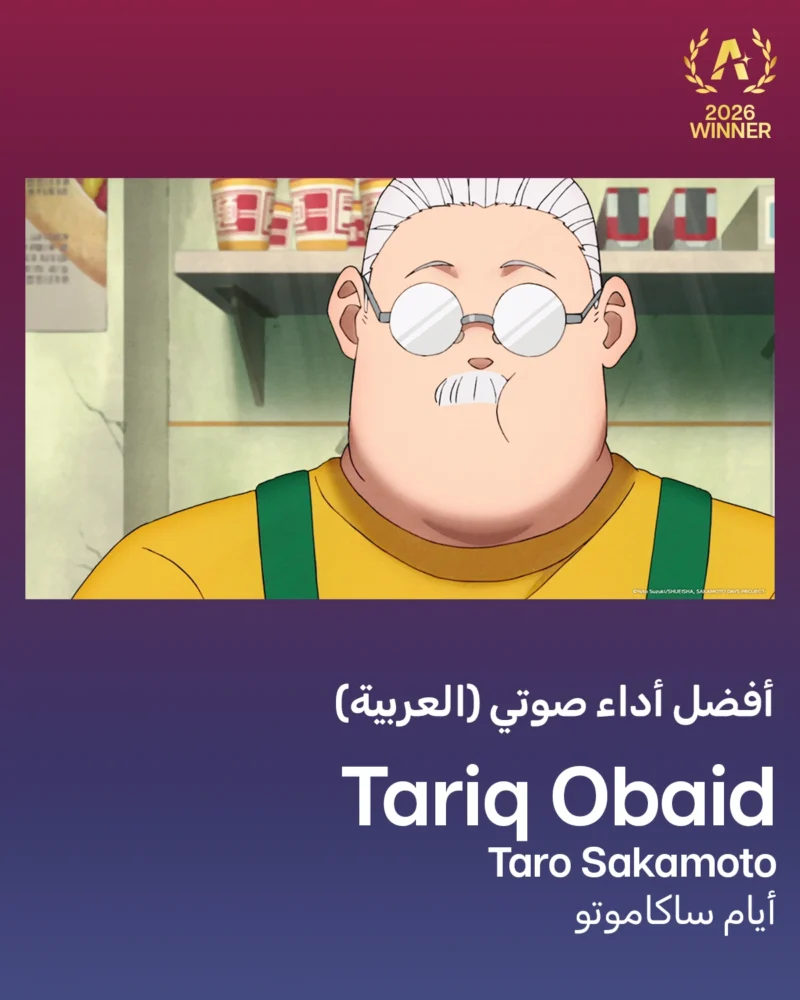
The 2026 Crunchyroll Anime Awards offered a revealing snapshot of anime’s expanding global footprint, particularly through its multilingual voice categories. Among the most notable developments was the recognition of Saudi voice actor Tariq Obaid, who took home the Best Voice Artist Performance (Arabic) award for his portrayal of Taro Sakamoto in Sakamoto Days. While the ceremony in Tokyo celebrated established franchises and technical achievements, Obaid’s win points to a quieter but meaningful shift in how anime reaches audiences in the Middle East.
For years, anime consumption in Arabic-speaking regions relied heavily on subtitled versions or imported dubs with limited cultural resonance. The rise of dedicated Arabic dubbing projects marks a practical response to growing demand. Streaming availability across the Gulf and broader Middle East has accelerated this trend, turning what was once a niche interest into a more accessible form of entertainment for younger viewers balancing local traditions with international pop culture. Obaid’s performance as the retired hitman Sakamoto brought a localized authenticity that evidently connected with voters, helping the category stand out amid a record 73 million global ballots.
The broader awards painted a familiar picture of industry momentum. My Hero Academia’s final season claimed Anime of the Year, while Demon Slayer: Kimetsu no Yaiba Infinity Castle secured Film of the Year. Wins for Solo Leveling Season 2 in action and animation categories, alongside DAN DA DAN Season 2 for comedy, underscored the enduring appeal of polished fight sequences and genre-blending storytelling. Director Tatsuya Nagamine received the Global Impact Award for his contributions to long-running series such as ONE PIECE and Dragon Ball Super, a nod to consistent craftsmanship across decades rather than fleeting trends.
Yet the inclusion of regional voice awards, spanning Arabic, Hindi, Brazilian Portuguese, and others, reveals anime’s gradual adaptation to diverse linguistic realities. These categories acknowledge that global fandom no longer funnels exclusively through Japanese or English interpretations. In the Middle East, where anime conventions and online communities have expanded steadily since the early 2010s, such recognition carries practical weight. It validates investment in local talent and encourages studios to consider cultural nuances in future adaptations, from dialogue delivery to emotional tone.
The tenth edition, hosted by Sally Amaki and Jon Kabira, blended celebrity presenters with industry tributes, including performances honoring Neon Genesis Evangelion and Naruto. A pre-show and later VOD release extended its reach. For audiences in the UAE and wider region, Obaid’s achievement may prove more lasting than the night’s bigger trophies. It signals that Arabic-language anime experiences are maturing, moving beyond translation toward genuine cultural participation. As production scales and competition grows, these incremental steps toward inclusivity could shape how the next generation of fans in the Middle East engages with the art form.