


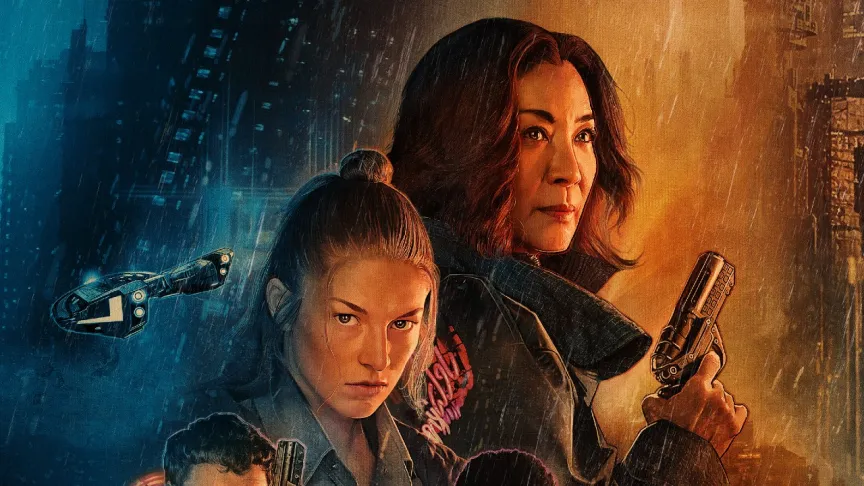

TL;DR: Blade Runner 2099 looks and sounds like the 1982 classic, and Schafer and Yeoh are terrific together. Bloated lore, filler episodes and an unresolved ending keep this Prime Video limited series from greatness.
Every Blade Runner story eventually asks the same uncomfortable question: if you can’t tell the difference between a person and a copy, does the difference still matter? Prime Video’s Blade Runner 2099 asks it again from an unusual angle. It puts a human in replicant clothing and drops her into a city where people like her sit at the bottom. That twist is the best idea in this eight-episode limited series from showrunner Silka Luisa, and for long stretches it’s enough to carry the show. The trouble is everything stacked around it. Blade Runner 2099 is gorgeous, well cast and clearly made by people who love this franchise. It’s also weighed down by lore and by a TV structure that keeps reaching for subplots when it should be thinking.
Hunter Schafer and Michelle Yeoh are the beating heart of Blade Runner 2099
Hunter Schafer plays Cora, a human so desperate to get herself and her brother Elias (Lewis Gribben) to safety that she agrees to pose as a replicant Blade Runner. It’s a con-artist setup with life-or-death stakes, and Schafer plays it like someone always one wrong word away from exposure. Every scene at work has a hum of panic under it, yet she never tips into twitchy caricature. Cora commits to the disguise because she has no other option, and Schafer makes that determination feel both brave and slightly unhinged. She’s easily the standout of the cast and gives the series its pulse.
Michelle Yeoh’s Olwen works as the opposite charge. She’s a replicant Blade Runner in the last days of her lifespan, assigned to hunt Marek (Johnny Harris), a fugitive replicant tied to her past. Yeoh plays her with a weary calm that makes every quiet moment feel like a countdown. Pairing a woman faking an identity with a woman running out of time is a smart piece of character design. Their partnership turns into the show’s real investigation: what makes someone human, and whether it matters who was built in a lab. I’d happily watch a version of this series that was just these two in a car for six hours.
A Blade Runner series that turns the franchise’s hierarchy upside down
The world-building decision that defines this season is the reversal. In this Los Angeles, replicants run the streets and humans are second-class citizens. On paper that sounds like a familiar “the machines won” premise, the kind of thing Westworld or Detroit: Become Human have already chewed on. Some fans will argue it misses what made Ridley Scott’s original unsettling, since the horror there came from humans treating replicants as disposable. I don’t buy that argument. Flipping who holds power doesn’t erase the theme. It tests it, and showing that cruelty works the same way whoever is on top lands as a pretty sharp point.
Where the reversal works best is through Cora’s eyes. Watching a human study replicants closely enough to pass as one turns the franchise’s old Voight-Kampff paranoia inside out. She keeps finding that the people she’s supposed to fear aren’t so different from her. That’s classic Philip K. Dick territory, and the series handles it with more confidence than I expected from a streaming spin-off.
The look and sound of 2099 are a love letter to 1982
If Denis Villeneuve’s Blade Runner 2049 was a brutalist cathedral of sleek CG scale, Blade Runner 2099 is a smoky jazz bar. The production leans on practical sets and an analog, hands-on texture that feels closer to Scott’s original than to the 2049 sequel. Surfaces look grimy and touchable. Instead of endless rain and neon, the show often bathes the city in warm, dusky light, which gives it a melancholy, end-of-an-era mood. The slower episodes linger on these landscapes, and those are some of the most satisfying minutes in the season.
Leopold Ross’s score deserves its own fan club. Built from saxophones and synths, it clearly bows to Vangelis without becoming a cover version, and it does more to set the tone than almost anything on screen. It brings the noir that the scripts sometimes forget to supply. Think Cowboy Bebop’s late-night melancholy run through a cyberpunk filter. Even when the show still has some of that polished TV look, the music pulls it back toward cinema.
Too much lore and too many detours for eight episodes
This is where Blade Runner 2099 starts tripping over its own trench coat. Despite being set in 2099, the series keeps looking back to the early days of the Tyrell Corporation and the origins of the Nexus line. Its central mystery introduces the Nexus-1s, a corner of the mythology the franchise hasn’t touched before. That’s a lot of lore to set up on top of a whole new social order. Some episodes slow down and breathe, while others become exposition dumps, and switching between the two makes the pacing feel lumpy.
The episodic format makes it worse. Each chapter seems to need its own self-contained mission or side story, and many of them feel like padding rather than development. A larger supporting cast also crowds the frame without getting enough room to matter, so the philosophical weight that should define a Blade Runner story gets squeezed out by plot machinery. What’s left is often familiar sci-fi that looks great but feels thinner than it should.
An ending that leaves Blade Runner 2099 feeling unfinished
Blade Runner 2099 is designed as a limited series, which makes its open-ended finale harder to defend. The films earned their ambiguity: the unicorn and the snow felt like invitations to think. Here, the loose threads feel more like missing pages. The new lore raises questions the show seems oddly unwilling to answer, and a self-contained story can’t really get away with that. You finish less haunted than slightly short-changed.
That points to the bigger problem. Blade Runner’s mood thrives on cinematic patience, and its ideas need room to get strange. Squeezing both into a standard streaming episode structure was always going to be hard. Shows like Andor proved franchise TV can break the mold when it commits to a bolder format. Blade Runner 2099 only gets partway there.
Verdict
Blade Runner 2099 has the ingredients of something special. Hunter Schafer gives a career-best-calibre performance, Michelle Yeoh brings real tragic weight, the practical world-building is beautiful and Leopold Ross’s score is outstanding. Flipping humans and replicants is a bold idea that respects the franchise’s central question instead of abandoning it. But the series gets bogged down in heavy lore, filler subplots, an overcrowded cast and an unsatisfying finale. Longtime Blade Runner fans and sci-fi noir lovers should watch it on Prime Video for the atmosphere and the lead duo. Viewers hoping for the philosophical depth of the films may come away wanting more.