
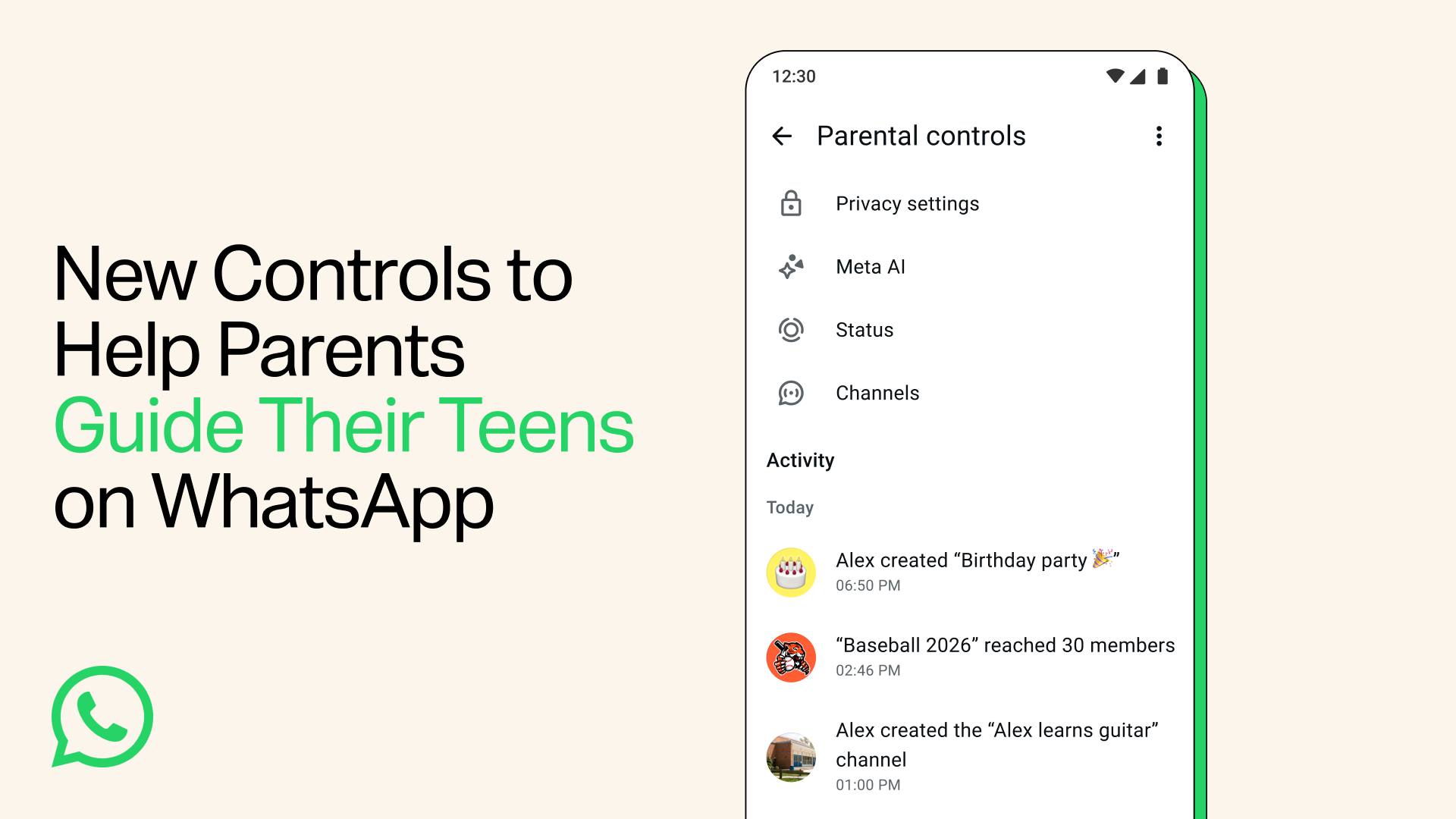
Meta has spent the past two years putting teen protections on Instagram, Facebook and Messenger. WhatsApp, its most widely used app and the one closest to a private phone line, has now joined them with an optional set of parental controls. The design reflects a tension that WhatsApp can’t avoid: parents want oversight, and the app’s main selling point is that nobody, including WhatsApp, can read your messages.
WhatsApp’s answer is to give parents control over the settings around a teen’s account while leaving the conversations alone. Parents can decide who sees their teen’s profile photo and who is allowed to add them to groups. Those choices are locked behind a PIN the parent sets, so a teen who wants to loosen them needs the parent to approve the change. Parents can also limit how teens use Channels, the app’s one-to-many broadcast feature, and decide whose Status updates their teen sees and who can see theirs.
The group alerts may be the most useful part. Parents get a notification when their teen joins or leaves a group, and also when a group the teen is already in “grows meaningfully” in size. That addresses a real risk: a small, familiar group chat can quietly fill up with strangers, and the teen may not notice. WhatsApp hasn’t said what size increase triggers an alert, which leaves parents guessing about how sensitive the feature is.
Meta AI is also covered. Parents can keep the default 13+ experience or switch to a stricter Limited Content mode. It’s a sign that chatbot conversations are now seen as a child-safety issue in their own right, not a side feature.
Messages and calls stay end-to-end encrypted the whole time. Parents can see who their teen is connecting with and in what settings, but not what anyone says. Whether that will satisfy anxious parents, or regulators pushing platforms toward stricter age-related obligations, is an open question.
There are also practical gaps. The controls are entirely optional, and families have to set them up together, so they will reach only households that are already engaged. WhatsApp hasn’t said how it confirms a user’s age, what stops a teen from simply registering a second number, or when the feature will reach every market. The company calls this a first step and says more tools will follow based on what families ask for.
For a platform that already serves as the default school group chat in much of the world, that roadmap may matter more than this first release. Parents now have a way to see the shape of their teen’s WhatsApp activity, while the contents stay off limits.