

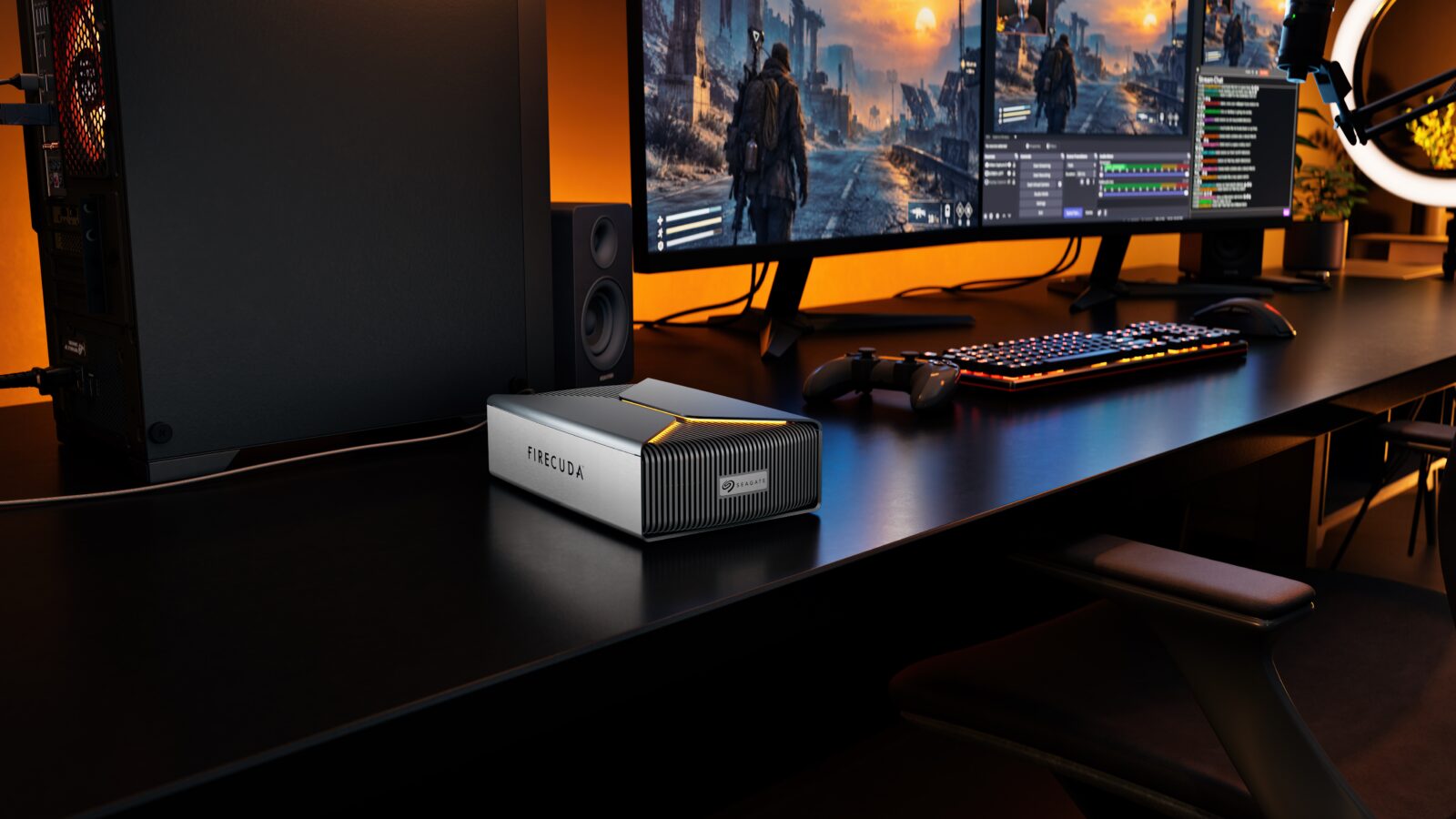
Seagate’s new FireCuda Forge is an external drive that tries to give you SSD speed and hard drive capacity in one box. The catch is that you have to supply the SSD yourself.
The Forge is the first product built on Alkemi, a new Seagate storage platform. Inside the enclosure is a high-capacity hard drive and an empty slot for an NVMe SSD that you buy separately. Alkemi watches which files you use and keeps recent and frequently used data on the SSD, while everything else stays on the hard drive. Your computer sees one drive, and the software decides where each file lives. Seagate describes this as bringing the data tiering used in data centres to a desktop drive.
The idea isn’t new, including at Seagate. The company sold FireCuda SSHDs, which paired a spinning disk with a small amount of flash. Apple’s Fusion Drive in older iMacs did something similar, and so did AMD’s StoreMI and Intel’s Optane caching on PCs. Those products were eventually replaced as SSDs got cheaper and bigger. Seagate is betting that game libraries, 4K footage and AI-generated content have grown fast enough that buying all-flash storage at those sizes is too expensive again. That case is reasonable: a 20TB SSD is still far out of reach for most gamers and creators.
Seagate rates the Forge at up to 2,500MB/s reads and 2,000MB/s writes over USB4. Those numbers will almost certainly apply only to data on the SSD, so real speeds will depend on which SSD you install and how well Alkemi predicts what you’ll need next. When a file has to come from the hard drive, it will run at hard drive speed. Seagate hasn’t said how big the SSD has to be, how long Alkemi takes to learn your usage, or what happens to your data if the SSD fails or is removed. The hard drive inside can also be upgraded, which is unusual for an external drive.
The Forge is on sale now from Seagate’s online store and authorised partners in 8TB and 20TB versions, priced at $699 and $899. It supports Windows 11 and macOS 26 or later. Availability varies by market, and Seagate hasn’t announced Middle East pricing.
Those prices are high for what you get, since they don’t include the SSD. Once you add a decent NVMe drive, the 8TB model costs much more than buying a separate external SSD and hard drive and sorting your files yourself. What you’re paying for is not having to manage that split. Whether that’s worth it will depend on how well Alkemi’s caching works in independent testing.