
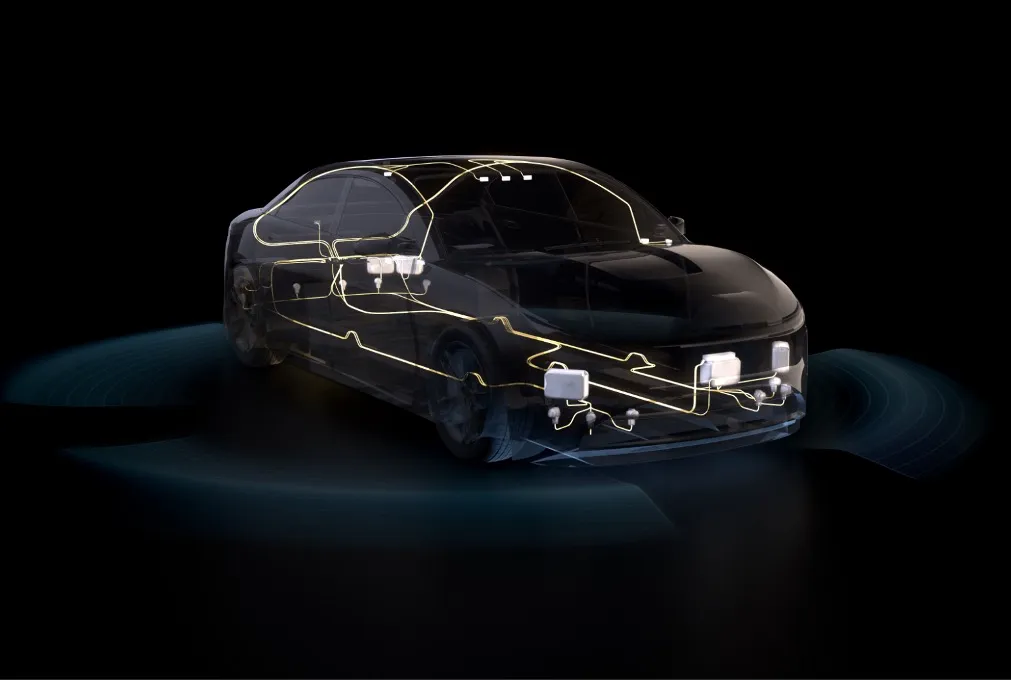
Nvidia is expanding its role in the autonomous vehicle space, announcing new partnerships with Chinese automakers BYD and Geely as part of its robotaxi platform strategy. The agreements, revealed during the company’s GTC conference, center on Nvidia’s Drive Hyperion platform, which combines chips, sensors, computing systems, and software designed for Level 4 autonomous driving.
Both BYD and Geely are already familiar with Nvidia’s technology. BYD has previously integrated Nvidia chips into its vehicles, and the new agreement extends that relationship into more advanced autonomous systems. Geely, meanwhile, is incorporating Nvidia’s latest Thor chips into its Zeekr-branded vehicles, which are also being supplied to Waymo for use in its US-based robotaxi services. Nvidia’s role in both in-car systems and supporting cloud infrastructure reflects a broader approach to covering multiple layers of autonomous vehicle development.
The addition of BYD and Geely highlights how Nvidia is positioning its Drive Hyperion platform as a shared foundation for different automakers and mobility providers. The platform is designed to support Level 4 autonomy, where vehicles can operate without human input under certain conditions. By offering a combined hardware and software stack, Nvidia is aiming to streamline development timelines for companies entering or expanding in the robotaxi segment.
The company is also working with other global partners. Nissan plans to use the Hyperion platform alongside software from Wayve, while Isuzu is collaborating with Nvidia and Tier IV on autonomous bus development. In the ride-hailing sector, Lyft is adopting Nvidia’s platform to support its own robotaxi ambitions, including improvements to machine learning systems and operational scaling.
Nvidia’s involvement extends to Uber as well, where the two companies are working toward building a large-scale robotaxi network. The partnership is expected to expand across multiple global markets, with early deployments planned in cities such as Los Angeles and San Francisco. Automakers including Lucid, Volkswagen, and Stellantis are contributing vehicles built with Nvidia-powered systems as part of that broader effort.
Although Nvidia has long supplied components for driver-assistance features, its automotive division remains a smaller part of its overall business compared to its AI-focused operations. Even so, the company is continuing to invest in autonomous driving as a long-term growth area, using its experience in AI computing to support both simulation and real-world deployment.
A key part of Nvidia’s strategy is its development ecosystem. The company points to its virtual testing tools and AI model portfolio, including its Alpamayo models, as central to accelerating progress in autonomous systems. These tools allow developers to simulate driving conditions and train systems without relying solely on physical road testing, which can be time-consuming and limited in scope.
Nvidia is also introducing a new safety-focused system called Halos OS. This software is designed to act as a safeguard within autonomous driving systems, helping detect potential issues and guide vehicles toward safe outcomes if something goes wrong. The goal is to provide an additional layer of reliability as more companies move toward higher levels of automation.
With partnerships now spanning automakers, ride-hailing platforms, and autonomous technology firms, Nvidia is building a broad network around its robotaxi platform. As development continues, the effectiveness of this approach will depend on how well these systems translate from testing environments into consistent real-world performance.