
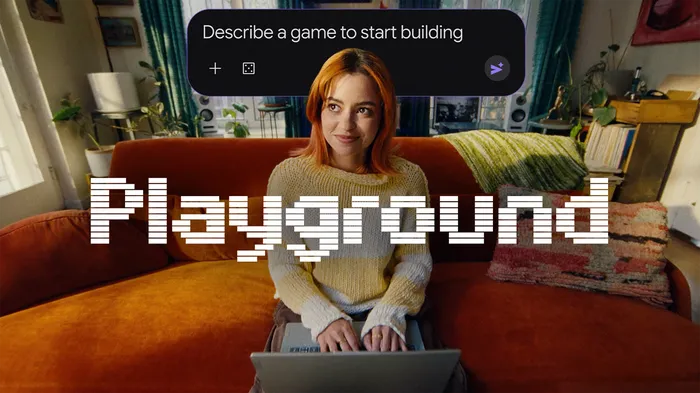
Google wants anyone with an idea and a keyboard to become a game designer. Its new experimental platform, Playground, lets people build, play and share custom games by describing them in plain language, with no coding or game engine knowledge required.
The process works through a chat-style interface. You can start from a blank canvas, remix one of the starter prompts or follow guided suggestions, then test the result straight away. Changes happen the same way: ask for different physics, new rules, redesigned characters or a fresh environment, and the game is reworked accordingly. Google hasn’t said which of its AI models powers the tool, or how complex these games can realistically get.
Playground is as much a social platform as a creation tool. It runs in the browser on phones and laptops, and finished games can stay private, be shared via a link, or be published to a public gallery called Explore. Some genres support multiplayer, games can carry leaderboards, and a Play Games profile lets players claim a handle, follow creators and like titles. Google says the gallery surfaces games based on ratings and play activity, and that every published game passes safety screening alongside user reporting.
If that sounds like a lightweight answer to Roblox or Fortnite’s creator tools, that’s essentially the pitch. The difference is the starting point. Those platforms still expect some scripting or level-building skill, while Playground swaps that for prompts. The obvious risk is that a tool this easy could flood the gallery with near-identical, low-effort games, which would put a lot of weight on Google’s discovery system.
The more interesting long-term piece is a planned integration with Unity Spark, which promises professional-grade mechanics, high-fidelity 3D and access to the Unity runtime. The idea is that a game could begin as a simple prompt and grow into something far more ambitious. Unity Spark is still in testing, though, with a closed beta described only as coming soon.
Access is also limited for now. Playground is available only in the US to users aged 18 and over, and creation features are tiered by Google AI subscription level, with no details yet on what each tier unlocks. There’s no word on international expansion, so players in the UAE and elsewhere will have to wait.
Google’s last big gaming push, Stadia, shut down in 2023, so some caution is understandable. Playground’s success will depend on whether players keep coming back to games made by other people, not just on how quickly AI can produce them.