
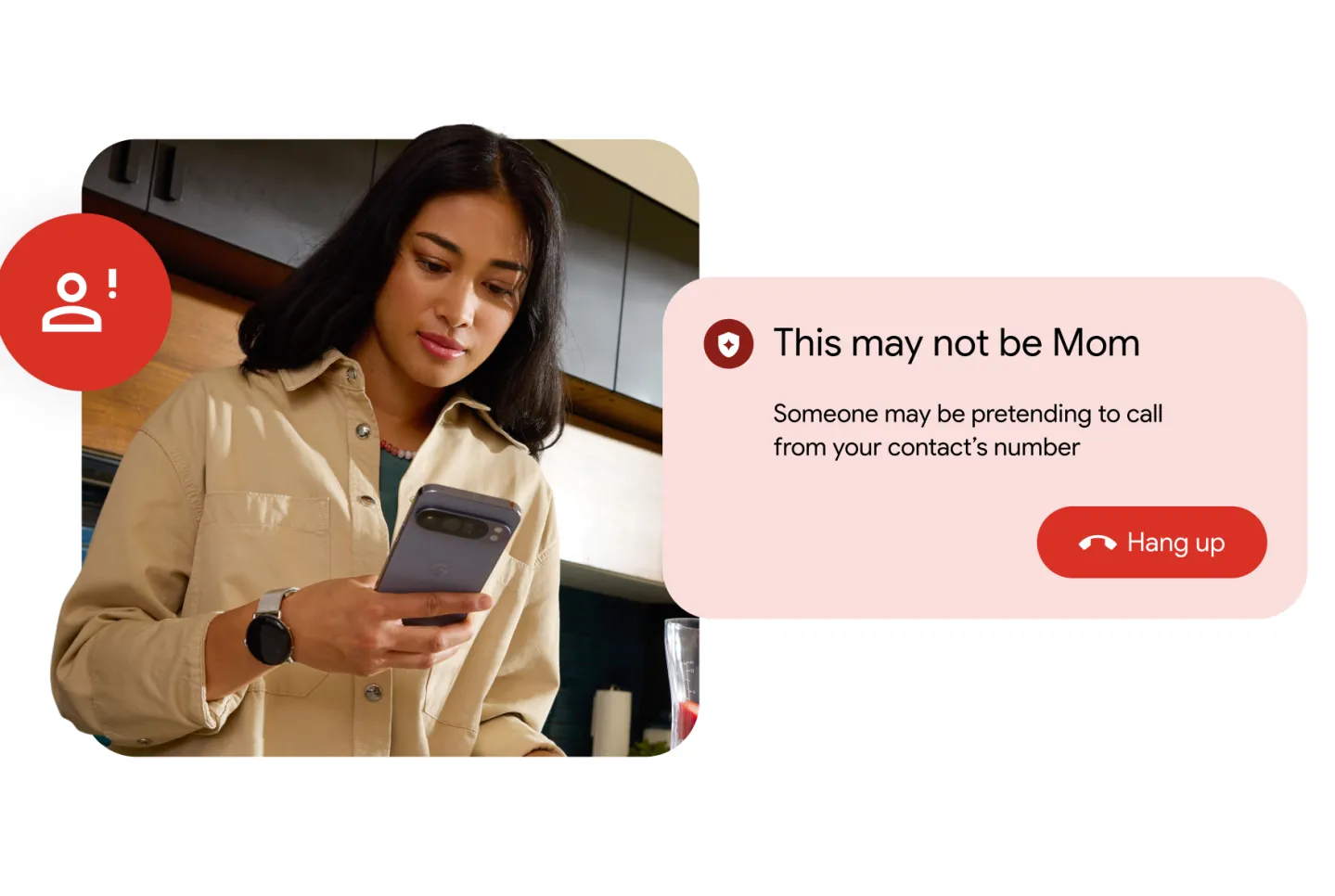
Google is rolling out a new safety feature in its Phone by Google app designed to alert users when a caller may be spoofing a contact’s number while using AI to mimic their voice. The tool displays a clear warning notification advising the recipient to end the call, addressing a rising category of scams that exploit trust in personal relationships.
According to Google, the feature activates by default for devices running Android 12 and later, beginning with Pixel phones. It relies on a silent confirmation signal exchanged between devices when both the user and the contact are using the Phone by Google app. This verification runs over end-to-end encrypted rich communication services, or RCS. If the signal is absent, indicating possible spoofing, the alert triggers. The approach builds on existing RCS infrastructure, potentially allowing broader adoption by other calling apps in the future.
The timing reflects a documented surge in AI-assisted fraud. The FBI reported that Americans lost over $893 million to scams involving artificial intelligence in 2025 alone. Voice cloning technology has become increasingly accessible, enabling fraudsters to impersonate family members, friends, or authority figures with alarming realism. These attacks often create urgency around fabricated emergencies to extract money or sensitive information quickly. Google’s response offers a practical layer of defense, but its effectiveness depends on widespread adoption within personal networks.
Limitations are evident. The system only functions when both parties use the same app, restricting its reach in mixed Android-iOS environments or among those who prefer carrier default dialers. It does not address all forms of caller ID manipulation or sophisticated deepfake audio that might evolve beyond current detection methods. Broader industry efforts against scam calls have shown mixed results over the years, from early robocall blockers to STIR/SHAKEN protocols, which have reduced some spam but struggled against determined actors who adapt quickly. Privacy considerations also arise with any expanded RCS usage, though end-to-end encryption helps mitigate risks.
This update arrives alongside other enhancements, including expanded access to Google’s Personal Safety app for children under 13. Together, they signal Google’s continued investment in device-level protections as AI tools lower the barrier for convincing fraud. Yet the feature underscores a persistent challenge: technology companies are playing catch-up to threats their own advancements help enable. Voice synthesis models, once confined to professional studios, are now available to anyone with basic technical skills, accelerating an arms race between security features and criminal innovation.
For everyday users, the new capability provides a welcome heads-up during suspicious calls, potentially interrupting scams before they gain traction. However, it should not replace fundamental practices like verifying requests through independent channels. As AI impersonation tactics grow more refined, sustained improvements in detection, combined with user education and regulatory pressure on telecom providers, will be necessary to curb the problem meaningfully. Google’s move represents incremental progress in a field where complete solutions remain elusive.