
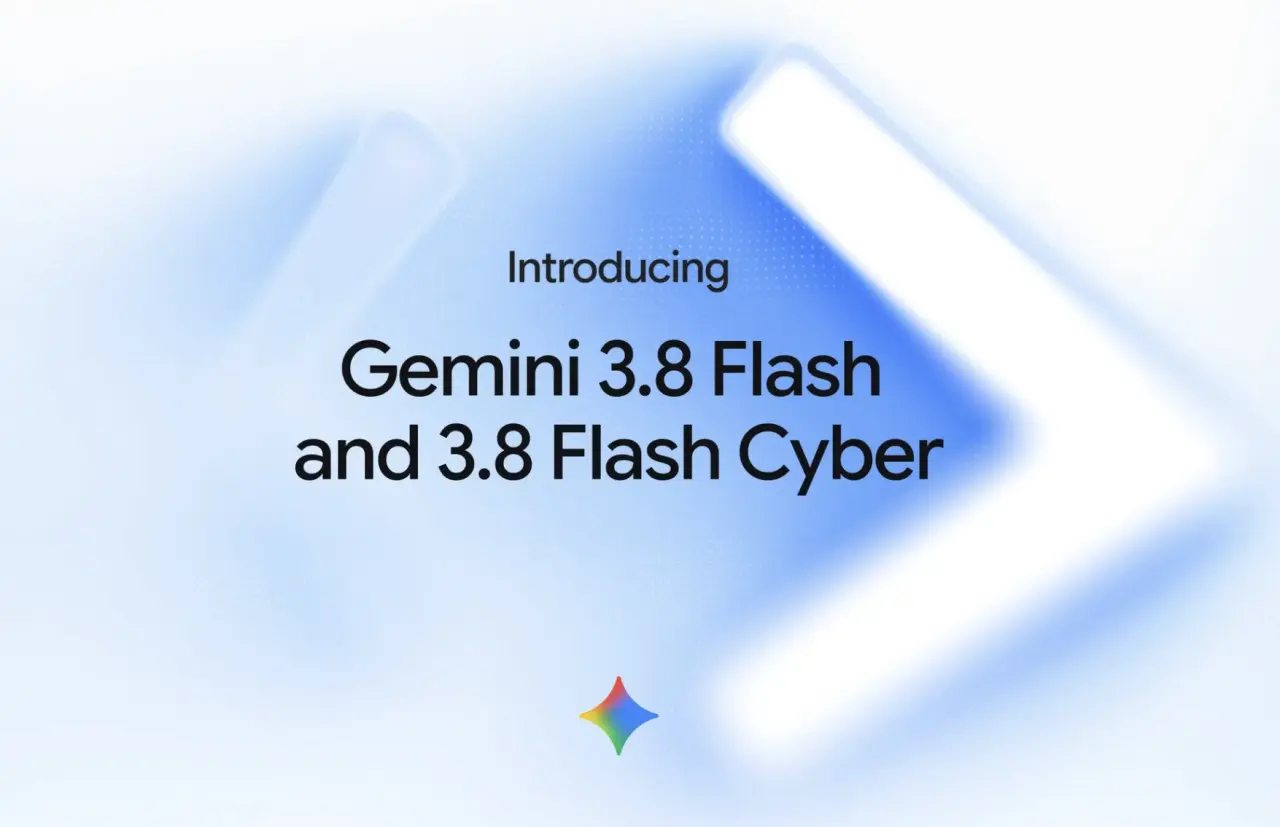
Google is pushing its Gemini release cycle into overdrive, introducing Gemini 3.8 Flash just three weeks after Gemini 3.7 Flash and only six weeks after the arrival of Gemini 3.6 Flash. The rapid-fire updates underline how aggressively AI companies are now competing on something beyond raw intelligence: useful performance at a price developers can actually afford.
Gemini 3.8 Flash is being positioned as Google’s recommended model for software engineering, autonomous agents and complicated multi-step reasoning. More importantly for developers running AI at scale, Google is temporarily pricing it at $0.75 per million input tokens and $3.75 per million output tokens through December 31, 2026.
That introductory pricing comes with an important catch. From January 1, 2027, rates are scheduled to double to $1.50 per million input tokens and $7.50 per million output tokens. Anyone evaluating Gemini 3.8 Flash primarily on cost therefore needs to account for the considerably higher long-term price rather than building forecasts around the launch promotion.
Google’s benchmark numbers nevertheless make the model interesting. Gemini 3.8 Flash scored 71% on DeepSWE v1.1, compared with 65.3% for Gemini 3.7 Flash and 74% for Claude Opus 5. On Terminal-bench 2.1, it reached 89.4%, narrowly exceeding the reported 89.1% for Opus 5 and 88.8% for GPT-5.6 Sol.
Benchmark scores should never be confused with universal real-world superiority, particularly when differences are this small. They do, however, illustrate the broader direction of the AI market. Smaller and cheaper models are increasingly being designed to handle workloads that recently required substantially more expensive flagship systems.
There is another trade-off. Google says Gemini 3.8 Flash can achieve its stronger results by performing additional reasoning and making more iterative tool calls on complicated tasks. That can increase output-token consumption, potentially reducing some of the apparent savings. Developers can lower reasoning effort when efficiency matters more, while Gemini 3.7 Flash remains an alternative.
Google is also introducing Gemini 3.8 Flash Cyber, a specialised version aimed at vulnerability discovery and automated patching. It recorded 47.2% on CWE-Bench, according to the supplied results, compared with 47.8% for an unnamed leading frontier model. Google additionally claims its internal testing produced 2.6 times more correct Chrome vulnerability patches than larger commercial models, although that remains a company-reported result rather than independent validation.
Access to the cyber model is deliberately narrower. Google is limiting Gemini 3.8 Flash Cyber to trusted government agencies, critical infrastructure operators and software maintainers through its Fairwind Program.
The standard Gemini 3.8 Flash is much more broadly available across the Gemini API, Google AI Studio, Android Studio, Antigravity and Gemini Enterprise, with additional access through consumer Google products for eligible subscribers. After three Flash generations in six weeks, the bigger question may be how long Gemini 3.8 remains Google’s recommended option before the next model arrives.