
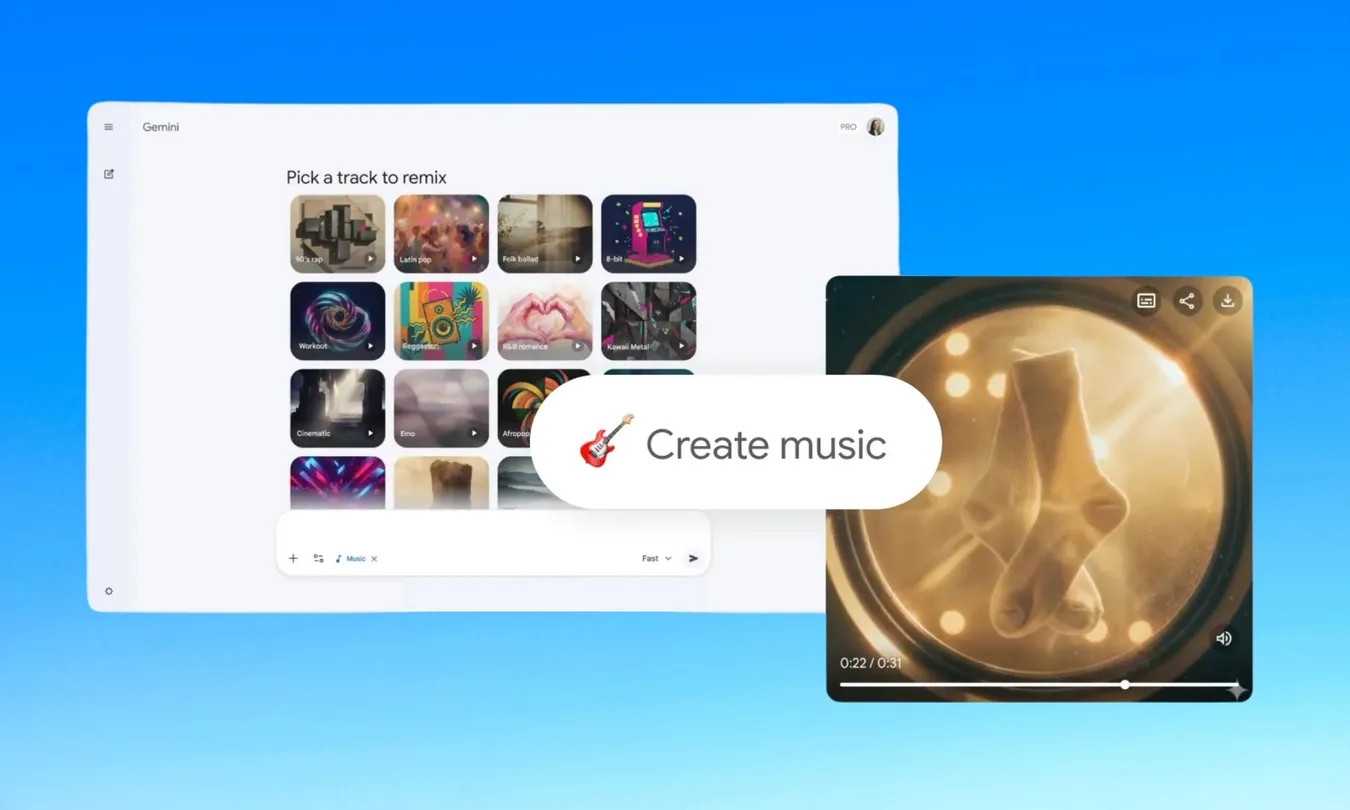
Google is pushing Gemini further beyond text, images and video by bringing its latest AI music technology directly into the chatbot, giving users another way to generate creative media without leaving the Gemini experience.
The new capability is powered by Lyria 3.5, Google’s latest music-generation model. Its arrival inside Gemini means users can create music through natural-language prompts rather than working with dedicated audio production software, continuing Google’s broader strategy of turning Gemini into a single interface for multiple generative AI formats.
AI-generated music is a particularly interesting addition because audio has remained less visible than text and image generation in the mainstream generative AI race. Tools capable of producing convincing songs and instrumental tracks already exist, but integrating music generation into a widely used general-purpose assistant lowers the barrier considerably. Someone experimenting with an idea no longer necessarily needs to seek out a specialist service before producing a track.
That accessibility is both the feature’s biggest strength and the source of some uncomfortable questions. Generative music systems are improving at a pace that increasingly blurs the line between an AI tool for musicians and an automated replacement for parts of the creative process. Making those systems easier to access potentially expands their usefulness for creators producing background music, demos, social content and experimental compositions, while also increasing the amount of synthetic audio competing for attention online.
For Google, Lyria 3.5 also strengthens the increasingly multimodal nature of Gemini. The company has spent the generative AI era expanding beyond conventional chatbot responses, with its models covering images, video and other media. Music gives Gemini another creative output and makes the product less dependent on text-based tasks.
The bigger shift is how little technical knowledge these systems increasingly demand. Traditional music production requires some understanding of composition, instruments or digital audio tools. Prompt-based generation changes the starting point from creating the individual components of a track to describing the desired result and allowing a model to construct it.
That does not make human musicians redundant. Generating something that sounds plausible is different from producing music with a distinctive identity, understanding an audience or making deliberate creative decisions across an entire project. AI can dramatically shorten the distance between an idea and an audio file, but speed is not the same thing as artistic judgement.
Google’s decision to put Lyria 3.5 inside Gemini nevertheless makes AI music generation considerably harder to treat as a niche experiment. As text, image, video and now music tools converge inside the same assistants, the more important question may soon be less about what generative AI can create and more about what remains worth creating ourselves.