
TL;DR: Unabomber splits its runtime between a compelling but underwritten Harvard origin story and a thin, forgettable FBI manhunt, leaving both halves underdeveloped. Tremblay impresses, Crowe plays it too safe, and the film’s refusal to show the adult Kaczynski muddies its own message. Worth a watch for true-crime curiosity, not for clarity.
Netflix dropping a biopic about America’s most notorious anti-tech terrorist right as we’re mid-meltdown over AI is either genius timing or a genuinely uncomfortable coincidence, and honestly, Unabomber never quite settles which one it wants to be. Andor director Janus Metz Pedersen tackles the Ted Kaczynski story through a dual-timeline structure: young Ted (Jacob Tremblay) getting psychologically dismantled at Harvard in the late 1960s, and FBI Agent Joanne Miller (Shailene Woodley) hunting the adult bomber decades later. It’s a genuinely fascinating premise on paper, the kind of “how did this brilliant mind end up mailing pipe bombs” story that should practically write itself. Unfortunately, at a lean 97 minutes, the film feels less like a fully realized character study and more like two half-finished scripts stapled together at the spine.
Tremblay and Crowe carry a Harvard storyline that deserved more room
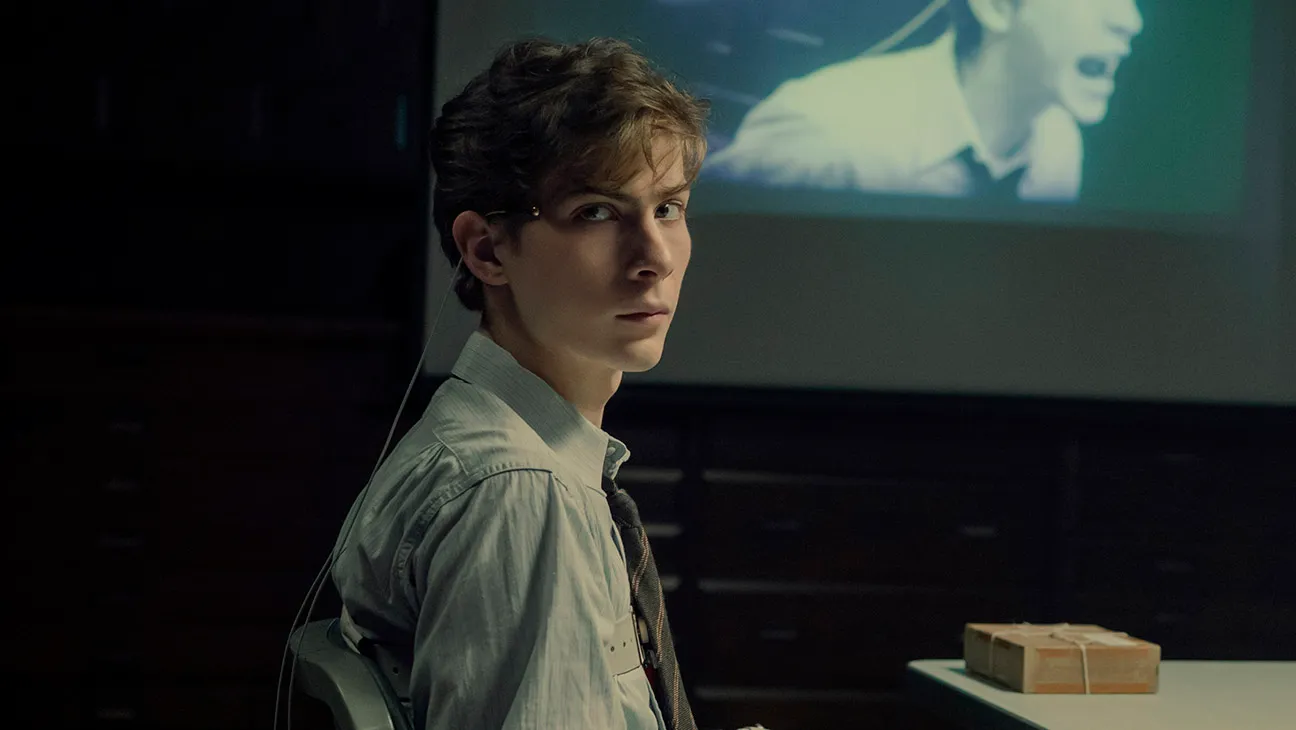
The Harvard timeline is where the movie’s DNA actually gets interesting, following Kaczynski through Dr. Henry Murray’s (Russell Crowe) infamous and later-condemned psychological experiments, the kind designed to prove “all men can be broken.” Tremblay plays young Ted with a controlled, almost robotic detachment, the sort of isolated-genius energy you’d get if Aidan Gallagher’s Number Five from The Umbrella Academy traded time travel for social anxiety and a growing grudge against modernity. It’s a quietly effective performance built on stillness rather than showy breakdowns, and it does a lot of heavy lifting in selling the idea of a mind being slowly, deliberately unraveled.
Crowe, meanwhile, plays Murray disappointingly straight. There’s an obvious echo of A Beautiful Mind in these Harvard sequences, watching a brilliant but socially unmoored young man try to survive an institution that doesn’t know what to do with him, and Crowe leaning into a more restrained, matter-of-fact cruelty rather than mustache-twirling villainy is an interesting choice in theory. In practice, it feels like a missed opportunity, especially coming off the back of his genuinely chilling turn as Hermann Göring in 2025’s Nuremberg. Murray gets sketched in just enough to be unsettling but never enough to be understood, and that half-measure characterization undercuts what should be the film’s most compelling relationship.
Woodley’s FBI hunt plays like a Clarice Starling knockoff running on fumes
The second timeline positions Woodley’s Agent Miller as this story’s answer to Clarice Starling, chasing down a serial bomber whose real-world campaign killed three people and injured twenty-three over eighteen years. Woodley does what she can with a thinly written role, and there’s enough procedural tension here to suggest the post-Silence of the Lambsplaybook was at least understood, if not fully executed. The problem is that this half of the movie almost completely writes the adult Kaczynski out of his own story, keeping him offscreen for nearly the entire runtime in favor of generic manhunt beats that never dig into who anyone actually is.
That absence feels like a deliberate structural choice rather than an oversight, but it’s one that backfires. Anyone who doesn’t already know the real history walks away with the film’s version of events as the only version, which is a strange gamble for something billed as based on a true story. I kept thinking about how much better this half could’ve worked as something closer to Mindhunter, digging into the psychology of the hunt itself instead of coasting on genre familiarity, and the gap between what it is and what it could’ve been is genuinely frustrating.
The movie’s biggest problem is that it doesn’t know what story it’s telling
Here’s the core issue: Unabomber wants you to draw a straight line from Murray’s experiments to Kaczynski becoming a domestic terrorist, but it does so by starving both halves of the context needed to actually make that connection land. Murray isn’t fleshed out enough to register as a real villain with a real ideology, and the adult Kaczynski is barely present to show us what those Harvard years supposedly turned him into. The real Kaczynski, notably, rejected the idea that the experiments caused his later actions, insisting his motivations were his own; the film’s near-total silence on that complicates whatever nuance it might’ve been reaching for.
There’s also an uncomfortable Joker parallel here that’s hard to shake, the way the Harvard sequences frame Kaczynski as a victim first and a mass killer second, without ever fully reckoning with the cost of what he actually did. Todd Phillips got plenty of heat for a similar approach with Joaquin Phoenix’s take on the Joker, and at least that film had the excuse of being fiction. A “based on a true story” label carries more weight, and Unabomber doesn’t seem to have decided whether it’s interested in earning that weight or just borrowing the intrigue of it.
Verdict
Unabomber has real ingredients for a great film: a strong central performance from Tremblay, a genuinely disturbing real-world premise, and a director capable of handling dual timelines with confidence. But splitting its runtime between an underdeveloped villain and an almost-absent protagonist leaves both halves malnourished, and the finished product reads more like a rough cut of two different, more interesting movies than a cohesive whole. True-crime fans curious about the Kaczynski case will find fragments worth chewing on, particularly in the Harvard scenes, but anyone hoping for a definitive, responsible portrait of the Unabomber should look elsewhere. It’s a frustrating watch precisely because you can see the better movie hiding underneath it.