

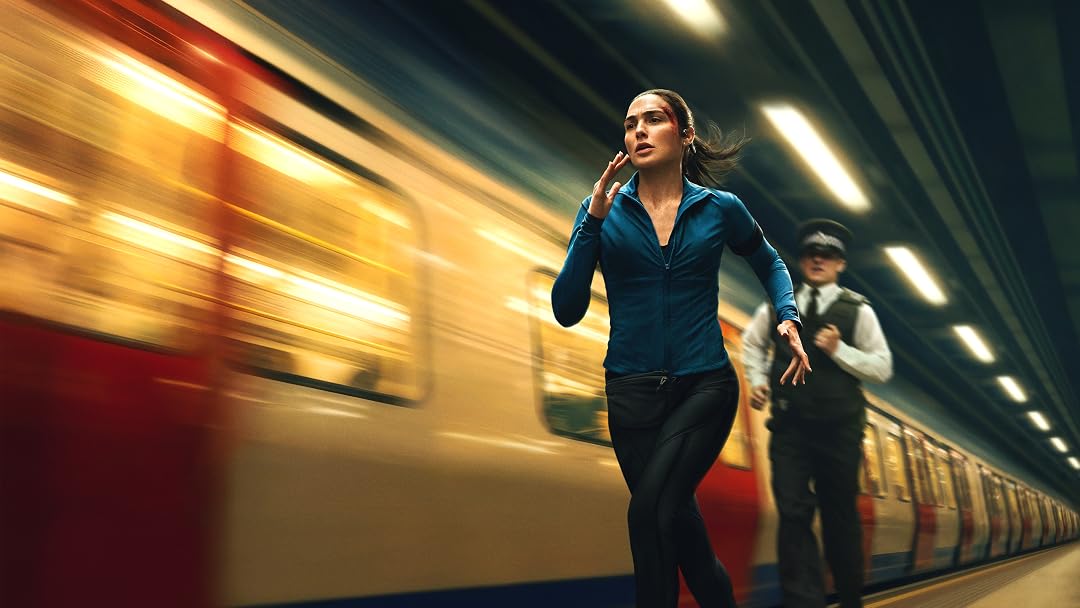
TL;DR: The Runner gives Gal Gadot a nightmare phone call, a ticking clock and apparently unlimited cardio. It’s fast, occasionally tense and visually energetic, but thin dialogue and undercooked psychological warfare keep this thriller stuck firmly in jogging mode.
There is something beautifully evil about a thriller that ruins somebody’s entire day with a single phone call. No alien invasion, no nuclear launch codes, no Thanos-level threat requiring seventeen superheroes and a suspicious amount of CGI. Just a voice on the other end of the line saying, essentially, “Congratulations, your morning is now completely screwed.” The Runner, starring Gal Gadot and directed by Kevin Macdonald, takes that wonderfully simple idea and turns it into an 84-minute race across London. The frustrating part is that while the movie keeps Gadot running like she accidentally accepted every side quest on the map, the thriller itself rarely gets its pulse above a brisk jog.
The Runner gives Gal Gadot the worst cardio session imaginable
Gadot plays Maia Marten, a London attorney and single mother involved in prosecuting a powerful crime boss. A key witness is preparing to testify, potentially giving the prosecution what it needs to finally put him away. Maia heads out for her morning run expecting a busy day at work and instead receives a call involving her son Noah. On the other end is a mysterious man, voiced by Damian Lewis, who has kidnapped Noah and engineered a particularly nasty ultimatum: Maia must follow his instructions and kill the witness if she wants her son to survive.
So yes, cancelling the morning run is apparently not an option.
It is a brutally effective setup because Maia immediately has two objectives that cannot coexist. Save her son and she potentially murders an innocent person while destroying the case she helped build. Refuse, and the consequences are unthinkable. Her tormentor has also compromised her technology and can monitor her movements, essentially transforming London into the world’s least enjoyable fitness app. Instead of congratulating Maia for closing her rings, however, this one threatens her family.
That simplicity should make The Runner an absolute tension machine. Unfortunately, the movie discovers fairly quickly that watching somebody run while having a stressful phone conversation requires more than an ominous voice and an aggressively ticking clock.
The phone call needed more bite
The biggest problem is the relationship between Maia and the man controlling her movements. This should be the movie’s main event: a psychological duel where every conversation changes the balance of power, reveals another weakness or gives Maia some tiny opportunity to regain control. Instead, their exchanges often function primarily as instructions, threats and exposition. Considering how much of the movie depends upon these two people talking, that becomes a problem surprisingly quickly.
Gadot handles Maia’s physical desperation convincingly enough. The role requires her to remain in almost permanent crisis mode while moving through London, and she certainly looks like somebody whose morning has gone catastrophically off-script. But when The Runner slows down and asks dialogue rather than movement to maintain the tension, her performance doesn’t always give those exchanges the additional electricity they need.
Lewis has the opposite challenge because his voice has to do most of the work. A disembodied villain can be wonderfully intimidating when the screenplay gives the actor enough personality to play with, but this antagonist never becomes quite as fascinating as the premise demands. The conversations therefore start feeling less like Hannibal Lecter playing psychological chess and more like the world’s most hostile customer-support call.
There is character material involving Maia’s past, but it doesn’t add enough emotional complexity to compensate. Her son being in mortal danger already gives the story an enormous emotional engine. Anything layered on top of that needs to change how we understand Maia or her choices rather than simply fill silence between obstacles. The Runner has information about its protagonist, but information and character depth aren’t automatically the same thing.
Kevin Macdonald throws plenty of visual caffeine at the problem
Director Kevin Macdonald clearly understands the nightmare facing him: how do you make “Gal Gadot runs around London talking on the phone” visually exciting for an entire movie? His answer is apparently: movement. Lots and lots of movement.
The camera becomes increasingly energetic when Maia is under pressure, while soft focus, lens flare and heightened colours attempt to pull us inside her increasingly overwhelmed physical state. There is genuine ambition behind the approach. Nobody can accuse Macdonald of simply planting a camera on the pavement and waiting for Gadot to jog past again.
The trouble is that cinematic energy and dramatic energy aren’t necessarily the same thing. At several points, The Runnerlooks incredibly stressed about events that haven’t become equally stressful for the audience. The editing is screaming “THIS IS INTENSE” while the screenplay is standing behind it politely clearing its throat.
It’s basically boss music playing while you’re still wandering around collecting health potions.
The movie is considerably better whenever its style, premise and obstacles finally align. One particularly effective sequence involving Maia losing possession of her phone on the London Underground demonstrates exactly what The Runner should be doing more often. It takes something painfully ordinary and turns it into a crisis because the phone is effectively Maia’s lifeline, leash and ticking bomb all at once. Suddenly the rules of the premise matter, Maia has to improvise, and the tension comes naturally rather than being dragged onto the screen by the editing.
The smaller problems are much more exciting than the bigger ones
Ironically, The Runner becomes shakier whenever it decides the situation needs to become larger and more elaborate. Later developments stretch the central concept when the film would have been better served finding increasingly clever ways to torture Maia within its original boundaries. There is something inherently suspenseful about turning everyday urban obstacles into potentially catastrophic problems when somebody is racing against a clock.
That’s where the movie occasionally shows flashes of the nasty little thriller it could have been. Make every train delay terrifying. Make every crowded street an obstacle course. Make losing signal feel like the Death Star just entered firing range. The premise provides endless opportunities for ordinary inconveniences to suddenly become life-or-death situations.
Instead, The Runner sometimes seems worried that simplicity isn’t enough. That’s a shame because simplicity is its superpower.
At only 84 minutes, at least the movie understands that overstaying its welcome would be criminal. It moves quickly, Gadot remains physically committed to the role, and Macdonald keeps throwing visual energy at the screen whenever the narrative threatens to lose momentum. There are individual sequences where everything clicks and you can briefly see the lean, vicious thriller hiding underneath.
But The Runner needed sharper dialogue, more psychological warfare and considerably more creativity within its restrictions. The concept should leave us checking our own heart rate. Instead, I mostly found myself admiring how many kilometres Maia was presumably adding to her weekly total.
Somewhere, her smartwatch is having the greatest day of its life.
Verdict
The Runner has the kind of beautifully simple premise that should produce 84 minutes of pure anxiety, and there are moments when it gets surprisingly close. Gal Gadot brings the necessary physical commitment, Kevin Macdonald attacks the visual limitations with plenty of enthusiasm, and the best sequences cleverly turn everyday London chaos into serious obstacles. Unfortunately, the central phone conversations lack the psychological bite needed to sustain the movie, while later escalation isn’t nearly as effective as the smaller problems created by the original setup. It’s perfectly serviceable Prime Video popcorn for thriller fans who want something fast and undemanding, but for a movie called The Runner, it spends an unfortunate amount of time struggling to catch up with its own premise.