

TL;DR: A stretched-out soap-opera parody nearly sinks the episode, but powerful Pike material and excellent work from Anson Mount rescue its final act from the temporal dumpster.
There is a genuinely powerful episode of Star Trek: Strange New Worlds trapped inside “Like Chronitons Through the Hourglass.” Unfortunately, getting to it means surviving an extended soap-opera experiment that stretches a mildly amusing joke far beyond its natural lifespan. Season 4 has increasingly embraced high-concept detours, and while experimentation has always been part of Star Trek’s DNA, this particular adventure demonstrates the danger of letting the gimmick become more important than the characters. The frustrating part is that once the episode finally focuses on Christopher Pike, grief and the impossible life he has lost, Strange New Worlds suddenly remembers exactly how emotionally potent it can be.
The Enterprise goes full soap opera, and the joke wears thin
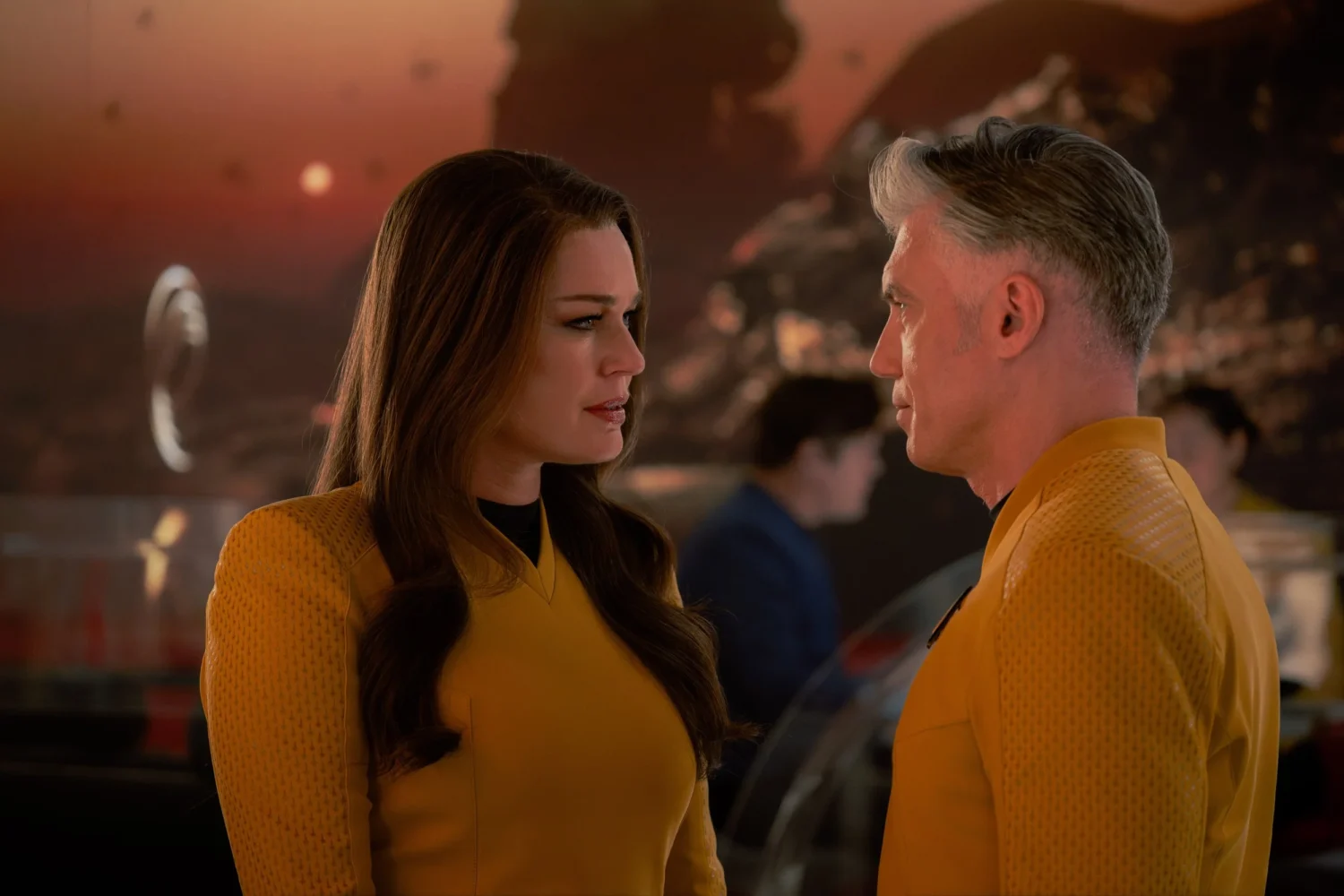
Rhys Darby returns as the mysterious Trelane-like troublemaker introduced previously, once again possessing enough reality-bending power to turn the Enterprise crew into unwilling participants in his entertainment. This time, they are dumped into the exaggerated universe of an old-fashioned television soap opera, complete with artificial lighting, melodramatic performances, absurd developments and aggressively dramatic close-ups. As a visual and tonal gag, there is something initially entertaining about watching Star Trek deliberately transform itself into daytime television from another dimension.
The problem is longevity. What works as a sketch becomes increasingly exhausting when the episode refuses to leave the bit behind, and the intentionally ridiculous performances eventually stop being funny because we already understand the joke. Strange New Worlds has earned plenty of goodwill for being willing to play with genre, but experimentation needs more than novelty to justify consuming such a large chunk of an episode. With the series operating on relatively short seasons, every hour feels valuable, making this detour particularly difficult to embrace when far more interesting character material is waiting backstage.
Trelane himself compounds that frustration. There is obvious fun in connecting this incarnation with the character from The Original Series and leaning into his distinctly Q-flavoured powers, but his presence here feels strangely disconnected from the episode’s strongest ideas. He essentially facilitates the madness and observes it rather than becoming essential to Pike’s eventual emotional confrontation. For a character capable of turning reality into his personal sandbox, he feels less like the final boss and more like somebody holding the controller while the game plays itself.
Anson Mount finds the wounded man underneath Captain Pike
Then the episode changes gears, and suddenly everything clicks.
The strongest material returns to the emotional consequences of Marie Batel’s loss and the extraordinary life Pike experienced with her. That history is especially cruel because Pike did not merely lose someone he loved; he carries memories of an entire existence that was simultaneously real to him and impossible within his ordinary reality. He remembers growing older with Marie and raising their daughter Juliet, meaning his grief encompasses a family and future that effectively vanished from the universe while remaining completely alive inside his memory.
That concept is pure Star Trek: science-fiction weirdness being used not merely as spectacle, but as a scalpel for cutting into something painfully human. Anson Mount takes full advantage of it. Pike’s conversation with the Enterprise counsellor gives Mount room to strip away the captain’s usual confidence and confront the psychological damage underneath. His recollection of teaching Juliet to read is devastating precisely because the episode finally stops performing tricks and allows Pike’s grief to occupy the screen.
This is the Pike I want Strange New Worlds to explore more often. We know his destination, and Pike himself knows enough about his future to make that knowledge an unavoidable part of his character. Add memories of a family he cannot simply recover, and his relationship with time becomes uniquely tragic even by Star Trek standards. The episode understands this beautifully during its final stretch, which only makes the lengthy soap-opera diversion feel like someone buried a dilithium crystal inside a mountain of packing peanuts.
La’an and Spock quietly deliver another emotional highlight
Pike is not the only character given worthwhile material once reality returns to something resembling normality. Christina Chong and Ethan Peck share a quieter scene between La’an and Spock that deals with the lingering emotional wreckage of their relationship without manufacturing some enormous romantic confrontation. Instead, there is an uncomfortable distance between two people whose emotional languages no longer align.
La’an has glimpsed something she perhaps wanted from Spock, while the real Spock remains increasingly committed to the Vulcan side of himself. That creates a painful disconnect when she attempts to communicate what their separation has meant to her. Peck’s restraint and Chong’s vulnerability work because neither needs to transform the moment into another soap opera. After spending so much of the episode deliberately exaggerating emotion, Strange New Worlds ironically becomes far more affecting when its actors are allowed to underplay it.
The appearance of an imagined Sybok, meanwhile, feels more like a reminder of unfinished business than a meaningful development. The series teased Spock’s half-brother much earlier, creating expectations that the younger versions of these characters might eventually properly collide. With the clock continuing to move on Strange New Worlds, invoking Sybok without substantially advancing that thread risks highlighting how many fascinating possibilities remain unexplored.
Season 4’s obsession with gimmicks is becoming the real problem
None of this means Strange New Worlds should suddenly become relentlessly serious. This is a franchise containing Tribbles, omnipotent tricksters, body swaps, musical episodes and enough temporal nonsense to give a Starfleet engineer a migraine. Tonal flexibility is one of the show’s strengths, and abandoning that would remove much of its personality.
But there is a difference between versatility and dependence on novelty. “Like Chronitons Through the Hourglass” contains enough emotional material to support an excellent Pike-focused episode without needing such an oversized comedic framework. When the character drama finally takes command, the improvement is immediate. The result is an episode whose best scenes almost become evidence against its own creative choices.
Verdict
“Like Chronitons Through the Hourglass” is one of Season 4’s strangest contradictions: an irritating gimmick episode containing some genuinely excellent Star Trek. The soap-opera concept is amusing briefly but overstays its welcome, while Trelane never becomes important enough to justify dominating the setup. Yet Anson Mount delivers some of Pike’s most affecting material, and Christina Chong and Ethan Peck bring welcome emotional subtlety to La’an and Spock.
Fans who enjoy Strange New Worlds at its most experimental may get more mileage from the television parody, but anyone craving meaningful character development will probably spend much of the runtime wishing the episode would reach its real story faster. When it finally does, the results remind me why Pike and this crew remain so compelling. There is still an excellent series inside Strange New Worlds; I just wish Season 4 would stop making us dig through so many gimmicks to find it.