
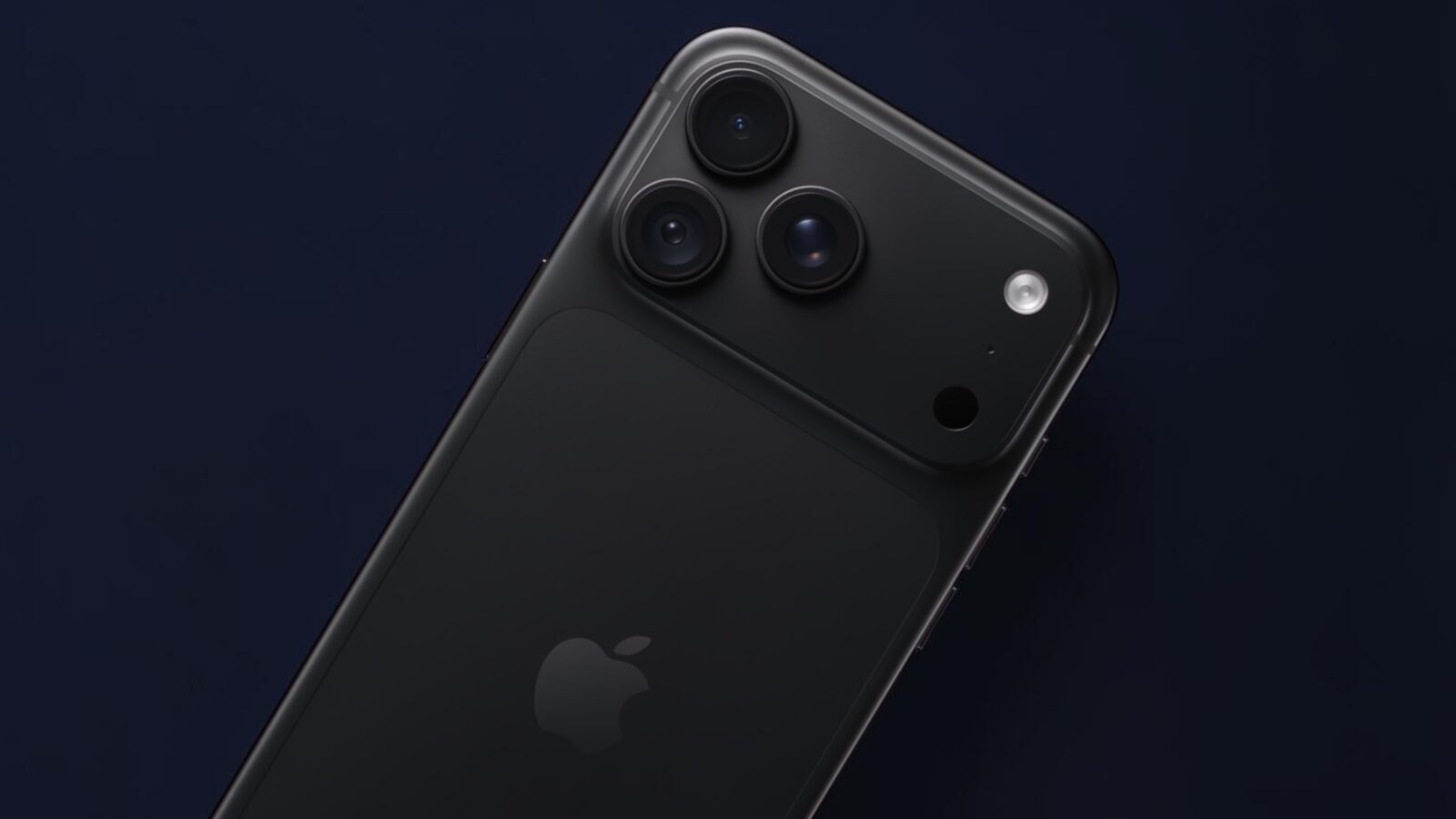
TL;DR: The iPhone 18 Pro Max hit 4,003/11,165 in Geekbench 7 CPU, 61,958 in GPU and 3,509 in Steel Nomad Light. But the star is its 75.1% Wild Life Extreme stability, retaining a 5,834 score from a 7,770 peak after 20 loops. A20 Pro is brutally fast; Apple’s redesigned cooling is what makes that speed genuinely interesting.
I already covered the iPhone 18 Pro Max as a complete package, so this time I wanted to concentrate on the part that makes my inner benchmark goblin happiest: performance. More specifically, I wanted to know whether the A20 Pro is simply another spectacularly fast Apple chip or whether the redesigned cooling system actually lets it stay fast when the workload refuses to go away.
That second question matters more than ever. Flagship phones can produce absurd benchmark numbers for a few minutes, but gaming, video processing, computational photography and increasingly AI workloads don’t politely stop before the chassis gets hot. So I ran the iPhone 18 Pro Max through Geekbench 7, 3DMark Steel Nomad Light and a full 20-loop Wild Life Extreme Stress Test. The results show that Apple’s biggest performance upgrade isn’t simply more horsepower — it’s giving that horsepower considerably more room to breathe.
A20 Pro has ridiculous CPU performance
The A20 Pro is built on a 2nm process and combines a six-core CPU with a seven-core GPU, Dual 16-core Neural Engine and Apple’s widest iPhone memory interface yet. Memory bandwidth is up 50 percent generation-over-generation, while Apple has changed the physical relationship between the processor and memory to create a more effective path for moving heat away from the silicon. Those aren’t particularly glamorous changes when you’re staring at an iPhone in a shop, but they’re exactly the sort of engineering decisions that matter once you start pushing the hardware.
And push it I did. My iPhone 18 Pro Max returned a Geekbench 7 single-core score of 4,003 and multi-core score of 11,165. Against the Galaxy S26 Ultra figures in my comparison, Apple’s single-core result is particularly brutal, while the multi-core gap becomes considerably narrower.
| Geekbench 7 CPU | iPhone 18 Pro Max | Galaxy S26 Ultra |
|---|---|---|
| Single-core | 4,003 | 2,975 |
| Multi-core | 11,165 | 9,826 |
| CPU cores | 6 | 8 |
The single-core difference works out to roughly 35 percent in the iPhone’s favour, which is substantial. Multi-core brings Samsung much closer, but the iPhone still finishes roughly 14 percent ahead despite using six CPU cores against eight. That distinction makes Apple’s result particularly impressive: the A20 Pro isn’t simply throwing additional cores at the problem.
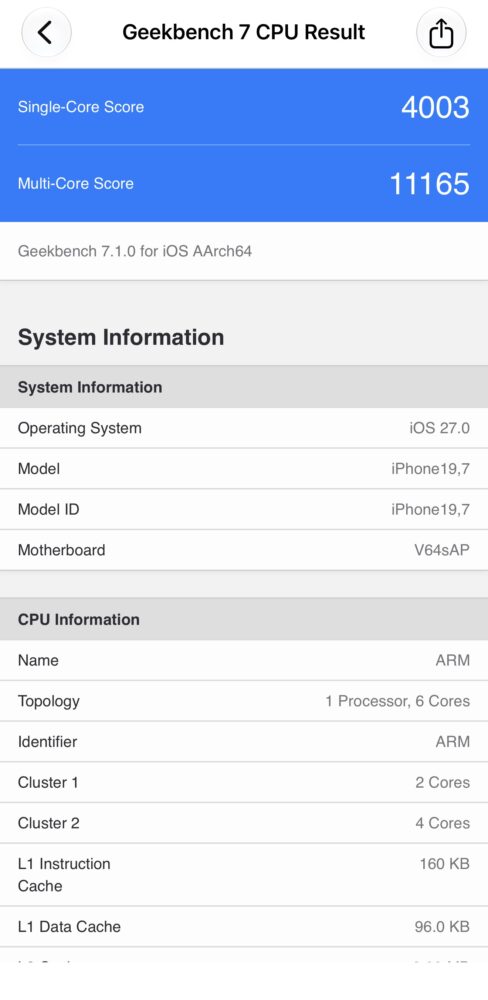
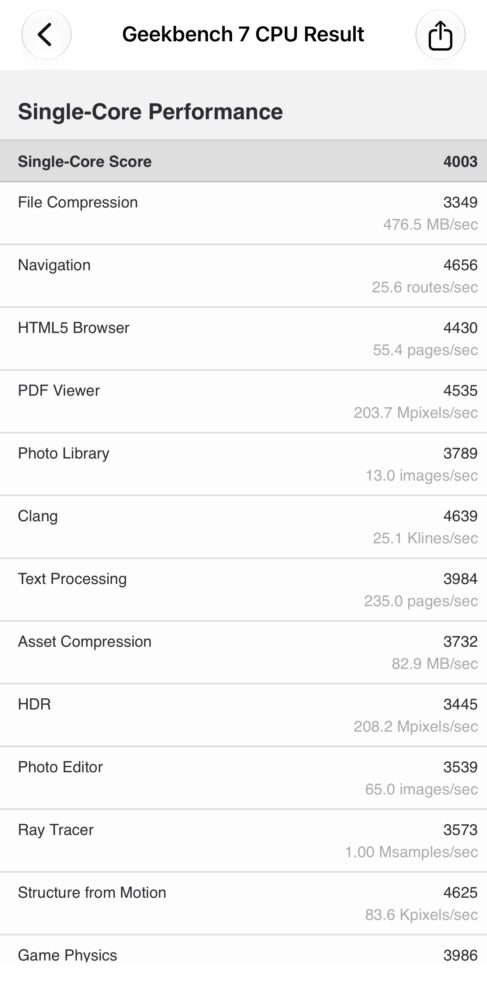
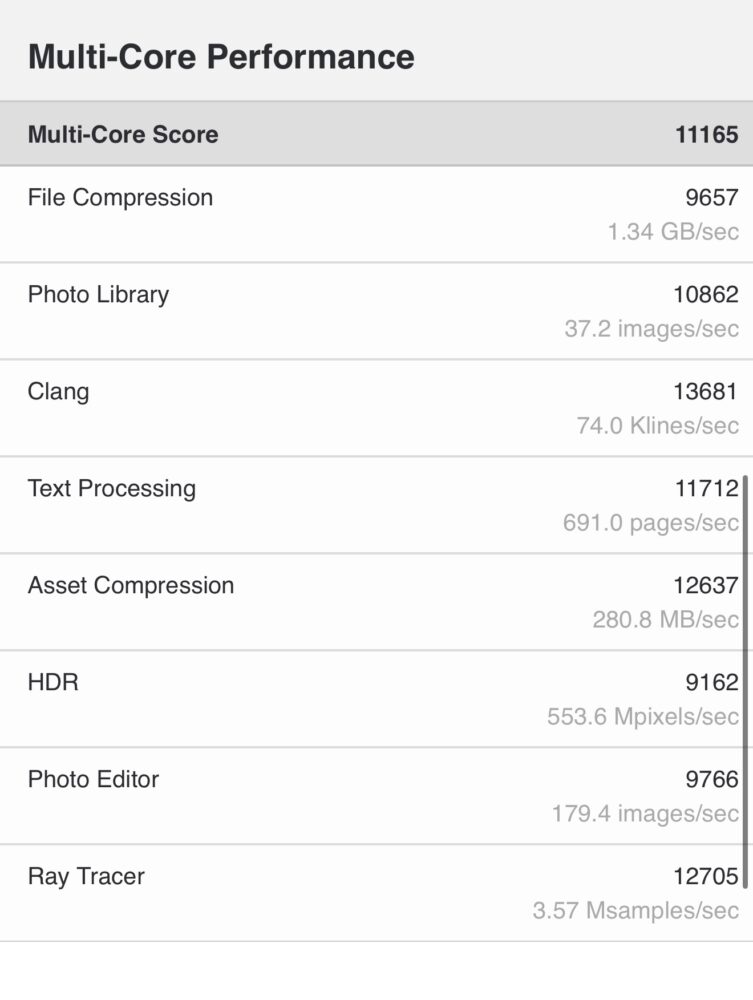
Dig deeper into Geekbench and there are similarly healthy numbers across practical workloads. I recorded 4,639 in Clang, 4,656 in Navigation, 4,535 in PDF Viewer and 3,986 in Game Physics on the single-core side. Multi-core Clang reached 13,681, Asset Compression hit 12,637 and Ray Tracer landed at 12,705. This isn’t one monster score carrying an otherwise ordinary CPU; the A20 Pro is consistently quick across very different workloads.
The seven-core GPU gives the A20 Pro some serious teeth
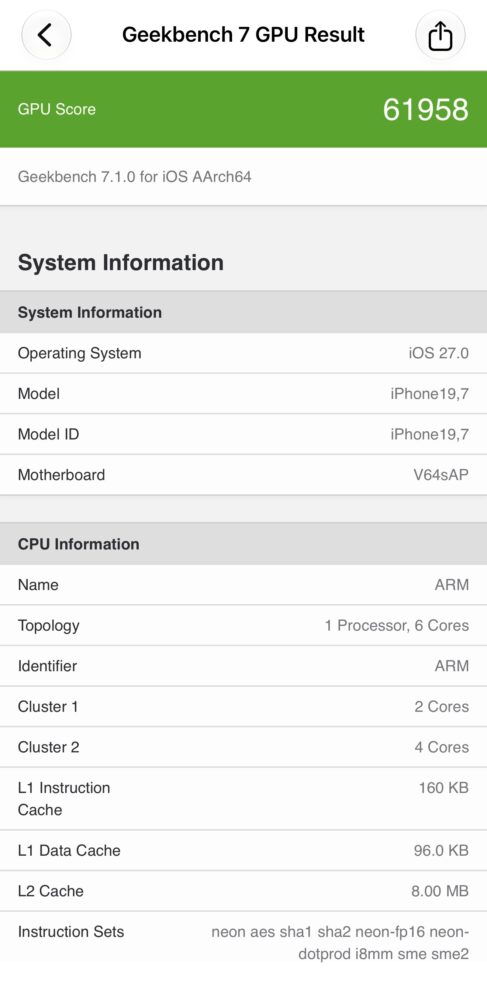
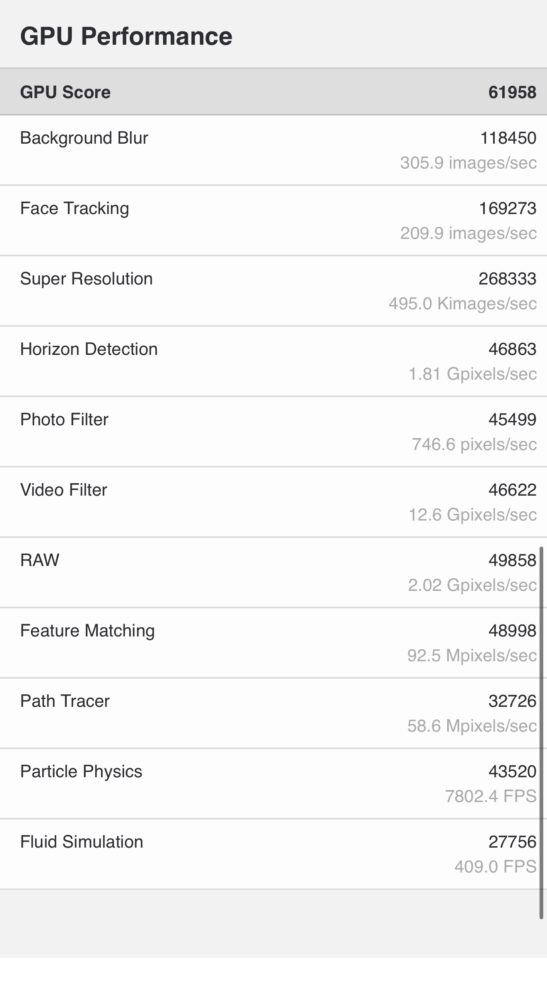
The CPU is impressive, but Apple’s seven-core GPU is where this performance story gets considerably more interesting. My Geekbench 7 GPU test returned an overall score of 61,958, which is a wonderfully ridiculous number to see coming from something I can lose between sofa cushions.
Individual workloads show how broad that graphics and compute capability is. Super Resolution scored 268,333, Face Tracking reached 169,273 and Background Blur produced 118,450. Path Tracer scored 32,726, Particle Physics hit 43,520 and Fluid Simulation returned 27,756.
| Geekbench 7 GPU | iPhone 18 Pro Max |
|---|---|
| GPU score | 61,958 |
| Background Blur | 118,450 |
| Face Tracking | 169,273 |
| Super Resolution | 268,333 |
| Horizon Detection | 46,863 |
| Photo Filter | 45,499 |
| Video Filter | 46,622 |
| RAW | 49,858 |
| Feature Matching | 48,998 |
| Path Tracer | 32,726 |
| Particle Physics | 43,520 |
| Fluid Simulation | 27,756 |
Those individual tests are also a useful reminder that modern GPU performance isn’t just about games. Image processing, machine learning, video, computational photography and increasingly sophisticated graphical workloads all lean on these resources. Apple has essentially built an increasingly general-purpose computational monster into the GPU, and the A20 Pro has plenty of muscle to feed it.
But synthetic compute performance still doesn’t answer my biggest question. For that, I needed something nastier.
Steel Nomad Light makes the GPU sweat
3DMark Steel Nomad Light is much closer to the kind of benchmark I want when evaluating a modern flagship GPU. It’s a demanding graphics workload that makes these tiny slabs of glass and silicon question their life choices, and it gives us both a score and actual frame-rate information.
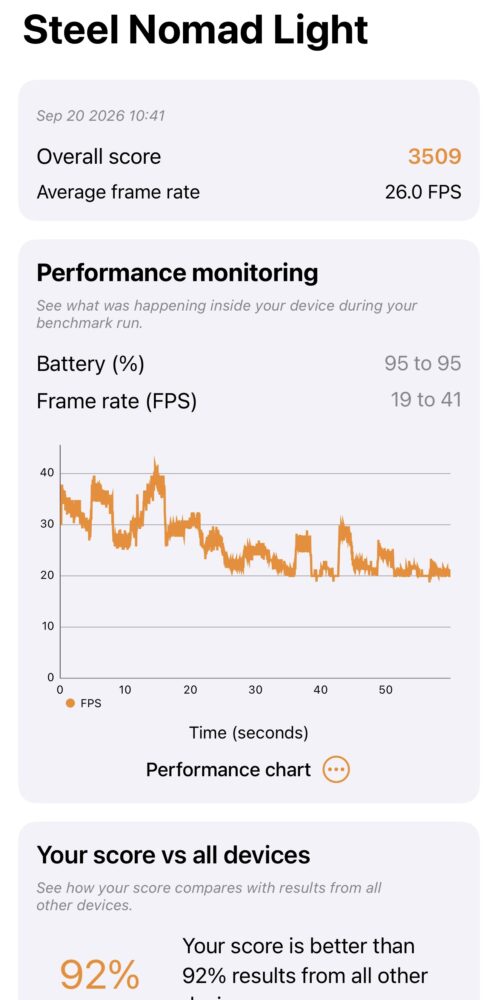
The iPhone 18 Pro Max returned 3,509 points with an average frame rate of 26.0 FPS. During the run, I saw frame rates ranging between 19 and 41 FPS.
| 3DMark Steel Nomad Light | iPhone 18 Pro Max | Galaxy S26 Ultra |
|---|---|---|
| Overall score | 3,509 | 2,708 |
| Average frame rate | 26.0 FPS | ~20 FPS |
| iPhone FPS range | 19–41 FPS | — |
That’s roughly a 30 percent advantage for the iPhone 18 Pro Max on the overall score. In flagship-phone terms, that’s not trading punches — that’s A20 Pro landing a fairly convincing lightsaber swing.
Samsung’s hardware is certainly fast enough that we’re dealing with extremely capable mobile GPUs on both sides, but Apple’s advantage here matters because Steel Nomad Light represents exactly the sort of demanding graphics workload where GPU architecture, memory bandwidth and thermal management start working as one system. A20 Pro isn’t merely posting a pretty Geekbench number. It’s delivering serious graphics performance under a considerably heavier workload.
Apple finally treats cooling like a performance feature
This is where the iPhone 18 Pro Max becomes much more interesting than another annual chip upgrade.
Apple has completely reworked the thermal architecture around A20 Pro. The new vapor chamber has three times the surface area, there’s more thermally conductive graphite, a Nanotwin copper material helps move heat through the display plate, and the chip packaging itself has been reorganised to create a more effective thermal path. The aluminium unibody then becomes another part of that heat-spreading system.

The move to aluminium suddenly makes considerably more sense when viewed through that lens. Apple’s 7000-series alloy is vastly more thermally conductive than the titanium construction used by previous Pro models, allowing heat to spread through the chassis instead of remaining concentrated around the processor. Yes, that potentially means you’ll feel more warmth across the phone, but that’s not inherently a bad thing — heat leaving the processor is precisely what you want.
Apple essentially built A20 Pro a bigger radiator.
And my stress testing suggests it wasn’t wasted engineering.
Twenty loops later, A20 Pro still has plenty left
This is the benchmark I care about most.
3DMark’s Wild Life Extreme Stress Test repeatedly hammers the GPU across 20 loops. Instead of asking how fast the phone is while everything is cool and comfortable, it asks what happens when you keep punching the accelerator after the silicon has already started getting hot.
My iPhone 18 Pro Max recorded a best loop score of 7,770 and lowest loop score of 5,834, resulting in 75.1 percent stability.
| Wild Life Extreme Stress Test | iPhone 18 Pro Max | Galaxy S26 Ultra |
|---|---|---|
| Best loop | 7,770 | ~7,900 |
| Lowest loop | 5,834 | 3,741 |
| Stability | 75.1% | ~47% |
| iPhone battery | 95% → 85% | — |
| iPhone FPS range | 23–60 FPS | — |
Now things get spicy.
Samsung comes extremely close at the beginning and can actually edge slightly higher in peak performance. If we stopped there, you’d basically call this a draw and go home for tea. But that’s exactly why single-run benchmarks can tell only part of the story.
The iPhone’s first loop scored 7,770 before performance quickly settled into the 6,000s. Loop 2 came in at 6,331, Loop 3 at 6,324, Loop 4 at 6,378 and Loop 5 actually climbed to 6,433. Performance then gradually declined as temperatures increased, eventually reaching the lowest result of 5,834.
That’s the important bit.
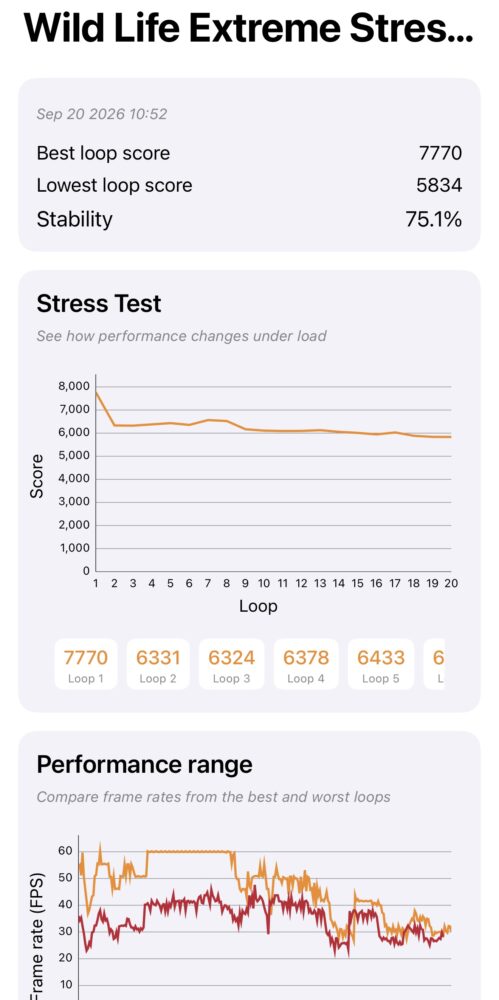
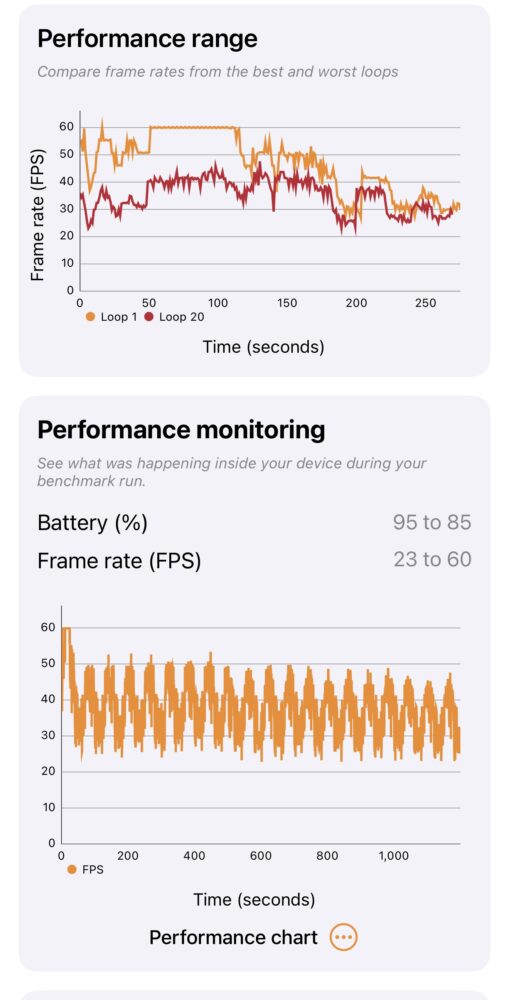
The Galaxy’s peak is impressive, but Apple’s 5,834 sustained floor is dramatically higher than 3,741. The iPhone retained 75.1 percent of its maximum result compared with roughly 47 percent for the Galaxy figure here. So while Samsung can stand toe-to-toe with Apple for that initial burst, the A20 Pro starts separating itself once this turns from a sprint into a boss battle.
The graph proves Apple’s vapor chamber isn’t just marketing
The performance graph is probably my favourite screenshot from all of this testing because it visualises exactly what Apple was trying to accomplish.
Loop 1 spends considerable time around the upper reaches of the graph and can touch 60 FPS. Loop 20 is clearly slower, frequently running around the 30–40 FPS region and occasionally falling lower. There is throttling here, and that’s important to acknowledge. Apple hasn’t discovered a secret branch of physics inaccessible to everyone else.
But throttling isn’t the problem. Uncontrolled performance collapse is the problem.
| Sustained performance | iPhone 18 Pro Max |
|---|---|
| Peak loop score | 7,770 |
| Lowest loop score | 5,834 |
| Score lost | 1,936 |
| Performance retained | 75.1% |
| Performance lost | 24.9% |
| Test loops | 20 |
A 24.9 percent decline after this kind of sustained GPU abuse is much easier for me to accept than looking only at the gap between Loop 1 and Loop 20 might suggest. The phone takes a sizeable initial step down once temperatures rise, but it then spends most of the test fighting to maintain a relatively narrow performance envelope instead of continuously plummeting.
That behaviour is arguably more important than the A20 Pro’s enormous opening score. Peak performance sells silicon. Sustained performance determines how much of that silicon you actually get to use.
This is where Apple pulls away from Samsung
The Galaxy S26 Ultra comparison becomes particularly interesting because Samsung gets very close to Apple at peak GPU performance. Rather than weakening the iPhone’s case, I think that makes Apple’s thermal result even more impressive.
At roughly 7,900 versus 7,770 in Wild Life Extreme, there’s essentially nothing meaningful separating these phones at the starting line. The Snapdragon-powered Galaxy is clearly capable of enormous short-term GPU performance. But once the workload continues and heat builds, the gap becomes far more significant.
| Peak vs sustained GPU performance | iPhone 18 Pro Max | Galaxy S26 Ultra |
|---|---|---|
| Peak score | 7,770 | ~7,900 |
| Sustained low | 5,834 | 3,741 |
| Stability | 75.1% | ~47% |
| Approx. performance lost | 24.9% | ~53% |
This is where Apple’s engineering starts earning its keep. Samsung’s tiny peak advantage disappears once sustained performance becomes the metric, while the iPhone finishes the workload operating at a substantially higher level.
That’s exactly what I wanted Apple’s new vapor chamber to accomplish. The point wasn’t necessarily to make A20 Pro unbeatable for 30 seconds. It was to give the chip enough thermal headroom that more of its performance remains available after ten, fifteen or twenty minutes.
Samsung gets close to the Jedi at the opening duel.
Then the vapor chamber pulls out the high ground.
The iPhone 18 Pro Max is becoming a proper gaming machine
For gaming, sustained performance matters far more than winning the first benchmark loop. Nobody buys a AAA game to play it for three minutes, admire the frame rate and then quit before the phone gets warm.
That’s why the combination of 3,509 in Steel Nomad Light and 75.1 percent stability in Wild Life Extreme matters so much. One demonstrates how high A20 Pro can climb; the other demonstrates how much of that performance remains when the cooling system has to earn its salary.
| Gaming performance summary | iPhone 18 Pro Max |
|---|---|
| Geekbench 7 GPU | 61,958 |
| Steel Nomad Light | 3,509 |
| Steel Nomad Light average | 26.0 FPS |
| Wild Life Extreme best loop | 7,770 |
| Wild Life Extreme lowest loop | 5,834 |
| Wild Life Extreme stability | 75.1% |
| Stress-test FPS range | 23–60 FPS |
There’s still throttling, and anyone expecting desktop-style sustained performance from a passively cooled smartphone needs to have a stern conversation with thermodynamics. What impresses me is the shape of the decline. After the initial adjustment, A20 Pro settles down rather than immediately falling apart.
For longer gaming sessions, that’s exactly the behaviour I want. Give me slightly lower but predictable frame rates over spectacular opening performance followed by the GPU falling down a thermal elevator shaft.
The Dual 16-core Neural Engine is the other half of A20 Pro
Benchmarks naturally push us toward CPU and GPU performance because they’re easy to quantify, but the Dual 16-core Neural Engine might ultimately become just as important.
On-device AI is turning into one of the biggest computational workloads on modern smartphones. Running models locally requires enormous amounts of mathematical processing while moving data rapidly between memory and specialised accelerators. That’s why Apple’s 50 percent wider memory interface shouldn’t be treated as another specification destined to die quietly on a comparison sheet.



The interesting thing about A20 Pro is that Apple appears to be designing the entire chip around increasingly heterogeneous workloads. CPU, GPU, Neural Engine and memory architecture are becoming parts of the same computational puzzle.
I haven’t run a dedicated AI benchmark here, so I’m not going to manufacture a Galaxy comparison from unrelated numbers. That’s a fight for another benchmark session.
Creative workloads show another side of A20 Pro
Geekbench’s individual workloads give us another interesting way to look at the CPU because smartphones aren’t gaming consoles with SIM cards. Photo processing, video editing, compression, HDR and computational imaging increasingly demand serious processing power.
My iPhone scored 10,862 in Photo Library, 9,766 in Photo Editor and 9,162 in HDR. Ray Tracer reached 12,705, while Clang produced 13,681.
| Geekbench 7 multi-core workload | iPhone 18 Pro Max | Galaxy S26 Ultra |
|---|---|---|
| Photo Library | 10,862 | 10,064 |
| Photo Editor | 9,766 | 7,176 |
| HDR | 9,162 | 7,674 |
| Ray Tracer | 12,705 | 12,784 |
| Clang | 13,681 | 11,920 |
Ray Tracer is basically a dead heat, with Samsung technically ahead by less than one percent. At that point I’d call the practical difference meaningless rather than start waving tiny percentage signs around like football scarves.
Look beyond that one result, however, and Apple’s broader performance is considerably stronger. The iPhone is around 36 percent ahead in Photo Editor, roughly 19 percent ahead in HDR and around 15 percent ahead in Clang. Photo Library is closer, but A20 Pro still leads there as well.
That matters because those workloads are closer to the sort of computational tasks increasingly happening behind the scenes on an iPhone. Apple isn’t simply building a benchmark monster; it’s building silicon around the increasingly complicated things smartphones actually do.
Camera performance is processor performance now
This is also why I no longer think camera performance and processor performance can be cleanly separated.
Modern smartphone photography is essentially computational imaging wearing a camera-shaped hat. The sensors capture the light, but the processor is simultaneously dealing with image pipelines, segmentation, subject recognition, HDR, noise reduction, colour processing and enormous amounts of data.
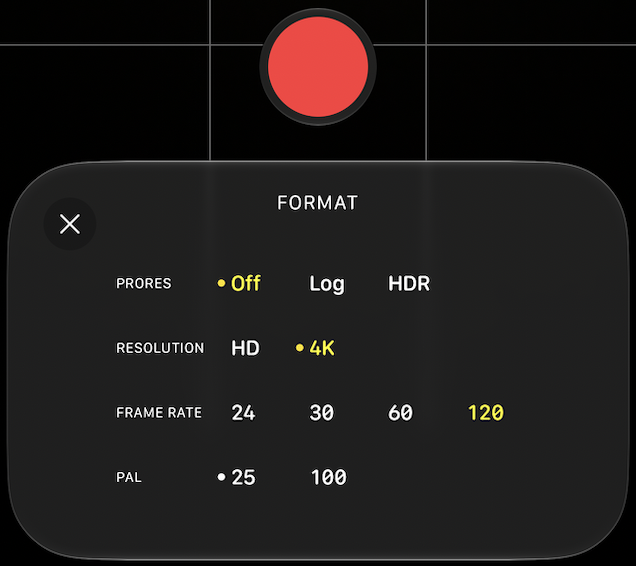
The iPhone 18 Pro Max can push 48MP information through its computational imaging pipeline while also handling sophisticated machine-learning features and demanding video formats. Throw 4K120 Dolby Vision and ProRes RAW into the conversation and suddenly all that CPU, GPU, memory bandwidth and specialised processing starts looking much less excessive.
My Photo Editor and HDR benchmark results reinforce that point. 9,766 and 9,162 respectively aren’t just numbers for the benchmark spreadsheet; they’re indicators of the computational horsepower sitting behind Apple’s camera system.
And that’s before we get into what developers can do with it.
A20 Pro’s six CPU cores punch absurdly hard
There’s another detail in these numbers that I keep coming back to: Apple is producing these CPU results with six cores.
| CPU comparison | iPhone 18 Pro Max | Galaxy S26 Ultra | iPhone advantage |
|---|---|---|---|
| Geekbench 7 single-core | 4,003 | 2,975 | ~35% |
| Geekbench 7 multi-core | 11,165 | 9,826 | ~14% |
| Clang multi-core | 13,681 | 11,920 | ~15% |
| Photo Editor | 9,766 | 7,176 | ~36% |
| HDR | 9,162 | 7,674 | ~19% |
The single-core result is particularly savage because it reflects just how much performance Apple is extracting from each high-performance core. Single-threaded speed still matters for responsiveness, application logic and workloads that don’t scale perfectly across every available core.
Multi-core naturally closes the gap because Samsung has additional CPU cores to throw into parallel workloads, but Apple still remains ahead in this set of results. That’s arguably the more impressive outcome.
Six cores. Eight cores.
A20 Pro apparently didn’t get the memo about being outnumbered.
Performance and battery are finally pulling in the same direction
All this performance has to come from somewhere, and battery consumption gives us another useful piece of the puzzle.
During my roughly 20-minute Wild Life Extreme Stress Test, the iPhone dropped from 95 percent to 85 percent battery. That’s a ten-percentage-point hit while the GPU was essentially being interrogated by 3DMark for twenty consecutive loops.
| Wild Life Extreme monitoring | iPhone 18 Pro Max |
|---|---|
| Starting battery | 95% |
| Ending battery | 85% |
| Battery used | 10 percentage points |
| Frame-rate range | 23–60 FPS |
| Stability | 75.1% |
| Duration | ~20 minutes |
I wouldn’t extrapolate that into everyday battery life because this is deliberately abusive. You’re unlikely to spend an ordinary afternoon running Wild Life Extreme on repeat unless your hobbies are extremely specific.
What matters is that the phone maintained substantial performance throughout that workload while dealing with the resulting heat and power consumption. The 2nm A20 Pro, larger battery, redesigned packaging and cooling system aren’t isolated upgrades. They’re all tackling different sides of the same performance-per-watt problem.

More performance is easy.
More performance without turning your battery icon into a countdown timer is considerably harder.
The numbers tell a surprisingly simple story
Once all my benchmark results are put together, the A20 Pro performance picture becomes remarkably consistent.
| Benchmark | iPhone 18 Pro Max | Galaxy S26 Ultra |
|---|---|---|
| Geekbench 7 single-core | 4,003 | 2,975 |
| Geekbench 7 multi-core | 11,165 | 9,826 |
| Steel Nomad Light | 3,509 | 2,708 |
| Wild Life Extreme peak | 7,770 | ~7,900 |
| Wild Life Extreme sustained low | 5,834 | 3,741 |
| Wild Life Extreme stability | 75.1% | ~47% |
Apple dominates the CPU comparison, takes a substantial lead in Steel Nomad Light and holds dramatically more GPU performance once the stress test heats everything up. Samsung’s strongest showing comes right at the beginning of Wild Life Extreme, where it can slightly edge the iPhone’s peak result.
But that’s almost perfect for illustrating why I think the iPhone 18 Pro Max performance story is so interesting.
If Apple had simply built another chip capable of producing a gigantic first-run benchmark, I’d be impressed but not particularly surprised. Cupertino has been doing that for years. What’s different here is how aggressively the rest of the hardware has been redesigned around sustaining A20 Pro performance.
Samsung can get extremely close when both phones are fresh.
Apple’s advantage appears when you refuse to let them rest.
This much performance is complete overkill — and that’s the point
For ordinary smartphone use, almost everything I’ve just benchmarked is hilarious overkill.
WhatsApp doesn’t care that my iPhone scored 4,003 in Geekbench single-core. Instagram won’t unlock a secret mode because Steel Nomad Light hit 3,509. And I’m reasonably certain nobody has ever opened Mail and whispered, “Thank God for the three-times-larger vapor chamber.”
But performance headroom isn’t about making today’s lightweight apps run dramatically faster. It’s about giving tomorrow’s workloads somewhere to go.

AAA gaming is getting heavier. Computational photography keeps demanding more processing. Video workflows that once required dedicated cameras and computers increasingly happen directly on phones. Local AI models want compute power and memory bandwidth. And developers will inevitably find new ways to consume every scrap of performance Apple gives them, because software developers are basically Pac-Man for CPU cycles.
That’s why the benchmark that impressed me most isn’t Geekbench’s 4,003 single-core result.
It’s 75.1 percent.
Peak performance tells me A20 Pro is incredibly fast.
That stability figure tells me Apple has finally built an iPhone designed to let it stay fast.
Verdict
The iPhone 18 Pro Max produces some frankly absurd performance numbers. My unit scored 4,003 single-core and 11,165 multi-core in Geekbench 7, 61,958 in Geekbench GPU and 3,509 in Steel Nomad Light, with that latter test averaging 26 FPS. Those are flagship numbers with very sharp teeth.
But none of them is my favourite result.
That honour goes to the 75.1 percent stability score in Wild Life Extreme. My iPhone started at 7,770, settled down as temperatures increased and ultimately bottomed out at 5,834 after twenty loops. It throttles, because of course it does, but it retains an impressive amount of its performance after sustained punishment.
And that’s where the Galaxy S26 Ultra comparison makes Apple’s achievement stand out even more. Samsung can get remarkably close in peak Wild Life Extreme performance, even slightly edging the iPhone at the start, but Apple’s thermal architecture allows A20 Pro to remain operating at a much higher level once sustained heat enters the equation. The fight becomes less about who throws the first punch and more about who’s still swinging in round twenty.
Apple didn’t simply give the iPhone 18 Pro Max another faster processor. It redesigned the surrounding hardware so that A20 Pro can actually use more of the performance it already has. The larger vapor chamber, aluminium structure, new chip packaging, wider memory interface and 2nm silicon all contribute to that equation.
For everyday use, it’s ludicrously overpowered. For gaming, creative workloads, computational photography and whatever increasingly demanding AI workloads arrive next, that excess performance suddenly looks a lot more sensible.
The Force is strong with this one.