

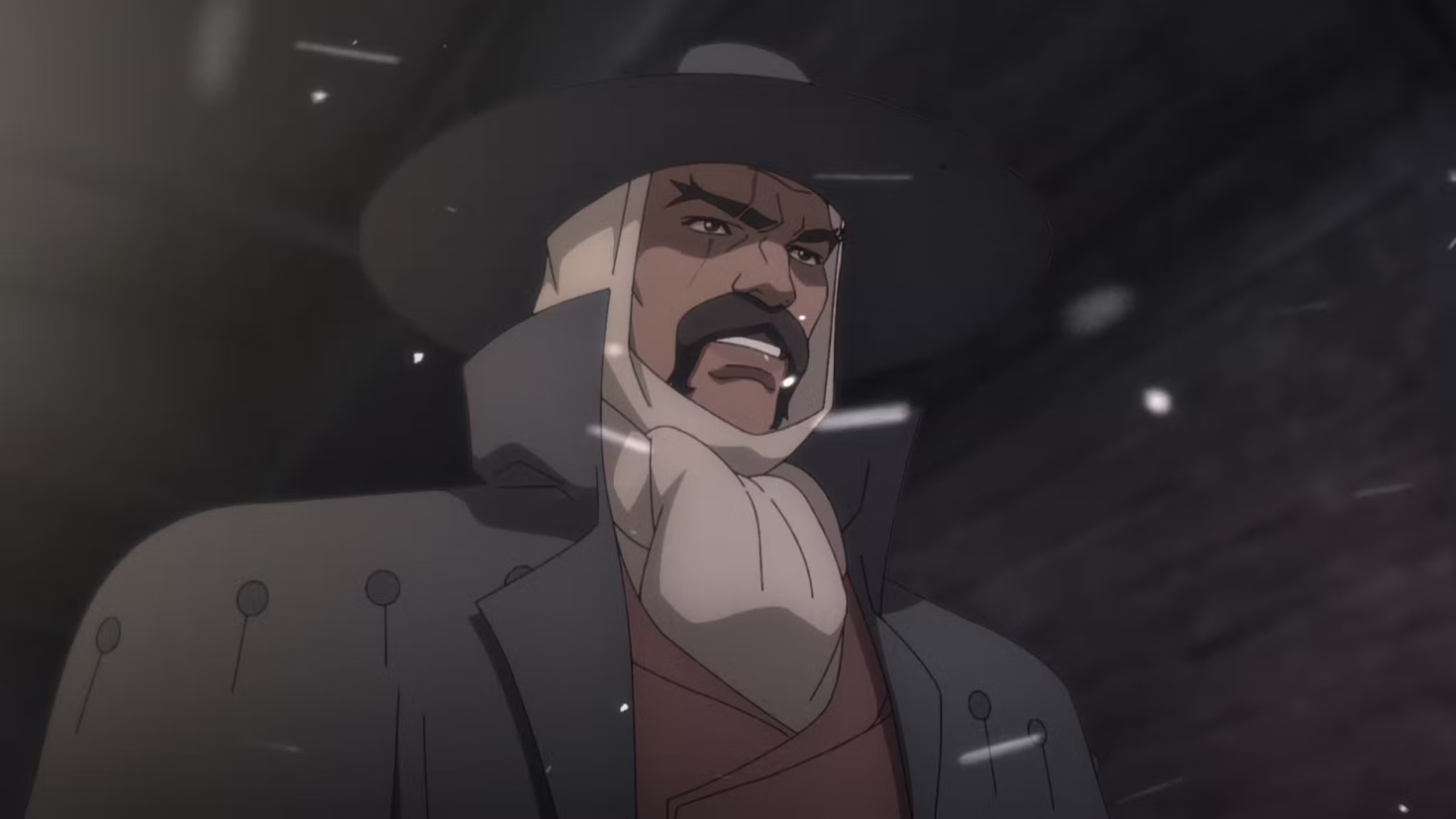
TL;DR: Bass x Machina gives real-life lawman Bass Reeves a laser arm, a steampunk frontier and a surprisingly sharp conscience. Gorgeous, fun and smart, it’s let down only by a too-short six-episode run on Netflix.
Westerns have spent decades pretending the frontier was a sepia-toned place populated almost entirely by squinting white guys, so it’s a joy when someone kicks the saloon doors off their hinges. Netflix’s Bass x Machina does exactly that, and after bingeing all six episodes, I came away grinning like a kid who just found the secret level. The show is built around Bass Reeves, the real-life escaped slave who became one of America’s first Black U.S. Marshals, a man whose story has already fuelled Watchmen and a Taylor Sheridan series. Here, though, history is basically a character select screen. Created by LeSean Thomas (Yasuke) and animated by Studio Mir (The Legend of Korra), it keeps Reeves and the Civil War’s aftermath, then hands the frontier a steampunk overhaul. Bass now has a robotic arm that fires lasers, which is the most Saturday-morning-cartoon sentence I’ve written all year, and I mean that as a compliment.
Brian Tyree Henry is the hero of this story
Brian Tyree Henry voices Bass and also serves as executive producer, and you can feel him guarding this character like a final boss guarding loot. His performance has real weight, the kind of voice that sounds like it has seen too much and still gets up every morning anyway. This Bass isn’t a Marshal yet; he’s a bounty hunter still carrying the war around, including that arm, which came courtesy of a gruesome experiment by Confederate General Rivenbark (Currie Graham), who remains frustratingly at large. Henry never plays him as a grim-dark edgelord, which is a trap plenty of cyborg gunslingers fall into. Instead, Bass is a husband with a third kid on the way, and that domestic warmth makes every flash of anger land harder. Think Guts from Berserk if Guts had a loving home and a reason to calm down.
The supporting cast is stacked. Tati Gabrielle plays Dana Starr, a gadget-obsessed aspiring engineer searching for her missing uncle, who ends up riding along on Bass’s classic “one last job.” It’s the grizzled-mentor-meets-plucky-kid formula Westerns love, but Gabrielle gives Dana enough spark that she never feels like an escort mission. Janelle Monáe voices Bass’s wife Glory, and also sings the theme song, because apparently Monáe has decided to be good at everything. Cree Summer rounds things off as Ahni, a lightning-wielding firebrand tied to Bass’s past, and having the voice of half of your childhood cartoons throwing thunderbolts is a delight.
The world-building is the real scene-stealer
If Bass is the hero, the Badlands are the scene-stealer. This frontier comes loaded with bull-shaped mech suits, guns that fire goop, elemental powers and buildings that literally get up and walk around, like Howl’s Moving Castle went cowboy. Studio Mir’s pedigree shows, and Korra fans will feel right at home whenever someone starts bending the elements. The anime-inspired style is a perfect match for a setting this unhinged, because realism would have choked the fun right out of it. Every piece of tech feels like it belongs to someone and does something, rather than existing purely so the trailer looks cool.
The smartest move is who gets to own that world. Choctaw characters, including Bass’s friend Lighthorse (Chaske Spencer) and the elemental mystics known as the Holy People, are woven into the story instead of being pushed to the edge of the map. Etta (Starletta DuPois), a Native inventor who protects her hideout with electrified fruit trees, is an instant favourite, and the show insists what she does is engineering, not mysticism. That’s a quietly brilliant correction to a century of Westerns treating Indigenous characters as either spiritual guides or targets. Also, electrified fruit trees. I need those in a Fallout settlement immediately.
Lasers, mechs and some seriously uncomfortable questions
Under all the chrome, Bass x Machina has real things on its mind. Bass is weighing whether to become a Marshal for a system that openly values him less; bounties on Black outlaws pay half what white ones do, which tells you everything. Even the gleaming high-tech monorail still splits passengers by race, a sharp reminder that a tech upgrade isn’t a patch for prejudice. A train robbery spirals into an argument over whether you owe anything to laws that were never built to protect you. Ahni wants Bass to join her violent crusade and treats his reluctance as betrayal, while Glory pleads with him not to let rage rewrite the man she married.
What impressed me is that the show doesn’t pick a side and slap a moral on the end like an old PSA. Both arguments carry weight, which gives the series a moral texture closer to Andor than a typical animated adventure. The catch is the episode count. Six episodes means some of these arguments feel like they’re only reaching the mid-game when the credits roll, and Rivenbark in particular feels like a raid boss we barely got to fight.
Smart enough to think about, fun enough to binge
Here’s the thing: none of this turns into a lecture. Dana’s wide-eyed love for every new machine is basically the show’s own personality, and it wants you to enjoy the ride. When a gang of ex-Confederate killers gets torched by a woman wielding fire, it’s pure popcorn catharsis, and the series knows it. That balance between big ideas and big spectacle is something plenty of “prestige” animation forgets, too busy being important to remember being entertaining.
The short run makes it a perfect weekend binge, but also leaves you hungry rather than full. Western purists who want dust, horses and nothing that runs on steam may find the genre mash-up too much. Anime fans, steampunk nerds and anyone who enjoyed Yasuke‘s remix of history, though, are getting something special.
Verdict
Bass x Machina is a wildly fun, surprisingly thoughtful Netflix animated series that turns a real American legend into a laser-armed steampunk gunslinger without losing the man underneath. Brian Tyree Henry gives it a big, warm heart, the supporting cast is excellent, and the world-building puts Black and Native characters where Westerns rarely have. Its questions about justice, anger and loyalty hit harder than you’d expect from a show with walking buildings. Six episodes is too short, the villain is underused, and traditionalists may balk at the mech suits. For everyone else, saddle up.