


TL;DR: Instant handles most of life. Medium is the smart first upgrade for research, planning, and moderate coding. High and above exist for genuinely difficult work. Terra is the practical daily choice in Work and Codex while Sol takes the heavy lifts. Leave automatic switching on and only override when the first answer feels thin.
I still remember the days when picking a ChatGPT model felt like ordering coffee at a place that had rewritten the menu in Klingon every other month. One week you were supposed to swear by the latest o-series reasoning beast, the next week everyone was whispering about some multimodal speed demon that could also write your grocery list while juggling three PDFs. By early 2026 the whole naming circus finally calmed down, sort of, and what we have now is cleaner on the surface yet still full of the same delightful geek tension between “just make it fast” and “I need this answer to survive peer review.”
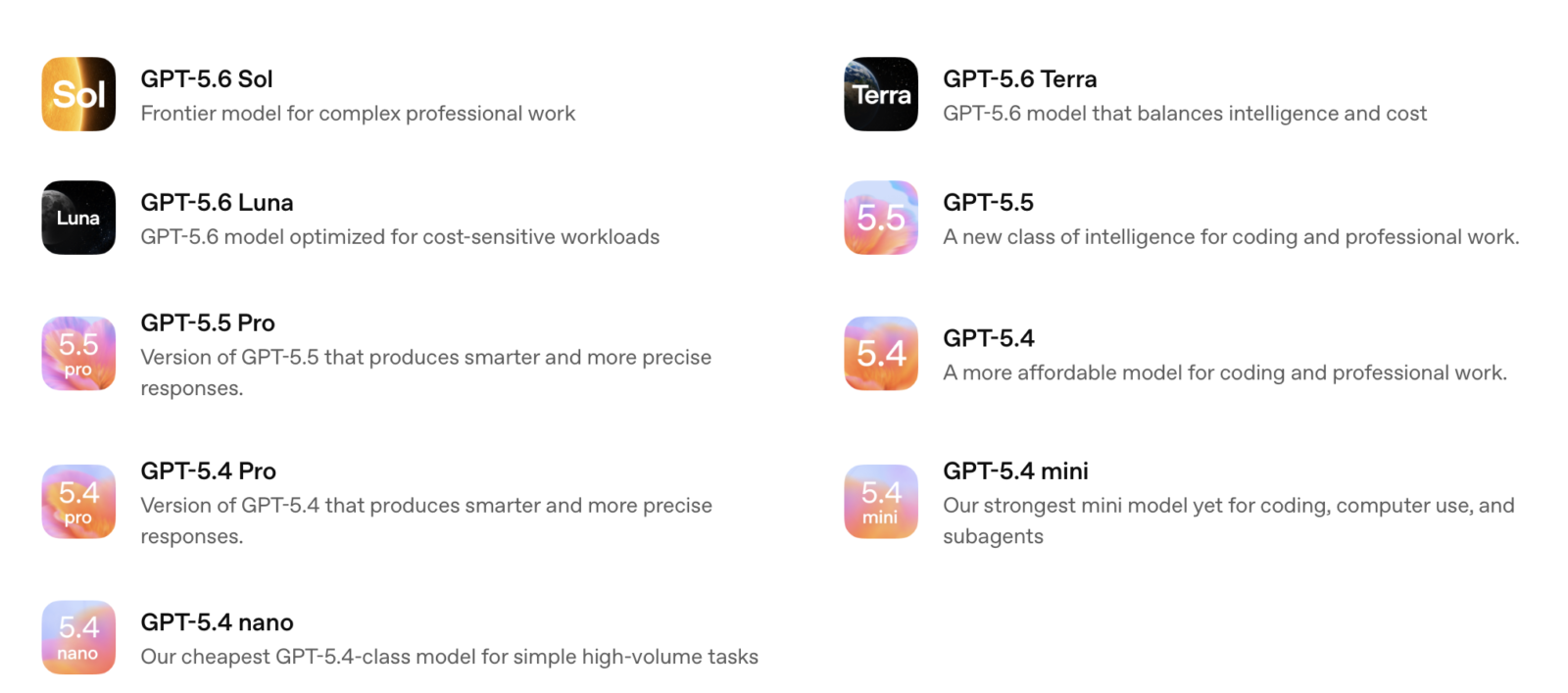
If you open ChatGPT today you will mostly see a simple set of reasoning dials rather than a museum of retired model names. Instant sits there as the default, ready to fire back almost before you finish typing. Medium and High give the system more room to think. Extra High and the Pro tier exist for the nights when you are staring at a tangled codebase or a research question that refuses to behave. Underneath those labels the actual engines have shifted again. The everyday Instant experience runs on a highly optimized GPT-5.5 Instant variant, while the deeper settings lean on different flavors of the GPT-5.6 family. The names Sol, Terra, and Luna show up once you step into Work, Codex, or the API, and they are not just marketing fluff. They represent real trade-offs in depth, speed, and cost.
I spend a ridiculous amount of time living inside these tools, both for actual work and for the pure joy of poking the machine until it surprises me. What follows is the mental model I use every single day, not some polished corporate flowchart. Think of it as the advice I would give a friend who just pinged me at 1 a.m. asking which setting will stop wasting their tokens.
Everyday life belongs to Instant. Rewriting a half-baked email, brainstorming titles for a half-finished blog post, asking why the new router keeps dropping devices, or turning a messy meeting transcript into something readable all live happily in Instant territory. The model is fast enough that the conversation still feels like talking to a sharp colleague rather than waiting for a committee to finish arguing. I leave Instant selected by default and only reach for something heavier when the first answer comes back thin or when I can already feel the problem has layers.
The moment the task starts looking like research, multi-step planning, or anything that needs the model to hold several constraints in its head at once, Medium becomes the sensible jump. I use it constantly for outlining longer articles, comparing product options across half a dozen sources, or sketching the architecture of a small script before I open the IDE. Medium still feels responsive, but you can sense the extra deliberation. High is the setting I reach for when Medium starts skating over important details or when the problem involves conflicting requirements, dense technical documentation, or stubborn bugs that laugh at surface-level suggestions. Extra High exists for the rare cases where I am willing to wait longer because the cost of a wrong answer is higher than the cost of another coffee.
Pro is its own animal. It is not simply “High but more.” It pulls in the stronger Sol Pro variant and is the place I go when a workflow stretches across many steps or when I need the model to stay sharp across a long, evolving conversation. Most people do not need it for daily work. The people who do know who they are. They are the ones running complex analyses, maintaining large personal knowledge bases, or treating ChatGPT as a genuine collaborator rather than a fancy autocomplete.
Automatic switching is available on eligible paid plans and I generally leave it on. ChatGPT is decent at noticing when a prompt looks more demanding and quietly bumping itself up to Medium. It is not perfect. Sometimes it stays too light on a prompt that looked casual but actually needed depth, and sometimes it overthinks a simple request. When that happens I just override manually. The goal is never to turn model selection into another productivity system that steals time from the actual work.
The Free and Go tiers still give you a surprisingly capable experience for light use. You get Instant-level answers, limited access to some of the deeper tools, and enough room for occasional image generation or file analysis. The ceiling appears quickly if you treat ChatGPT as a daily workhorse. Plus is where most serious individual users should land. It unlocks the Medium and High reasoning levels on the stronger Sol lineage, expands the limits on research and Codex, and removes the constant feeling that you are about to hit a wall. Pro is the escalation path for heavy users, with two price points depending on how aggressively you burn through the allowance. Business and Enterprise sit in a different category entirely. They are less about raw model power and more about workspace controls, data protections, and the ability to connect internal tools without turning your company’s knowledge into training data.
Once you leave the main chat interface the naming changes again. Work is built for longer projects that produce finished artifacts, documents, decks, spreadsheets, the kind of output you would actually send to someone else. Codex is the software-focused cousin, happier living inside repositories, reviewing diffs, writing tests, and iterating on code. In both environments Sol is the heavyweight choice for open-ended or high-stakes work, Terra is the practical daily driver that balances quality and speed, and Luna is the economical sprinter for high-volume or highly predictable tasks. The default Power setting in Codex already lands on a solid Sol Medium combination, which is a reasonable place to begin if you are unsure.
Developers working through the API face a cleaner but still deliberate choice. The same three GPT-5.6 family members appear, and the decision is mostly about the cost-capability curve. Sol when the answer quality is non-negotiable, Terra when you want production economics without dropping to the lightest tier, Luna when the workload is repetitive and latency or price dominates. Specialized models still exist for images, speech, embeddings, and the rest, and none of them are interchangeable with the general-purpose trio.
The older names that once dominated every Reddit thread have largely left the main interface. GPT-4o and its close relatives were retired from ChatGPT earlier in the year. The original o-series reasoning models are either gone or living on borrowed time in legacy settings. Old conversations usually keep working by mapping to a newer equivalent, so there is no need to panic and rebuild every thread. The API often keeps models around longer than the consumer product, which is useful if you have production code pinned to a specific checkpoint, but it also means you should check the deprecation notices rather than assuming the ChatGPT picker tells the whole story.
My personal workflow has settled into a comfortable rhythm. Instant for the constant low-stakes chatter that fills a geek’s day. Medium as the first escalation when a question starts to feel like real work. High when the problem fights back. Extra High or Pro only when the stakes justify the wait. In Work and Codex I default to Terra unless the task is clearly in Sol territory, and I keep Luna in the toolkit for bulk extraction or classification jobs. Automatic switching stays enabled because I would rather spend my attention on the problem than on the model picker.
The biggest mistake I still see people make is treating every prompt like it deserves the maximum reasoning budget. That approach turns a fast tool into a slow one and burns through limits for no good reason. The second biggest mistake is never leaving Instant at all, then wondering why the answers feel shallow on harder tasks. The middle path is boring and effective. Start light, escalate when the output tells you it is necessary, and remember that the model is a collaborator, not a magic oracle that improves simply because you waited longer.
I have watched friends waste entire afternoons second-guessing model choices instead of iterating on the actual work. The picker is a tool, not a personality test. Use Instant until it stops being enough. Move up when the conversation needs more brain. Save the top tiers for the nights when the problem is genuinely hard and the answer matters. That approach has served me well through every model renaming cycle so far, and it still holds in 2026.
Verdict
For the overwhelming majority of people the right answer in 2026 is simple. Leave ChatGPT on Instant for daily life, switch to Medium the moment a task starts requiring real analysis or multi-step thinking, and keep High, Extra High, and Pro in reserve for the hard problems. In Work and Codex treat Terra as your everyday workhorse and reach for Sol when the job is open-ended or high-stakes. The models have gotten better at staying out of your way. Your job is to return the favor and stop overthinking the dial.