


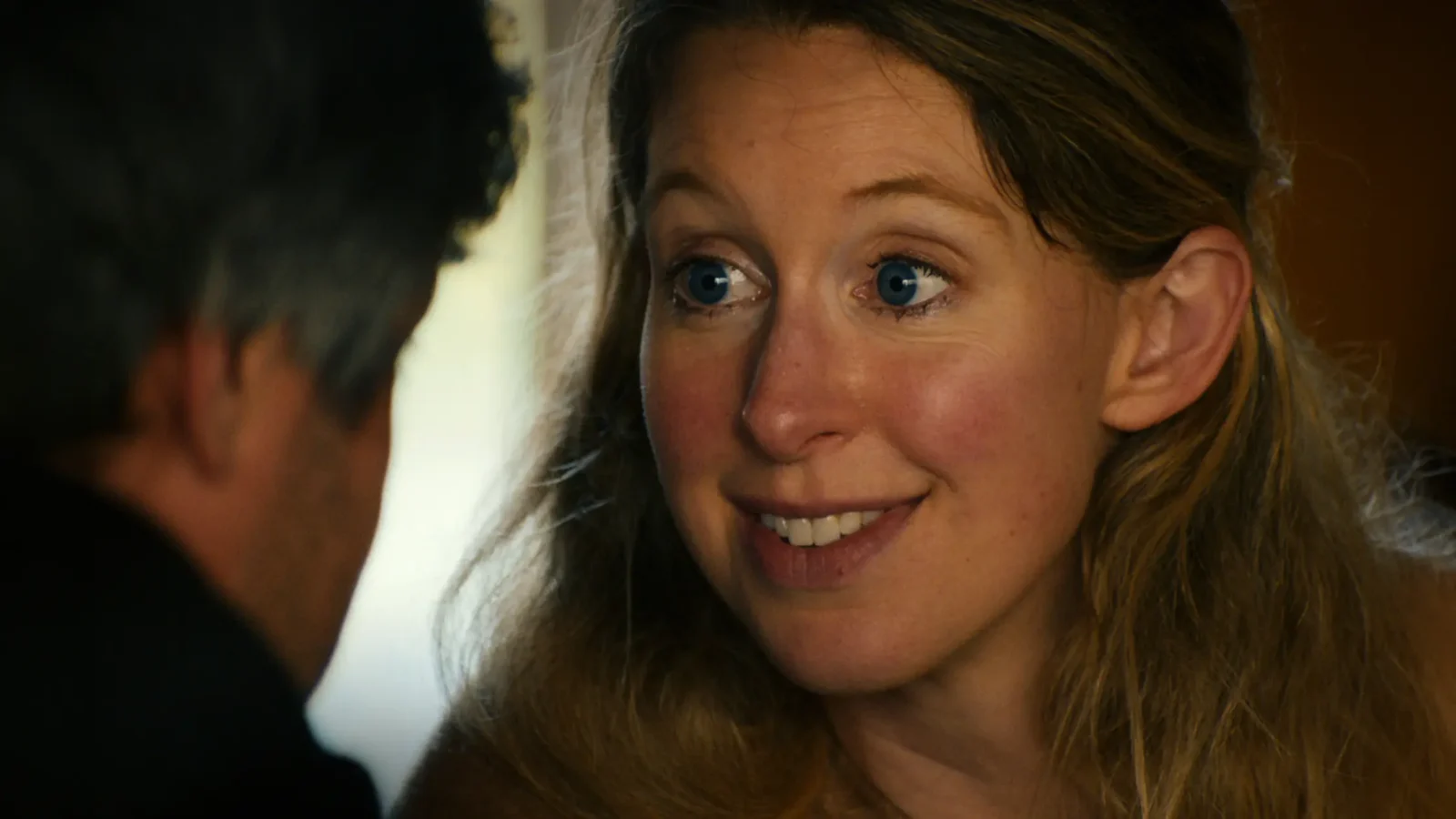

TL;DR: Nathan Fielder and Lance Oppenheim spend Elizabeth Holmes’s last weeks before prison in her home, and get a funny, unsettling documentary out of it. It ends up questioning how quickly we think we know someone.
For years, most people saw Elizabeth Holmes in a black turtleneck, explaining what her company could do with a few drops of blood. Theranos promised to make blood testing easier. Holmes, a young founder with an instantly recognisable voice, gave Silicon Valley a story it was eager to believe.
By the time a jury convicted her of defrauding investors, another image had taken its place. You could watch Amanda Seyfried play Holmes in The Dropout and feel you knew the woman well enough to recognise when the actress had got her right. It’s worth considering how strange that is. Most of us had spent more time watching someone play Elizabeth Holmes than we had listening to Holmes herself. That history gives You Can See Everything its reason to exist.
With 34 days left before she is due to report to prison, Holmes and her partner, Billy Evans, invite filmmakers Nathan Fielder and Lance Oppenheim into their home. You can see the appeal from her side. Millions of people have had the opportunity to form an opinion of her at work.
Perhaps they would feel differently if they could spend an ordinary morning with her family. What makes this such a fascinating documentary is the question buried in that invitation. What would Elizabeth Holmes consider an ordinary morning once she knew we were coming?
Consider what happens over breakfast. Holmes is whisking eggs while talking to Fielder. Evans reaches over, takes the bowl and carries on whisking. In most kitchens, a guest would let that pass. Fielder wants to know why Billy took the eggs. It’s an exceptionally funny question because the manners involved are so familiar. You’ve probably seen one half of a couple do something that made you glance at the other. Fielder is willing to risk the rest of breakfast to ask what you’d save for the car ride home.
Much of the early film’s pleasure comes from Evans gradually emerging as a subject in his own right. He seems keen for Fielder to appreciate how much he loves Holmes. It’s a touching impulse, particularly with a separation approaching. It also makes him unusually attentive to the impression the two of them are making. You begin to notice who gets to finish an answer and who decides when a conversation has run its course. The question of who speaks for Holmes, which once concerned an entire industry, has followed her all the way into her kitchen.
Fielder had originally intended to stay behind the camera. Holmes and Evans kept talking to him there, and eventually the operators began turning to catch his side of the exchange. That created a practical problem. With a single camera, the time it took to pan towards the listener was long enough to lose the look on their face when they first heard the question. The crew switched to a wide shot and two cameras with long zoom lenses. It’s a lovely piece of filmmaking ingenuity because what the directors wanted to preserve was so fleeting. An answer can take a minute. The expression that makes you reconsider it can be gone before the camera arrives.
Crucially, that arrangement also gives us time to look at Fielder. I appreciated being able to decide for myself when he’d asked a fair question and when I thought his hosts had earned a little peace. His silences are especially good. From behind a camera, silence can be a journalist’s way of giving someone room to continue. On camera, sitting in another person’s home, it can start to look an awful lot like a guest declining to do his share of the conversation. Oppenheim lets that embarrassment sit with the filmmaker. Some of the biggest laughs come at his expense.
The harder moments belong to Holmes. A woman facing years away from her family has good reason to be frightened, and the film allows that fear its full weight. I found myself thinking about how quickly sympathy can stray from its source. Feeling for somebody facing separation tells me something about the separation. It gives me precious little insight into what she knew when she spoke to investors. Suspicion is just as slippery. Once you know about Theranos, it’s remarkably easy to watch someone choose her words carefully and decide you’ve caught her doing something. Fielder and Oppenheim make you conscious of how much interpretation you’re contributing from your seat.
That becomes especially interesting when Seyfried enters the picture. The directors turn to her to explore conversations that took place beyond the reach of their cameras. Here is an actress who has already spent considerable time deciding how Holmes might behave in private.
Now she has footage of the actual woman to work from, and some of it gives her fresh reason to reconsider those decisions. There’s a peculiar generosity in letting an actor show us the uncertainty involved in a performance audiences have already applauded. It also raises an uncomfortable possibility. Sometimes an actor is easier to believe because she’s done us the courtesy of working out what a gesture means.
You Can See Everything occasionally spends longer on an exchange than its discovery warrants. Still, editor Adam Locke-Norton puts the accumulated time to good use. By the later passages, you’ve developed opinions about this household. You recognise an interruption. You think you know what a look from Billy means. The filmmakers can then return to something you remember and expose the considerable distance between what the camera recorded and what you supplied yourself.
I kept coming back to those eggs. I could tell you exactly who had the bowl and who took it. Give me another minute and I could probably offer you a fairly confident reading of the relationship, based on evidence that wouldn’t get me through a follow-up question from Nathan Fielder.
That’s the achievement of You Can See Everything. Holmes opens her door hoping that proximity might change how people see her. By the end, the person whose judgement I wanted to revisit was my own.