
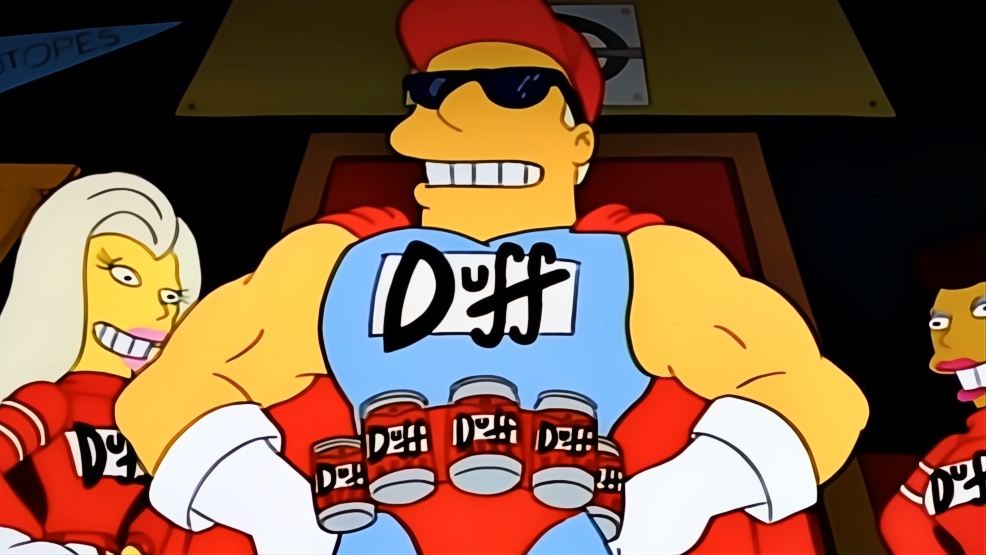
After nearly three decades of loud entrances, exaggerated bravado, and deliberately hollow slogans, one of The Simpsons’ most recognizable supporting characters has been quietly written out. In a recent season 37 episode, the long-running animated series retires Duffman, the corporate mascot of Duff Beer, marking the end of a character that has been part of the show’s satirical fabric since the late 1990s.
The Simpsons Season 37
Duffman first appeared during season 9, arriving fully formed as a parody of beer advertising excess at its peak. With his skin-tight costume, third-person speech, and relentless enthusiasm, he was less a character than a walking critique of marketing culture. His debut established the tone that would define his role: an aggressively cheerful spokesman whose concern for responsibility extended only as far as the script required. Over time, Duffman became shorthand for the emptiness of corporate messaging, especially in industries built on lifestyle branding.
Unlike many Springfield residents, Duffman was never meant to evolve emotionally or morally. That static quality was part of the joke. While characters like Homer or Moe were allowed moments of self-awareness or growth, Duffman existed in a loop of catchphrases and promotional stunts. His frequent “deaths” over the years only reinforced the idea that the character was disposable by design, easily replaced by the next actor in the suit.
In season 37’s episode “Seperance,” a clear parody of Severance, the show formalizes what had long been implied. The Duff Corporation retires Duffman outright, citing the decline of traditional advertising and the inability of mascot-driven branding to resonate with younger audiences. Within the episode, this is framed as a corporate calculation rather than a moral reckoning, consistent with how The Simpsons has always treated Duff as a symbol of cynical marketing.
The explanation reflects a real-world shift. Mascots that once thrived on television ads now struggle for relevance in an ecosystem dominated by social platforms, short-form video, and algorithmic promotion. While some branded characters have adapted, many have faded as advertising strategies become less centralized and less character-driven. Duffman’s removal feels less like a dramatic loss and more like an acknowledgment of that transition.
Still, his absence is notable. Duffman functioned as an efficient comedic tool, able to puncture scenes with immediate satire. His exaggerated masculinity and performative enthusiasm captured a specific era of consumer culture, and his recurring appearances offered continuity even as the show itself changed. Removing him narrows the show’s roster of pure symbolic characters, those who exist primarily to critique systems rather than advance plot.
That said, The Simpsons has rarely treated continuity as binding. Characters presumed gone have returned before, sometimes without explanation. Whether Duffman’s retirement is permanent or simply another temporary gag remains unclear. For now, though, the show has chosen to close the door on one of its most pointed corporate caricatures, leaving behind a reminder of how both advertising and satire have shifted since the character first shouted his way into Springfield.