
TL;DR: Star Trek: Starfleet Academy Episode 5 is the series’ strongest outing yet, blending Deep Space Nine legacy with a heartfelt coming-of-age story that finally gives the show a clear identity. Kerrice Brooks shines as Sam, the Sisko connections feel meaningful rather than nostalgic for nostalgia’s sake, and the episode proves this series works best when it embraces youth, choice, and personal agency. Ignore the weird blobfish dinner subplot, and you’ve got a genuinely moving piece of Star Trek.
Star Trek: Starfleet Academy
Star Trek: Starfleet Academy Episode 5 Review – The Show Finally Earns Its Uniform
There’s a moment in Star Trek: Starfleet Academy Episode 5 where I felt the franchise snap into focus again.
Not in a “phasers on stun” way. Not in a nostalgia-bait cameo blitz. But in that deeply Star Trek way, where a character stares into the void of expectation, destiny, and self-doubt and decides to define themselves anyway.
Episode 5, “Series Acclimation Mil,” is easily the best installment of Star Trek: Starfleet Academy so far. It’s a coming-of-age story wrapped in a Deep Space Nine love letter, sprinkled with fourth-wall-breaking flair, and anchored by Kerrice Brooks’ magnetic performance as Sam. More importantly, it’s the first time this new Trek series truly understands what kind of show it wants to be.
And honestly? I’m relieved.
A Deep Space Nine Love Letter That Actually Means Something
Let’s get the obvious out of the way: yes, this episode heavily invokes Star Trek: Deep Space Nine. Yes, it revolves around Benjamin Sisko. Yes, we hear from Avery Brooks. And yes, Cirroc Lofton returns as an adult Jake Sisko.
But here’s the thing: this isn’t empty fan service
Too many modern franchise revivals treat legacy characters like Funko Pops with dialogue. They show up, deliver a line that trends on X for six hours, and vanish into the IP void. Episode 5 does something smarter. It uses Sisko’s legacy as thematic scaffolding for Sam’s journey.
The mystery of what happened to Sisko at the end of DS9? Still unresolved. And thank the Prophets for that. The episode resists the urge to canonically “solve” it. Instead, it leans into ambiguity. Characters speculate. They interpret. They mythologize.
That’s exactly what Sisko became in the Bajoran context: a figure of faith, history, and personal meaning.
Sam’s exploration of Sisko isn’t about lore archaeology. It’s about identity. She sees in him someone who was both an Emissary and a man. A symbol and a father. A destiny and a choice.
And for a being who is barely 200 days old and already burdened with expectations from her makers, that hits hard.
Sam’s Coming-of-Age Arc Is Where Starfleet Academy Finally Clicks
Up until now, Star Trek: Starfleet Academy has felt like it was trying to be three different shows at once: prestige sci-fi drama, CW-esque teen series, and philosophical Trek throwback.
Episode 5 narrows the aperture.
This is Sam’s hour. The tone shifts to match her perspective. We get colorful graphics, text overlays, and fourth-wall-adjacent commentary. It’s playful. It’s bubbly. It feels young in a way that doesn’t feel condescending.
And that tonal commitment makes all the difference.
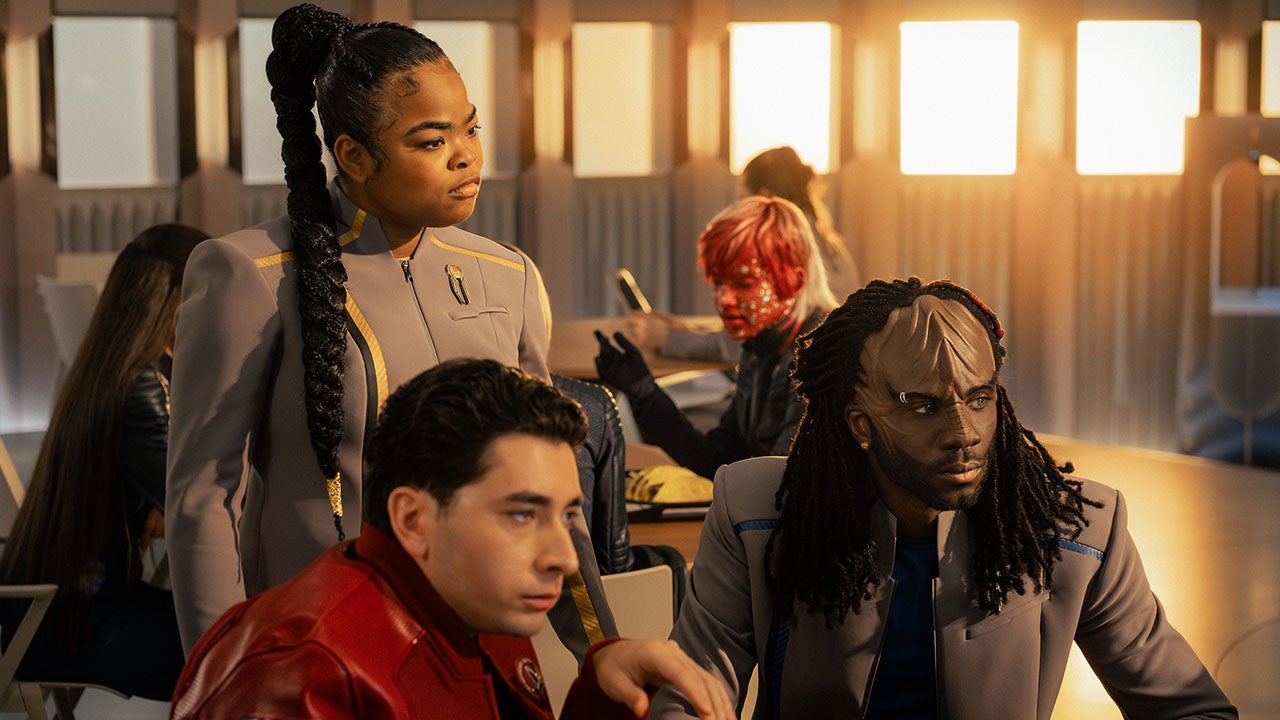
Kerrice Brooks plays Sam like a supernova of curiosity. Every experience—bar fights, replicated New Orleans cuisine she can’t actually eat, awkward academic maneuvering—lands with genuine wonder. She’s not just “the optimistic one.” She feels like someone discovering the universe in real time.
The central conflict is deceptively simple: her makers insist she must gain entry into Professor Ayla’s course, Confronting the Unexplainable, to remain at the Academy. They believe understanding organic unpredictability is key to her purpose.
But Sam starts asking a very un-Starfleet question: what if my purpose isn’t the point?
That tension—duty versus desire—is Trek 101. But here it’s refracted through a youthful lens. Instead of captains debating Prime Directives, we get a cadet wondering if she’s allowed to want something different than what she was built for.
It’s the most emotionally coherent storyline this show has delivered so far.
The Sisko Museum and the Power of Legacy
One of my favorite sequences involves a virtual recreation of the Sisko Museum. We see artifacts. Bajoran texts. A children’s book recounting Sisko’s role as Emissary.
It would’ve been easy for this to turn into a checklist of references. Instead, it feels reflective. Almost reverent.
Jake Sisko’s presence is especially poignant. Watching an older Jake mentor Sam—echoing the guidance he once received from his father—creates a generational symmetry that genuinely moved me. It’s not just about continuity; it’s about thematic inheritance.
Star Trek: Starfleet Academy Episode 5 understands that legacy in Star Trek isn’t about starships or uniforms. It’s about ideals being handed down and reshaped.
And when Sam realizes she can interpret her own “Emissary” role differently than her makers intended, that’s the real climax.
Not a battle. Not a twist.
A choice.
That’s Trek.
When the Show Goes Full YA, It Actually Works
This episode also leans hard into the student-life vibe. Cadet bar night. Awkward social dynamics. Dumb, chaotic escapades that feel like they were ripped from someone’s freshman year memory bank.
And honestly? I loved it.
Starfleet Academy works best when it embraces the inexperience of its characters. These aren’t battle-hardened officers. They’re kids trying to figure out who they are in a galaxy that expects greatness.
There’s still an obligatory reminder that Caleb is a genius hacker—because of course there is—but the focus remains largely on the ensemble just being students. It humanizes the setting in a way previous episodes struggled to achieve.
For the first time, I believed this Academy functions as more than a narrative backdrop.
The B-Plot… Exists
Now, let’s talk about the blobfish in the room.
The adult B-plot involving a diplomatic dinner rehearsal is… rough. War College Commander Kelrec’s elaborate setup, bizarre mouth-trumpet communication devices, and a gaseous blobfish entrée feel like they wandered in from a Lower Decks cold open.
I love weird Trek. I really do. I have defended some truly unhinged episodes of various series over the years. But here, the tonal whiplash is real.
Every time the episode cuts away from Sam’s introspective arc to watch adults struggle through a farcical dinner rehearsal, the emotional momentum stalls. It’s not offensively bad. It’s just unnecessary.
The good news? It barely affects the core story.
Why Episode 5 Is a Turning Point for Star Trek: Starfleet Academy
If you’re searching for a Star Trek: Starfleet Academy Episode 5 review to decide whether this series is worth sticking with, here’s my take: this is the acclimation milestone the show desperately needed.
It finds a clear POV.
It commits to a tonal identity.
It uses franchise history to deepen character rather than distract from it.
Most importantly, it proves that this series can tell a self-contained, emotionally resonant story while still contributing to larger Trek lore.
By the end, as Sam claims agency over her own future, I felt something I haven’t consistently felt watching this show yet: confidence. Not just hers.
The show’s.
If the rest of the season builds on this foundation—character-first storytelling, thoughtful legacy integration, and a willingness to let young characters be messy and idealistic—Star Trek: Starfleet Academy could become something genuinely special.
Right now, Episode 5 is the template.