
TL;DR: Killer Whale has a solid B-movie premise and just enough competence to avoid disaster, but it never commits hard enough to be either thrilling or hilariously bad. Weak CGI, borrowed tension, and underdeveloped character work leave it stranded between better micro-thrillers that know how to squeeze their hooks for all they’re worth.
Killer Whale
I love micro-thrillers. I love them the way some people love gas-station coffee or late-night grilled cheese: irrationally, unconditionally, and fully aware that when they’re bad, they’re really bad. But when they work, when they hit that sweet spot of lean premise, escalating tension, and just enough character to trick my brain into caring, they feel like proof that cinema’s basic survival instincts are still intact.
That’s why watching Killer Whale left me with such a specific kind of disappointment. Not the fun kind. Not the “wow, that was trash but I had a blast” kind. The worse kind. The kind where I can see the movie it wants to be hovering just out of reach, like a breath of air right before a dive that goes on too long.
Killer Whale isn’t awful. That’s the problem. It also isn’t good. It exists in a strange, murky middle zone where nothing quite collapses, but nothing locks into place either. In a genre that thrives on commitment, Killer Whale feels weirdly hesitant, like it doesn’t trust its own hook enough to go all in.
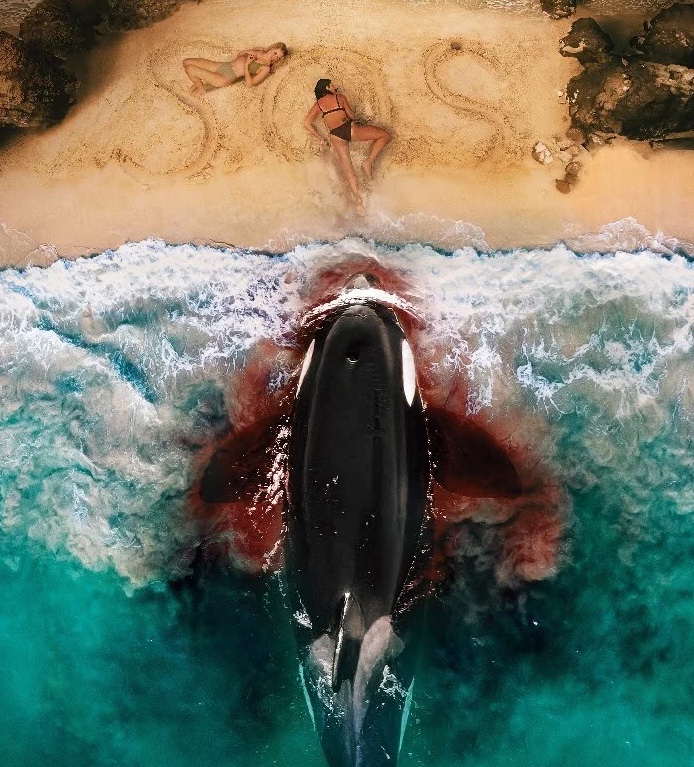
And that’s fatal for a movie whose hook is literally “orca stalks stranded women.”
Over the past decade, micro-thrillers have quietly become one of the most reliable subgenres in modern cinema. These are movies built on a single, aggressively simple idea and executed with ruthless efficiency. Strip away subplots, trim the fat, put a handful of characters in an extreme situation, and squeeze.
We’ve seen it work beautifully. Crawl took the concept of “alligators in a flooded house” and wrung real suspense out of it through physical geography and pacing. The Shallows turned one rock, one shark, and one surfer into a tightly wound survival puzzle. Fall made height itself the monster, using vertigo as a weapon. Even more recently, Primate leaned into B-movie madness with enough confidence to make its insanity infectious.
The common thread isn’t budget or realism. It’s clarity. These movies know exactly what they are and what they need to do. They understand that when you only have 90 minutes and one location, every decision matters.
Killer Whale understands this intellectually. You can feel the filmmakers studying the blueprint. But studying the blueprint isn’t the same as understanding why the house stands up.
The opening act actually gave me hope. There’s a familiar face at the center of the story, and if you’ve seen Fall, you’ll clock the casting choice immediately. This time, the dynamic is flipped. Instead of reckless instigator energy, we get grief. Maddie is defined by loss, creative frustration, and emotional stasis. On paper, that’s fertile ground.
The problem is how that backstory is deployed. The inciting trauma lands with all the grace of a deleted scene from a mid-2000s Final Destination sequel. It’s loud, abrupt, and staged in a way that feels more unintentionally comedic than tragic. Worse, the movie keeps reminding us of it, as if repetition might magically give it weight.
By the time we jump ahead to the “healing vacation” setup, I already feel the screenplay straining. Characters don’t move because they want to. They move because the movie needs them near water.
And yes, that water just happens to be near a neglected marine park housing a mistreated killer whale. Subtlety is not on the menu.
There’s an entire stretch where logic quietly packs its bags and leaves. Barefoot decisions are made. Motivations blur. Emotional beats are implied rather than earned. It’s the kind of thing micro-thrillers usually avoid because they can’t afford it. Here, it’s treated like background noise.
Let’s talk about the whale.
Orcas are terrifying in real life. Not because they’re monsters, but because they’re intelligent, massive, and operate with eerie precision. A killer whale doesn’t need to snarl or roar. The implication alone should be enough.
Unfortunately, Killer Whale turns its titular threat into a visual liability. The CGI never quite settles into the environment. The lighting doesn’t match. The water physics feel off. The whale often looks less like a living creature and more like an animated suggestion of one.
In a micro-thriller, the threat has to feel tactile. It has to feel present. When the creature doesn’t convince, the entire illusion collapses. You can get away with cheap effects or limited locations, but not both at the same time. That’s rule number one. Killer Whale breaks it repeatedly.
What’s worse is that the film can’t decide whether the whale is a force of nature, a misunderstood victim, or a metaphor with fins. There’s a late-game attempt to parallel Maddie’s emotional imprisonment with the whale’s captivity trauma, and it lands with a thud. It’s not that the idea is bad. It’s that the movie hasn’t done the work to support it.
Metaphor only works when it grows organically out of character and situation. Here, it’s stapled on in a quiet moment that feels like the screenplay whispering, “Do you get it? Do you see what we’re doing?”
Yes. I see it. I just don’t feel it.
The central survival scenario is basically The Shallows with the emotional scaffolding of Fall, but without the strengths of either. There’s no strong spatial logic to the danger. The geography never becomes a character. Time pressure exists mostly because the script says it does.
Interpersonal conflict bubbles up, but it never boils. Arguments flare and vanish without consequence. Revelations feel perfunctory. When characters make risky decisions, it’s rarely because desperation has driven them there. It’s because the plot needs a jolt.
This is where micro-thrillers either shine or die. The best ones make you understand every choice, even when it’s a bad one. Killer Whale skips that step. As a result, tension feels manufactured rather than inevitable.
And that’s a shame, because the cast is doing what they can. There’s a baseline level of sincerity that keeps the film from collapsing entirely. But sincerity without momentum just turns into inertia.
I kept waiting for Killer Whale to pick a lane. Go full camp and embrace the absurdity. Or strip it down further and chase raw survival terror. It never does either. It hovers in that awkward middle space where the tone is too serious to laugh at and too flimsy to take seriously.
That’s a dangerous place to be in 2026, especially when the micro-thriller shelf is already crowded with better options. When movies like Primate understand exactly what they are and deliver accordingly, mediocrity stands out more than ever.
Killer Whale feels like a first draft that made it to screen intact. The idea is fine. The execution just never sharpens. It doesn’t embarrass itself. It doesn’t thrill me. It just drifts.
And in a genre built on tension, drifting is the worst sin of all.