


TL;DR: Bridgerton Season 4 Part 1 delivers its strongest romance yet by pairing a Cinderella-style class-crossing love story with richer worldbuilding and standout performances. It’s peak escapist TV that finally gives its fantasy some bite without sacrificing the swoon.
Bridgerton Season 4 Part 1
I’ve always thought watching Bridgerton feels like stepping into a parallel universe where stress doesn’t exist, everyone is hot, and problems can be solved with a string quartet cover of a pop song and a well-timed longing glance. Season 4 Part 1 of Bridgerton doesn’t just continue that fantasy. It upgrades it. This is the show leveling up like it just unlocked a new romance skill tree, and I say that as someone who went in cautiously optimistic.
I didn’t doubt the show could still be fun. I doubted whether Benedict Bridgerton, resident artsy second son and professional chaos flirt, could carry a season. He’s always felt like the guy who’d rather sketch a nude model than settle down. But the Cinderella-coded romance at the center of Season 4 rewires the series in a way that feels fresh, emotionally grounded, and surprisingly political for a show that sells itself on yearning and waistcoats.
This is Bridgerton at its most self-aware and, somehow, its most romantic.
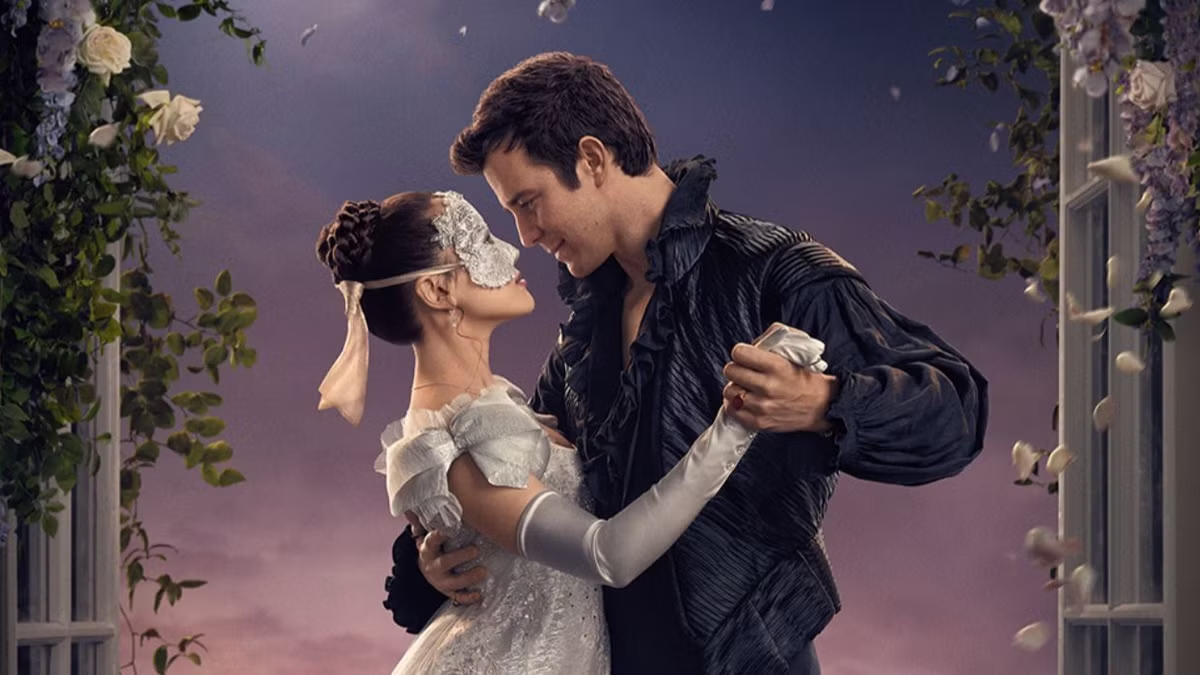
The core hook of Bridgerton Season 4 is deliciously simple: Benedict meets a mysterious woman in silver at a masquerade, sparks fly, and she disappears at midnight like a Regency-era Batman. That woman is Sophie Baek, played by Yerin Ha with the kind of luminous screen presence that makes you understand, instantly, why the entire season orbits her.
Sophie isn’t just a romantic lead. She’s a structural shift for the show. Unlike previous heroines who floated comfortably within the upper crust of the ton, Sophie exists in the machinery that keeps that glittering world running. She’s a servant. Her Cinderella parallels aren’t subtle, but they don’t need to be. The show uses the fairy tale framework as a Trojan horse to smuggle in a much-needed look at class.
Watching Benedict obsess over a woman he can’t place socially is half the fun. The other half is watching Sophie navigate a world that would reject her instantly if it knew the truth. Every stolen interaction carries tension, not because of petty misunderstandings, but because the social rules are a loaded gun on the mantelpiece.
Yerin Ha is the MVP here. She plays Sophie with a blend of guarded intelligence and romantic vulnerability that makes her feel modern without breaking the period illusion. You see the calculation behind her smiles. You see the hunger for something bigger than survival. It’s the kind of performance that expands the emotional vocabulary of the series.
I’ll admit it: I underestimated Luke Thompson. Benedict has always been fun, but fun isn’t the same thing as compelling. Season 4 turns him into a full-fledged romantic lead by leaning into his contradictions. He’s sensitive but clueless. Idealistic but sheltered. A man who thinks he’s rebellious while still cushioned by obscene privilege.
Thompson plays the lovestruck spiral with exquisite embarrassment. Benedict chasing the memory of the woman in silver feels like a Regency rom-com montage stretched across four episodes. When he starts falling for Sophie without realizing she’s the same woman, the show taps into a vein of dramatic irony that’s almost Shakespearean in how gleefully it toys with him.
And yes, the show still knows exactly what its audience wants. The steamy moments are shot with the same glossy confidence that made earlier seasons meme royalty, but they’re anchored in character. Desire here isn’t just spectacle. It’s narrative propulsion. Every charged glance is a plot point.
One of the smartest pivots in Bridgerton Season 4 Part 1 is its expanded focus on the servant class. For three seasons, the show treated the staff like elegant set dressing. Now they’re characters with agency, frustrations, and ambitions. It’s not a gritty class exposé, but it adds texture that the series desperately needed.
Sophie’s storyline acts as the gateway into this perspective. Through her, the glittering balls start to look like logistical nightmares powered by invisible labor. The tension between employers and employees simmers in quiet conversations about pay, loyalty, and dignity. These threads mirror the romantic drama upstairs, suggesting that love and survival are negotiations at every level of society.
This added dimension makes the Bridgerton world feel less like a theme park and more like a functioning ecosystem. The fantasy is still intact, but it has weight now.
Season 4 doesn’t forget the rest of the family, and honestly, the sprawl is part of the charm. Penelope adjusting to life after her big reveal, Eloise continuing her war against social expectations, and Violet flirting with a late-in-life romance all add layers to the central love story.
What impressed me is how the show has improved its juggling act. Previous seasons sometimes felt like they were speed-running subplots. Here, the longer episodes give relationships room to breathe. Francesca’s marriage storyline explores intimacy with surprising tenderness, while Violet’s romantic arc adds a mature counterpoint to Benedict and Sophie’s fairy tale.
Not every character gets equal focus, and you can feel the strain of an ever-growing ensemble. But the emotional throughline remains clear: this is a series obsessed with the many shapes of love, from reckless infatuation to quiet companionship.
If Bridgerton were judged purely on aesthetics, it would still be winning. The costume design this season looks like the wardrobe department was given a blank check and a dare. Sophie’s silver gown is the kind of dress that deserves its own credit. The masquerade sequence alone is a masterclass in visual indulgence, all candlelight and silk and slow-motion eye contact.
The music continues its tradition of turning modern tracks into orchestral earworms. Every time I recognize a melody, I feel like I’m in on a joke the show is sharing with me personally. It’s campy in the best way, a reminder that Bridgerton knows it’s a fantasy and leans into it without apology.
Verdict
Bridgerton Season 4 Part 1 is the show refining its formula instead of repeating it. The Cinderella romance between Benedict and Sophie injects urgency and class awareness into a series that could have coasted on vibes alone. Yerin Ha arrives like a meteor and reshapes the emotional landscape, while Luke Thompson proves Benedict was worth the wait.
This is comfort viewing with ambition. It’s swoony, funny, occasionally sharp, and deeply invested in the idea that love stories still matter. By the time the midseason break hits, I felt personally attacked by the cliffhanger and immediately ready to rewatch.