
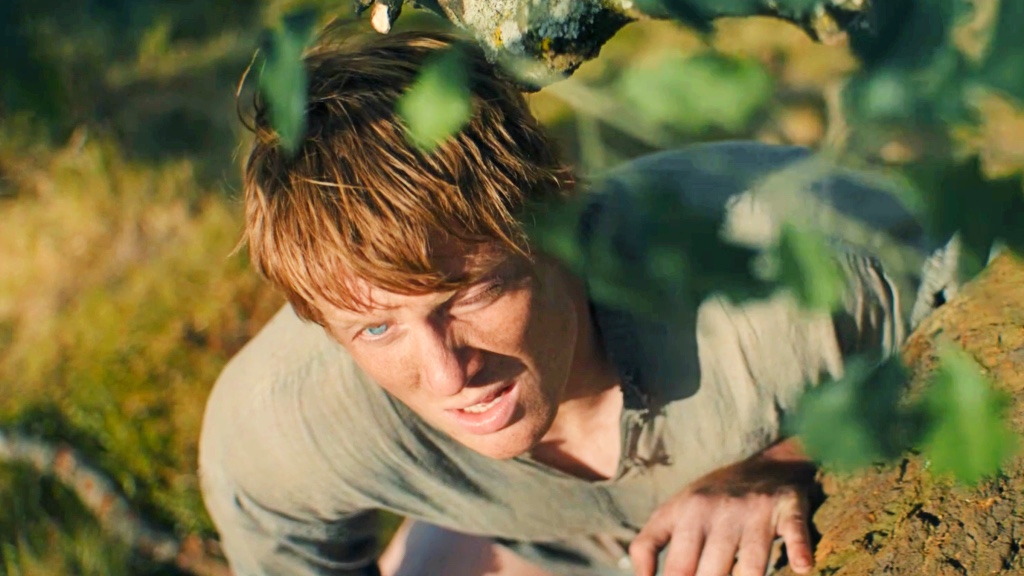
A Knight of the Seven Kingdoms wastes no time announcing that it is comfortable poking fun at the weight of Game of Thrones history. The series opens by doing something few HBO fantasy projects would dare: it cues up the familiar swell of the Game of Thrones theme and then cuts it off mid-reverence. Not with a dragon or a sword clash, but with its hero squatting in the bushes, dealing with a far less mythic problem.
The interruption lands as a clear gag, but it also works as a thesis statement. Viewers are briefly invited to expect the usual ceremony associated with Westeros, only for the show to yank that expectation away. The music that once accompanied map animations and royal intrigue now underscores a moment of digestive distress. The joke is not subtle, and it is not meant to be. This is a series that understands how sacred that theme has become and decides the cleanest way to introduce itself is to trip over it.
A Knight of the Seven Kingdoms
Unlike House of the Dragon, which preserved the full title sequence and score from Game of Thrones, this prequel largely skips opening credits altogether. The brief tease of Ramin Djawadi’s theme functions like a prank on the audience. It plays just long enough to trigger muscle memory before being cut short by Dunk’s very unheroic crouch. The message is immediate: whatever epic journey lies ahead, it will not begin with grandeur.
Series creator Ira Parker has framed the moment as character-driven rather than purely juvenile. Dunk has just committed to stepping into the role of a knight, sword in hand, ambition finally outpacing caution. The music represents the version of himself he wants to become. The interruption represents reality, arriving right on time to ruin the fantasy. It is hard to feel like a chosen hero when your stomach has other plans.
The comedy is heightened by contrast. The Game of Thrones theme is famously confident, swelling with certainty about destiny and power. Dunk, by comparison, is nervous, inexperienced, and deeply aware of how unprepared he is. The gag lands because the music overshoots him entirely. It belongs to kings and wars, not to a hedge knight starting his journey on the side of the road.
Actor Peter Claffey has described filming the scene as deliberately low-key, with a minimal crew and a lot of laughter. That behind-the-scenes tone matches what ends up onscreen. The show is not mocking Westeros so much as reminding viewers that its legends were built by people who probably had moments like this too.
By cutting off the most recognizable piece of Game of Thrones iconography in such a mundane way, A Knight of the Seven Kingdoms establishes its comic voice early. It is less interested in reverence than in contrast, less focused on inherited myth than on the awkward road toward earning it. The interruption of the music is not just a joke; it is a promise that this story will keep puncturing expectations whenever they get too comfortable.