
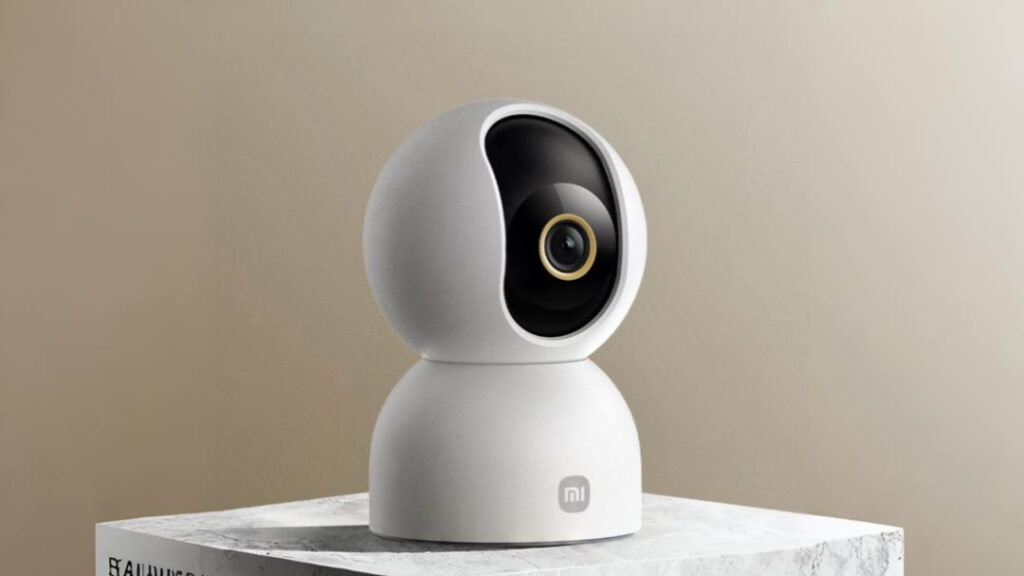
Xiaomi has introduced the Smart Camera 3 3K in China, expanding its lineup of entry-level indoor security cameras with a model focused on higher resolution and local AI features. Priced at 199 yuan, the camera is currently offered at a launch price of 169 yuan, positioning it among the more affordable 3K indoor cameras available in the local market.
The Smart Camera 3 3K uses a 5-megapixel sensor capable of recording video at 2960 × 1666 resolution. This places it well above standard 1080p cameras in terms of raw image detail, which can be useful when reviewing footage, zooming in on faces, or identifying objects in a room. While higher resolution does not automatically guarantee better real-world results, it does provide more flexibility during playback, particularly in security-related scenarios.
For low-light environments, the camera relies on a full-color imaging mode designed to extend color recording in dim conditions. When ambient light drops too low, the system switches to infrared night vision using eight IR lights. These operate without visible red illumination, allowing discreet black-and-white monitoring in complete darkness, a common expectation for indoor cameras in bedrooms or living spaces.
Physically, the camera features a motorized pan-and-tilt mechanism, offering full 360-degree horizontal coverage and up to 109 degrees of vertical movement. Combined with human motion tracking, the camera can follow a person as they move through the frame, reducing blind spots without requiring multiple fixed cameras.

Privacy and data handling are central to how the device is positioned. A built-in security chip assigns each unit a unique encryption key and certificate, with encrypted video transmission and AES-128 protection for cloud-stored footage. Users can also define sleep schedules, effectively disabling recording during selected hours, which may appeal to those cautious about always-on indoor surveillance.
On the software side, the camera performs basic human detection directly on the device, minimizing latency and dependence on cloud processing. More advanced features, such as face recognition and familiar-person alerts, are tied to a paid cloud service. This separation keeps core functions local while reserving more data-intensive processing for subscribers.
Audio features include two-way voice communication, supported by a built-in speaker and a microphone array rated for pickup at distances of up to eight meters, with noise reduction intended to improve clarity during remote conversations.
Connectivity options include support for both 2.4GHz and 5GHz Wi-Fi networks, along with H.265 video encoding to reduce storage and bandwidth requirements. Storage is flexible, with support for microSD cards up to 256GB, cloud recording, and NAS backups. Integration with the Mi Home ecosystem allows the camera to work alongside compatible displays, televisions, and voice assistants as part of a broader smart home setup.