


Xreal is making a strong case for accessible mixed reality at CES 2026 with the launch of the Xreal 1S, a new pair of XR glasses that prioritizes immersion, comfort, and straightforward usability without drifting into luxury pricing. At $449, the Xreal 1S undercuts many competitors while delivering a noticeably improved visual experience compared to earlier models in the lineup.
The Xreal 1S arrives as a refinement rather than a radical redesign, but the changes add up. Field of view has increased slightly from 50 to 52 degrees, resolution moves from 1080p to 1200p per eye, brightness climbs to 700 nits, and the aspect ratio shifts to 16:10. None of these upgrades alone would be transformative, but together they make virtual screens feel larger, clearer, and more comfortable to use for extended sessions. In practice, the result is a more convincing sense of scale, whether you are watching video, working across multiple virtual displays, or gaming.
A key differentiator for the Xreal 1S is the company’s continued investment in on-device processing. Powered by Xreal’s X1 spatial computing chip, the glasses support native Real 3D without requiring external apps or software. Unlike competing systems that rely on companion applications to convert content, the Xreal 1S can turn virtually any 2D content into a stereoscopic 3D view at the press of a button. Even something as mundane as a smartphone home screen can be toggled into 3D, which speaks to how deeply the conversion is integrated at the hardware level.
That hardware-first approach also simplifies everyday use. Physical controls on the frame allow quick access to brightness, display modes, and the 2D-to-3D toggle, reducing reliance on companion apps. The glasses support three degrees of freedom head tracking by default, letting users fix content in space while still being able to glance away and remain aware of their surroundings. For those who want more advanced spatial anchoring, Xreal continues to offer its optional Eye camera module, which enables six degrees of freedom tracking and content capture with virtual overlays.
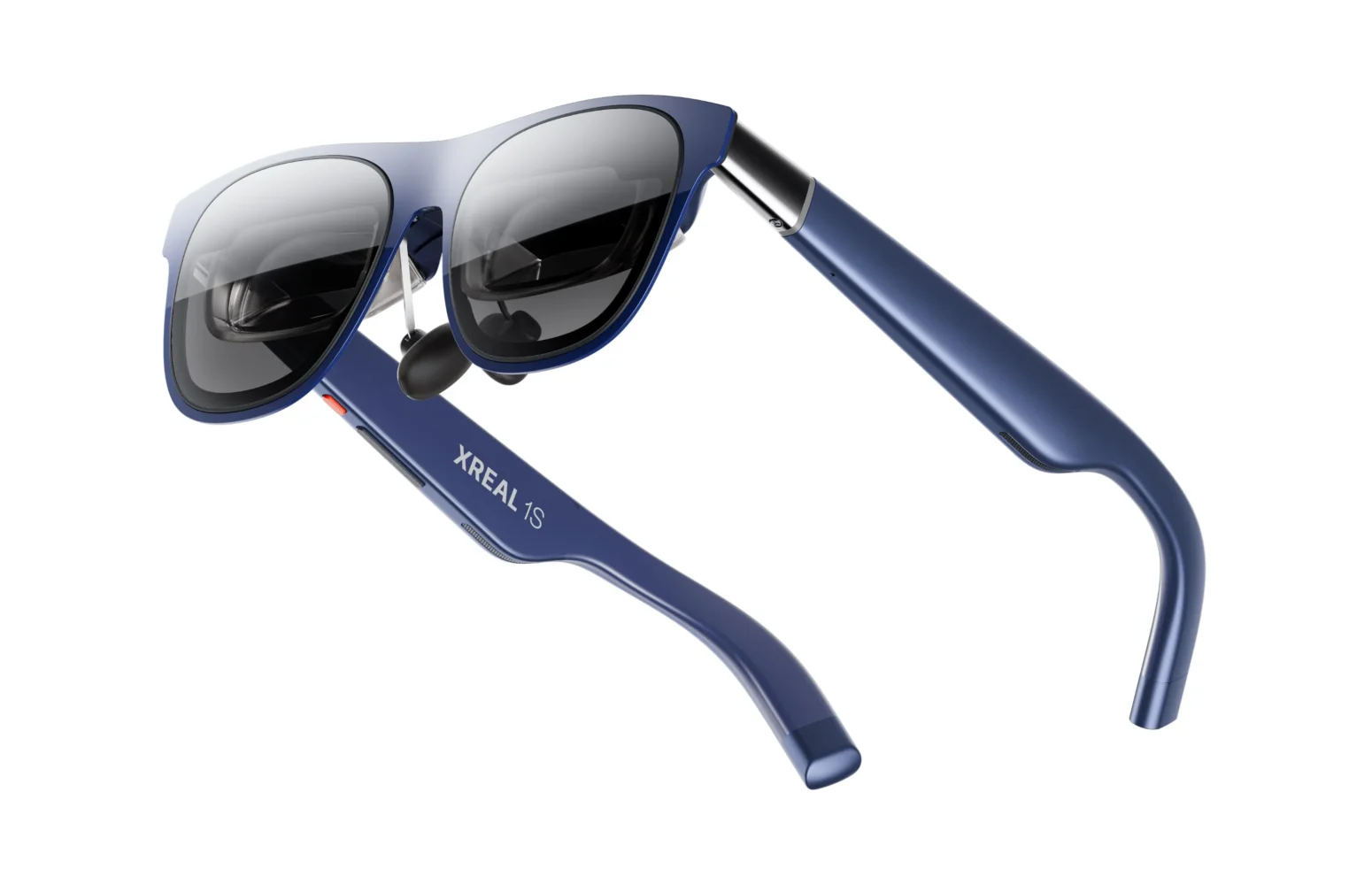
From a design and comfort standpoint, the Xreal 1S stays close to the look of conventional sunglasses. Weighing 82 grams, they are light enough for long sessions, aided by adjustable temple arms and multiple nose piece options to accommodate different face shapes. The dark navy finish with subtle silver accents keeps the design understated, while the red-highlighted primary button makes it easy to find controls by touch alone.
Audio is handled by downward-facing speakers built into the frame. Sound quality is clear and balanced in quiet environments, though volume levels may struggle in louder settings such as public transit. For commuting or travel, pairing the glasses with earbuds remains the more practical option. The lack of built-in diopter adjustment also means users who need vision correction will likely need prescription lens inserts, an added cost but a common compromise in this category.
Alongside the glasses, Xreal introduced the Neo accessory, priced at $99, which plays an important role in making the 1S more versatile. The Neo combines a 10,000 mAh battery pack with DisplayPort hub functionality, addressing two common limitations of XR glasses: device compatibility and battery drain. When using a phone, laptop, or gaming device, the Neo powers the source device while also handling video output to the glasses.
This is particularly relevant for owners of the Nintendo Switch and its successor, which cannot output DisplayPort video directly over USB-C. With the Neo, both Switch models can drive the Xreal 1S properly, effectively turning the glasses into a portable, high-resolution display. The Neo even upgrades the Switch’s output from 720p handheld mode to a sharper 1200p experience in “TV mode,” making games feel more detailed and immersive when viewed through the glasses.
Physically, the Neo is compact and thoughtfully designed. It measures just over 12 cm tall, weighs 244 grams, and includes an integrated USB-C cable. A built-in kickstand allows it to rest on a table or tray, while a strong front magnet lets it attach securely to compatible phones or included magnetic stickers. Charging tops out at 30W input, with up to 20W output to devices, or higher when paired with a capable wall charger.
In day-to-day use, the Xreal 1S excels at the scenarios XR glasses are best suited for: productivity on the go, personal media consumption, and portable gaming. The ability to summon an ultra-wide virtual screen on a laptop without external monitors remains one of the most compelling use cases, especially for frequent travelers. Paired with a Switch or similar handheld, the glasses offer a private, large-screen gaming experience that feels more practical than novelty.
The Xreal 1S does not attempt to replace full-fledged AR headsets or smart glasses loaded with cameras and AI assistants. Instead, it focuses on delivering a strong core experience: a convincing virtual display that is easy to use, comfortable to wear, and reasonably priced. At CES 2026, that restraint may be what makes it stand out most.