

Starbucks has built a long-standing reputation around seasonal merchandise, particularly its holiday drinkware, which tends to generate predictable waves of interest each year. In 2025, the company once again rolled out a wide range of cups, tumblers, and mugs aimed at holiday shoppers. Among those releases, the Bearista Cold Cup drew outsized attention, becoming a viral collectible and, in some cases, a source of public disruption as demand far exceeded supply. That frenzy, however, has been overshadowed by a quieter but more unusual item released exclusively through Starbucks’ China market.
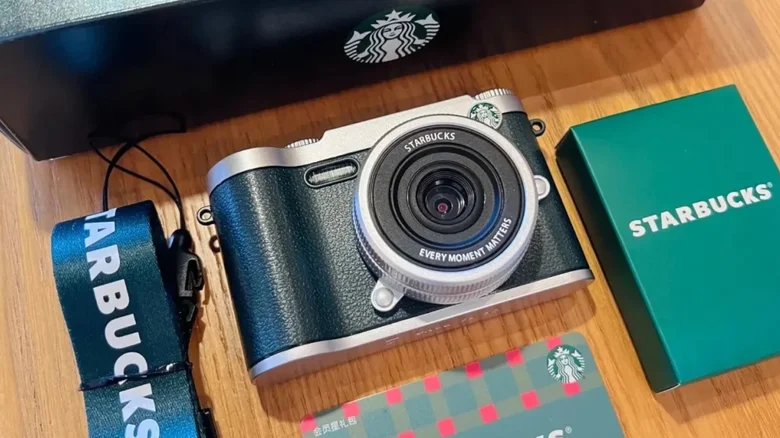
Priced at 198 yuan, or roughly $28, Starbucks China introduced a compact retro-style digital camera as part of its seasonal merchandise lineup. The product was not widely advertised outside the region, yet images and short videos of the camera quickly circulated online. As a result, resale listings on eBay have climbed well beyond the original price, with some sellers asking around $130 depending on condition and color.
The Starbucks retro digital camera is not positioned as a serious piece of photography hardware. Technical specifications have not been fully disclosed, and expectations around image quality are modest. Instead, the device appears designed as a novelty item that leans into early-2000s digital camera aesthetics. It includes two image sensors, one mounted at the rear and another embedded near the optical viewfinder to function as a basic front-facing camera. This allows for quick group photos or selfies without relying on a phone.

Additional features reinforce its throwback appeal. A small rear LCD screen provides simple image previewing, while nine built-in overlays add filters that mimic older digital photo styles. The camera is available in red and green colorways, clearly aligned with holiday themes, and features a body styled to resemble metal with leather-like accents. These design choices suggest the camera’s primary function is visual charm rather than technical performance.
The camera is currently only available in China, a market where Starbucks frequently experiments with exclusive merchandise concepts that do not always reach other regions. That limited availability has helped fuel its appeal among collectors and casual fans alike. While comparisons have been drawn to modern smartphone cameras, the point of the device is not competition but novelty, offering a low-cost, self-contained way to capture casual photos without relying on a phone.
Whether Starbucks plans to expand availability beyond China remains unclear. For now, the retro camera stands as another example of how limited regional releases can take on a second life through resale markets and online attention, even when the product itself is intentionally simple.