

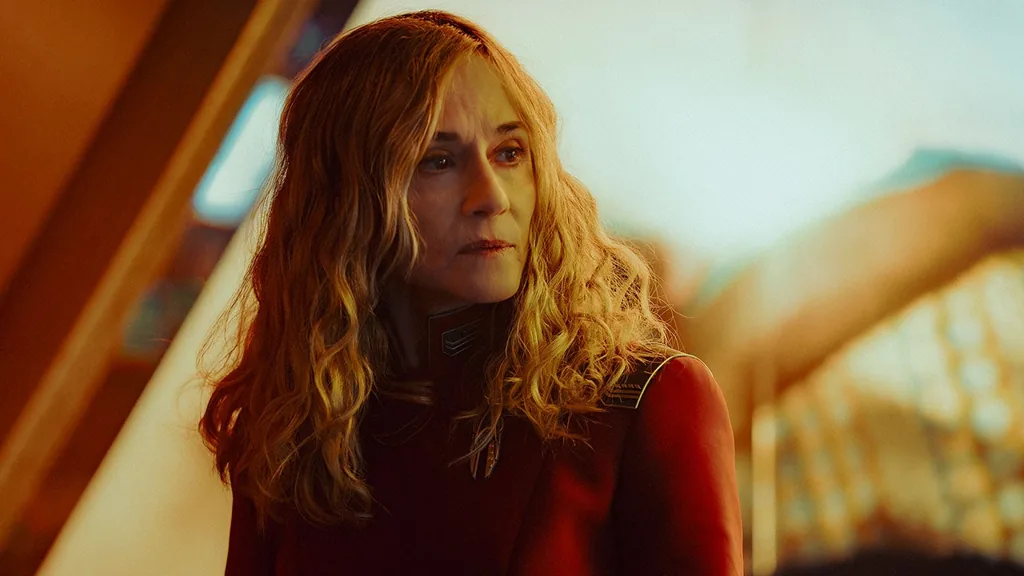
TL;DR: Star Trek: Starfleet Academy’s season finale, “Rubincon,” delivers exactly the kind of big-hearted, idea-driven chaos I want from a Star Trek finale. The technobabble is ridiculous, the stakes are massive, and the emotional payoff actually lands thanks to terrific work from Holly Hunter, Tatiana Maslany, and a cast of cadets who finally feel fully formed. More importantly, the episode understands that Trek is at its best when it treats hope as something earned through accountability, not handed out like a participation ribbon. It’s not flawless, but it absolutely sticks the landing.
Star Trek: Starfleet Academy
There’s a very specific kind of joy I get from a Star Trek season finale that goes all-in on big feelings, bigger ideas, and absolutely unhinged levels of technobabble. It’s the kind of joy that feels like watching someone confidently explain a warp core crisis with three glowing interfaces, a moral speech, and the sort of emergency plan that should absolutely not work but somehow does because everyone involved has reached the exact right level of emotional clarity. “Rubincon,” the Star Trek: Starfleet Academy season finale, is that kind of finale to its bones.
And honestly? I ate it up.
Not because it’s flawless. It’s not. This episode occasionally moves with the speed and subtlety of a shuttlecraft crashing through a stained-glass window. It piles on ideas, reversals, speeches, revelations, and courtroom drama like it’s trying to win a contest for “most Star Trek things to happen in 58 minutes.” But the reason it lands is the same reason Trek has kept its hooks in me for so long: beneath the space chaos, the franchise still believes that people can choose to be better. Not perfect. Better. That difference is the whole engine.
“Rubincon” doesn’t just end Starfleet Academy’s first season with a bang. It ends by reaffirming what this show wants to be. It’s not just a YA-flavored Star Trek with cadets and trauma and suspiciously attractive people making morally difficult choices in mood lighting. It’s a series about inheritance, responsibility, and whether institutions built on noble ideals can survive their own failures. That’s a much meatier proposition than a lot of modern franchise TV manages, and this finale understands that the highest-stakes battle here was never really the mines or the ship or even the Federation itself. It was the battle over who gets to define justice when everyone has blood on their hands.
A finale that understands the assignment
Picking up right after the cliffhanger, “Rubincon” wastes basically zero time before throwing everyone into fresh disaster. Captain Nahla Ake, Anisha Mir, Reno, the Doctor, and a handful of cadets are trapped outside the Omega-47 mine ring with Nus Braka closing in like a guy who’s been monologuing in the mirror for weeks and finally got his spotlight. There are hostages. There’s a crippled ship. There’s a shrinking margin for error. There’s enough scientific jargon being shouted at high volume to power at least three Reddit threads and one very agitated Memory Alpha edit war.
In other words, this is Trek in its natural habitat.
What I liked immediately is that the episode doesn’t pretend the mechanics matter more than the people. Yes, there’s a whole save-the-galaxy problem to solve. Yes, the cadets are basically forced to take the most violently unfair final exam in the history of education. But every puzzle piece is tied to character. Sam’s genius matters because we’ve watched him grow into it. Tarima’s emotional intuition matters because the season has been teaching her not to fear that part of herself. Caleb’s choices matter because he has spent the entire year feeling split down the middle, like he’s being asked to betray one version of himself to validate another.
That’s why the absurdity works. And make no mistake, some of this is gloriously absurd. At one point the episode practically runs on pure “trust me, I’m saying this next to a blinking console” energy. But Star Trek has always been a franchise where emotional truth can make the pseudo-science feel earned. I don’t need every chemical algorithm or tactical maneuver to survive a dissertation defense. I need it to reveal character under pressure. “Rubincon” does that well enough that I never really cared when it was stretching plausibility like a spandex uniform in a heatwave.
The real trial isn’t in space
The smartest thing this finale does is understand that the main event isn’t the external crisis. It’s the confrontation between Anisha and Ake.
That face-off has been simmering all season, and when it finally detonates, it gives the episode its center of gravity. On paper, it’s about Caleb. The woman who lost him and the woman who raised him standing in the wreckage of years neither can get back. But the scene works because it’s also about something larger and uglier. It’s about what institutions do to people when they fail them, and what those people become in response.
That’s where “Rubincon” gets more interesting than your average finale that just wants to stick the landing and tee up next season. Nus Braka puts Nahla Ake, and by extension the Federation, on trial for the sins of the Burn and the choices made afterward. He isn’t wrong that entire communities were abandoned. He isn’t wrong that the Federation’s ideals did not always translate into justice. He isn’t wrong that systems built to help people can still devour them and then issue a polished statement about values afterward. Trek has always been strongest when it lets utopia get scuffed up a little, and this episode does exactly that.
What I appreciated most is that it doesn’t flatten the argument into easy hero-versus-villain geometry. Ake has regrets. Anisha has rage. Both women have spent years framing their choices in ways that let them survive themselves. Neither is fully innocent. Neither is fully monstrous. That moral grayness gives the episode texture, and it also makes Caleb’s eventual position more powerful. He doesn’t have to choose a single “true” mother or a single uncontested version of the past. He gets to claim the complexity. He gets to say: both of these relationships shaped me, and I am not reducible to either one.
That’s a deeply Trek idea, even if the packaging here sometimes feels like prestige-TV melodrama beamed in through a YA lens. Identity in Star Trek has always been fluid, layered, contested. Spock lived there. Seven of Nine lived there. Worf built a summer home there. Caleb joining that lineage through a story about family, loyalty, and self-definition feels exactly right.
Holly Hunter and Tatiana Maslany absolutely cook here
Let me put this plainly: Holly Hunter and Tatiana Maslany walk into this finale and proceed to make it feel about ten degrees heavier, sharper, and more emotionally credible than it might have been otherwise.
Hunter does that thing great actors do where they barely move and somehow still make it feel like tectonic plates are shifting behind their eyes. Nahla Ake is not written as a grandly expressive character. She’s controlled, disciplined, and composed in that very Starfleet way that usually means “I have compartmentalized enough pain to fuel a medium-sized nebula.” Hunter makes that restraint fascinating. You can see the grief and guilt straining against the hull.
Maslany, meanwhile, gets the showier material and absolutely tears into it. Anisha’s pain is loud where Ake’s is quiet, raw where Ake’s is armored. But it never feels like one performance is operating in a more real register than the other. They’re matched, just calibrated differently. Their scenes together have that delicious dramatic friction where both characters are making valid points, both are protecting lies they need, and both are forcing the other to look at the cost.
This is the stuff that lifts “Rubincon” above a merely satisfying franchise finale. It doesn’t just tell me what the conflict is. It lets me sit inside the emotional architecture of it.
Even Paul Giamatti’s Braka, who could easily have become a standard-issue scenery-chewing antagonist, gets enough shading to feel like more than a plot device with a grudge. His backstory, growing up in deprivation and carrying the resentment of being left behind, gives him recognizable ideological weight. The episode doesn’t excuse him, but it does explain him. That matters. Star Trek villains are often better when they’re not embodiments of evil so much as embodiments of grievance taken to a ruinous conclusion. Braka fits that mold.
I still think the show could have dug deeper into why his hatred of Ake specifically burns this hot, because some of that feels more symbolic than personal by the end. But in a finale juggling this many plates, I understand why the script prioritizes the broader thematic function. Ake becomes a stand-in for the Federation itself: admirable, damaged, and implicated.
The kids are, in fact, alright
For a show called Starfleet Academy, the season needed to prove that these cadets were more than just archetypes orbiting the adults. I think the finale mostly succeeds there.
What I enjoyed is that the episode doesn’t hand out hero moments like participation trophies. Each cadet contributes in a way that feels tied to their growth across the season. Sam gets to be brilliant without the show treating intelligence like magic. Tarima gets one of the more quietly satisfying turns because embracing her abilities becomes an act of trust rather than fear. Even the Doctor’s glitchy detour gets a nice resolution that restores a little tonal balance before the finale goes full emotional warp breach.
And then there’s Caleb, who ultimately becomes the soul of the episode.
His big moment works because it isn’t framed as conquest. It’s not about him defeating his past or severing one bond to honor another. It’s about integration. He can love the mother who lost him and the mother who raised him. He can belong to his history and to the future he’s building at Starfleet Academy. He can stop treating his identity like a custody battle.
That emotional synthesis is the season’s most important win. In another show, a finale like this might have gone for a harsher twist, a death, a betrayal, some last-minute darkness to seem “serious.” But Star Trek has never needed nihilism to feel meaningful. The happy ending here isn’t cheap because it’s earned through accountability. Ake faces judgment. Anisha is heard. Braka is stopped. The cadets grow. The system doesn’t magically become perfect, but people within it choose repair over domination. That’s the key.
The cavalry arriving at the last second is absolutely classic Trek nonsense, and yes, I grinned anyway. Sometimes I don’t want my science fiction to look me dead in the eye and mutter that hope is naïve. Sometimes I want the ship to show up. Sometimes I want the speech to buy enough time. Sometimes I want the finale to believe that courage, competence, and community still count for something. “Rubincon” believes that without apology.
This is what Star Trek should feel like
The thing I kept coming back to after the credits rolled is that Starfleet Academy now feels like it understands its first principles. That title matters. In Trek, first principles aren’t just scientific assumptions or institutional ideals. They’re the baseline moral equations the universe keeps testing. Can we face our failures without becoming defined by them? Can we build systems worth believing in even after they’ve hurt people? Can chosen family become a real corrective to historical damage? Can justice exist without flattening everyone into heroes and villains?
That’s ambitious material for a first season finale, and “Rubincon” doesn’t answer every question cleanly. Some beats are rushed. Some of the plotting is held together with the narrative equivalent of a magnetic containment field and sheer faith. A few emotional turns could have used more room to breathe. But I’d always rather watch a show reach too far for meaning than play it safe with emptiness.
More importantly, this finale makes me want season two. That’s not a small thing in an era where so much franchise television feels engineered for discourse instead of delight. Starfleet Academy ends its first year not by proving it can mimic old Trek, but by proving it understands why old Trek mattered. It knows the ships and the jargon are only delivery systems. The real payload is hope with scars on it.
And as someone who has spent years loving this franchise through its highs, its lows, and its occasional “did we really need to do a time crystal again?” phases, I found that reassuring.
“Rubincon” is messy, heartfelt, overstuffed, and deeply sincere. Which is to say, it’s Star Trek.